Handbook · Foundations · 8 min read
What it means to be productive in the digital age
Forget counting hours worked. Real productivity means doing the right things at the right time — and still having energy left for a life outside work.
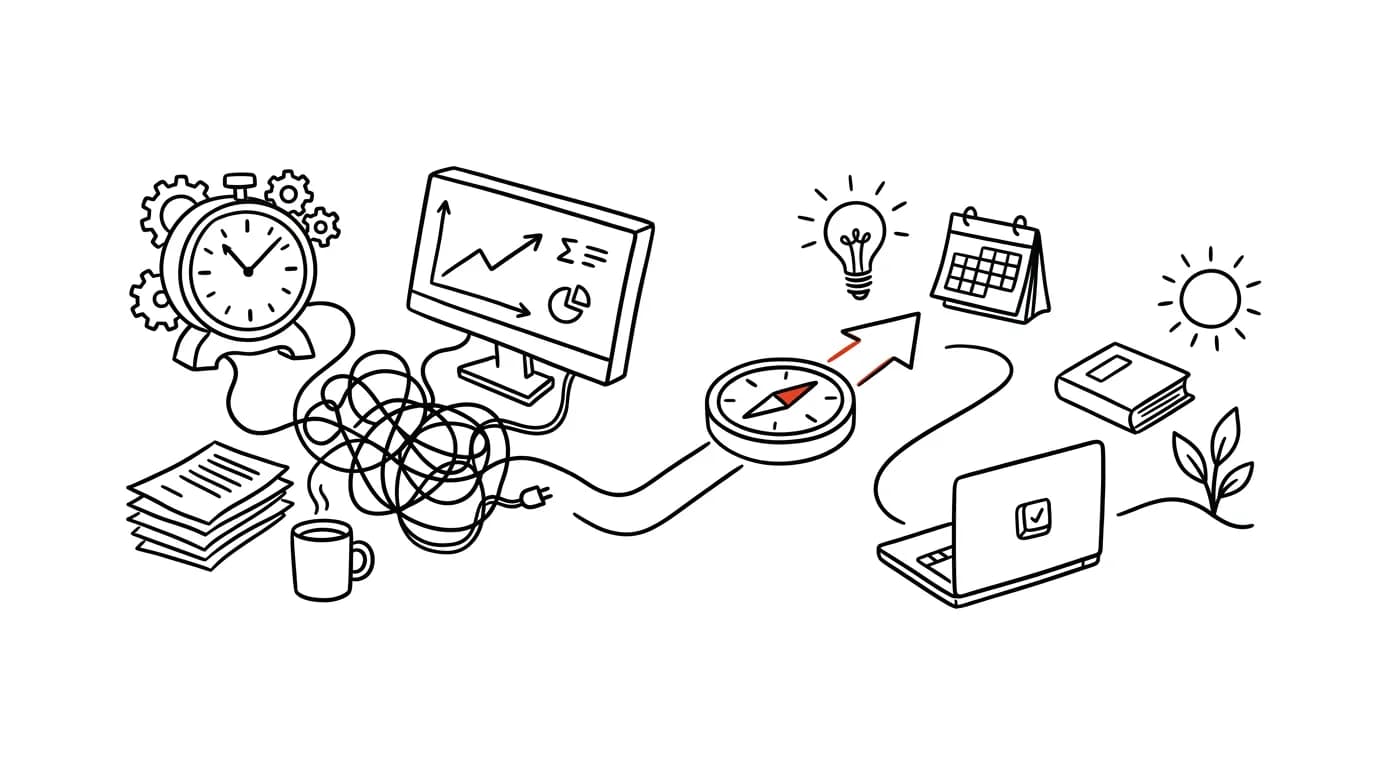
Do you remember when being productive simply meant sitting in the office as long as possible? I do. And I also remember how, after twelve-hour days, I was technically “productive” but so drained that I had no energy left for my family or my hobbies. Today we know that real productivity looks completely different.
A new definition of productivity
Forget counting hours worked. Modern productivity means doing the right things at the right time — and still having energy for a life outside work. It's like packing for a trip: the goal isn't to cram in as much as possible, but to bring exactly what you'll need.
What productivity is not:
- endless overtime,
- being permanently reachable on your phone,
- multitasking and juggling ten things at once,
- sacrificing your personal life for your job.
What productivity actually is:
- the ability to identify and finish the tasks that matter,
- clarity about your priorities,
- being able to say “no” to things that pull you away from your goal,
- ending the workday feeling fulfilled rather than depleted.
Efficiency vs. productivity
Picture two gardeners. The first mows the lawn with the newest mower and gets it done in an hour. The second sits down first, thinks it over — and decides to turn part of the lawn into a perennial bed that won't need regular maintenance at all.
- Efficiency is doing things right (the first gardener).
- Productivity is doing the right things (the second gardener).
In the digital age, being merely efficient isn't enough. Above all you need to be productive — which means focusing on the activities that actually make a difference.
How to measure productivity
Forget simple metrics like “hours worked” or “tasks closed.” In the digital age we measure productivity differently:
Qualitative metrics: goals reached, satisfaction of clients or managers, quality of output, your own sense of fulfillment.
Quantitative metrics: the ratio of time spent on important vs. urgent tasks, the number of key projects finished, deadlines met, time spent in deep focus.
The simplest place to start: at the end of each day, ask yourself two questions. Did I move something important forward today? And: Do I still have energy for the evening? When the answer is yes twice, it was a productive day — no matter how many boxes you ticked.
Work-life balance vs. work-life integration
The era of strictly separating work and personal life is over. Now that we can work anywhere and anytime, we need a new approach.
Work-life balance (the old model):
- fixed 9-to-5 hours,
- clear boundaries between work and personal life,
- often unrealistic in the modern world.
Work-life integration (the new model):
- work and personal life flexibly interwoven,
- the option to work when and where it suits you,
- emphasis on results, not hours logged.
Here's what an integrated day can look like in practice — instead of “sit in the office from 9 to 5 and then try to find time for the gym”:
- 6:30Morning workoutenergy for the whole day — in the old model there'd be no time left for it after work
- 10:00Intense work blockthe hardest tasks during peak performance hours (until ~3 p.m.)
- 15:30School pickuplife isn't squeezed into the evening — it's part of the day
- 20:30Wrapping up loose endsa quiet hour of work once the kids are asleep — by choice, not necessity
Watch out for one trap: integration doesn't mean work gets to seep into everything. It means you draw the boundaries — consciously and according to your own priorities, not according to whoever happens to be messaging.
How to get started
- 1Audit where you areTrack your activities and energy for a week. Find your biggest time sinks.
- 2Your own definitionWhat does a productive day mean to you? How will you know you had one?
- 3Small changesOne change this week. Watch the result, then add another.
- Audit where you are right now. Track your activities for a week, note your energy level throughout the day, and identify your biggest time sinks. You don't have to change anything — just observe. The data from that week will surprise you more than you expect.
- Set your own definition of productivity. What does a productive day mean to you? What are your priorities at work and in life? How will you know you're genuinely being productive? Without your own definition, you'll spend forever chasing someone else's.
- Start with small changes. Pick one thing you'll change this week. Watch the results. Add more changes gradually — habits compound, revolutions fall apart.
Remember: productivity in the digital age isn't about doing more. It's about doing things smarter and with your whole life in mind. In the chapters ahead we'll look at the specific tools and techniques that will help you get there.
Related tips
The weekly review: 30 minutes that run your whole week
On Friday or Sunday, go through your calendar, tasks, and notes — close out loose ends, plan three priorities. Monday starts with clarity.
Friday: AI builds your weekly review, you skim it in five minutes
A complete guide with prompts: how to connect your calendar, task manager, and mail with a connector, build a Friday review of what got done, what's stuck, and what fell through the cracks, and have three priorities for next week drafted for you. AI does the gathering — the decisions stay yours.
Batch similar tasks: emails with emails, calls with calls
Switching between types of work costs energy. Grouping similar tasks into blocks saves dozens of minutes a day.
A checklist for anything you do a second time
Client onboarding, publishing an article, the monthly close — a repeated process without a checklist means forgetting something, every time.
Want to keep the momentum?
One tip from the handbook by email each week — in an order that makes sense.
1 tip a week · no spam · unsubscribe in one click