Handbook · Methods · 13 min read
How to choose your system — and agile as a life philosophy
Kanban, Scrum, OKRs, or a mix? A decision guide based on the kind of work you do — and why agile thinking works on losing weight or writing a book too.
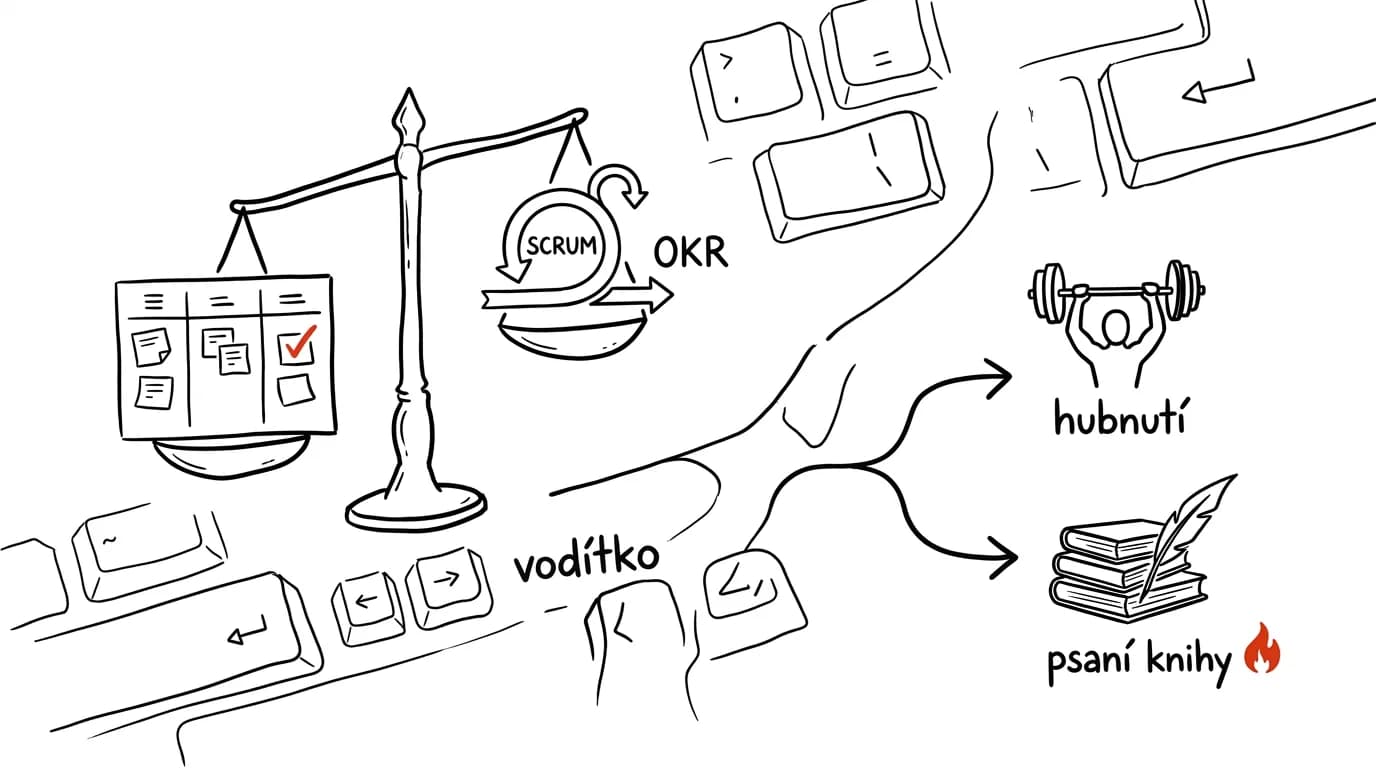
You probably know the feeling: you have plenty of tasks, projects and ideas, but no idea where to begin. Or you keep going in circles and never move forward. The basic methods work beautifully for personal tasks — but what if you're running several projects at once, working in a team, or chasing complex long-term goals? Then you need a system, and above all you need to know which one.
Why you need a system at all
Imagine you're learning the piano. You can either mash keys at random and hope something comes of it, or learn from a proven method. Productivity works the same way — the right system saves you years of trial and error.
What a good system gives you:
- less stress about forgotten tasks,
- more time for the projects that matter,
- a better balance between work and personal life,
- a sense of control over your own time,
- room for creativity and new ideas.
The methods on the table
Basic organizational methods are the foundation of personal productivity — GTD as a complete task-management system, Inbox Zero for email, time blocking for planning your day in solid chunks, and Pomodoro for working in focused intervals.
Advanced systems take productivity a level higher — Scrum for individuals as an agile method adapted for personal use, Kanban as a visual system for tracking the flow of work, OKRs for setting and tracking goals, and agile approaches for fast-moving environments.
Creative techniques exist to capture and organize your thinking — mind mapping, bullet journaling, Zettelkasten for organizing knowledge, and sketchnoting, which combines text with images.
The recommended order is the logical one: start with the basic methods, gradually add the advanced techniques, and finally experiment with the creative approaches.
A decision guide
Choosing a system isn't a technical decision, it's a strategic one. Start with three questions about yourself:
- What's your working style? Are you a visual thinker? Do you prefer digital or analog tools? Do you work better with detailed plans or broad ones?
- What most needs improving? Task organization, time management, project management, or your creative process?
- How much time can you give to learning a new system? Do you have room for something comprehensive, or do you need something simple you can deploy fast?
Then four questions about your context: What's my main problem? How many people are involved? How do I measure success? How much time can I spend maintaining the system?
Kvadrant „Důležité, neurgentní" je místo, kde vzniká skutečný pokrok — plánujte si pro něj čas dřív, než ho urgence sežerou.
The key isn't following a methodology perfectly, it's being able to adapt it. Productivity is a living organism that demands experimentation, learning and constant refinement. The details of each system are in the chapter on Scrum, Kanban and OKRs.
Rolling it out without a big bang
- Weeks 1–2Basic setuppick tools, set up processes, brief training if it's a team
- Weeks 3–4Pilottest on one small project, collect feedback, adjust
- Month 2Full rolloutextend to everything, review regularly, optimize
Three rules turn implementation into a walk rather than a battle. Go gradually — pick one system, introduce it in small steps, and give yourself time to absorb it. Adapt it to your needs — no system is perfect for everyone, so combine and adjust as experience dictates. Evaluate regularly — what's working, what isn't, where the biggest obstacles are, and what results you're getting.
Don't forget to connect it to what you already use: your calendar, your communication tools, and company systems where relevant. A system that lives apart from the rest of your work will die.
Track four metrics: cycle time (how long a task takes), lead time (from request to completion), throughput (how much you finish) and, for a team, velocity. And watch out for three classic traps: too many systems at once (consolidate), weak adoption (simplify and show quick wins), and information overload (filter and prune).
Three principles that hold across every system
Whatever you choose, three universal rules apply:
- Externalize — get tasks out of your head and into a system you trust, update your lists regularly, and keep one central point for all information.
- Review regularly — daily planning, a weekly overview, a monthly evaluation.
- Stay flexible — be ready to adjust the system, combine approaches, and experiment with new methods.
The goal isn't a perfect system. The goal is a system that works for you.
Agile isn't just for work
Picture your life as a project. Traditionally we've treated it as something rigid: you set a goal (“lose 30 pounds” or “renovate the apartment”), draw up a detailed six-month plan — and at the first obstacle, the first deviation from the plan, the whole thing collapses. Frustration, lost motivation, a sense of failure.
The agile approach offers the opposite: flexibility, adaptability and continuous learning. Instead of one fixed plan, it builds a dynamic framework that allows for small experiments, ongoing evaluation and course corrections along the way.
It rests on three principles:
- Iteration. The traditional model assumes change happens all at once and completely. Agile believes in the power of small, regular experiments. Instead of “lose 30 pounds,” you commit to a two-week experiment focused on eating better or moving regularly. After two weeks you evaluate what worked and adjust the plan gently.
- Regular feedback. Rather than waiting for a final verdict, you assess progress as you go. Every week you ask four questions: What went well? What didn't work? What did I learn? How can I improve my approach?
- Minimum viable product (MVP). The concept from the tech world transfers beautifully to personal development: instead of building the perfect solution, you test the simplest version that gives you the most information for the least effort.
- 1Small experimentA two-week attempt instead of a six-month plan.
- 2FeedbackWhat worked? What didn't? What did I learn?
- 3LessonsFailure isn't a verdict — it's data.
- 4AdjustTweak gently and run another round.
Traditional versus agile in practice
Losing weight and living healthier. Traditionally: set a goal to lose 30 pounds, build a detailed six-month plan, hit an unexpected event, watch the plan fall apart, and give up after the first slip. Agile: start with two-week experiments, measure progress every week, adapt based on what works, and treat setbacks as feedback.
Renovating an apartment. Traditionally: a detailed plan three months out, a rigid budget, one delay that shifts the entire schedule, and stress with every slip. Agile: break it into small manageable pieces, set weekly goals and review them, shift priorities flexibly, and keep a buffer for surprises.
Two stories
Jana wanted to move from accounting into programming. Instead of quitting and paying for an expensive bootcamp: sprints 1–2, evening online courses (a test of whether she even enjoys it); sprints 3–4, a first small project and networking in the community; sprints 5–6, a portfolio and her first freelance work. The result: a gradual, safe transition with the option to turn back — and real experience before the big leap.
Peter had been putting off writing a book for years. Agile: week 1, just fifteen minutes of writing a day with no editing, pure stream of thought. Weeks 2–3, a first chapter and feedback from two readers. Week 4, revisions based on that feedback and a plan for the next chapter. The result: a habit built step by step, steady motivation from small wins, and a good outcome thanks to frequent feedback.
When agile helps most
- During major life changes — moving, changing careers, starting a family, studying while working.
- On long-term goals — fitness and health, financial planning, personal development, building habits.
- In uncertain situations — business ventures, creative projects, travel plans, big life decisions.
What agile thinking gives you
Mental calm — less stress about big projects, a clear view of what actually matters, and the ability to say no to things that aren't a priority. Better results — reaching goals faster through iteration, higher quality thanks to continuous feedback, and less time wasted on things that don't work. More flexibility — the ability to react quickly to change, the option to revise plans without feeling like a failure, and a better balance across areas of your life.
Psychologically it works for three reasons. Traditional planning produces anxiety about missing the goal, while the agile approach turns failure into learning. Regular small wins motivate far more than rare big milestones. And over time you learn to see change as an opportunity rather than a threat — adaptability becomes your key competence.
First steps
Pick one small project, plan your first weekly sprint, take a small step every day, and evaluate at the end of the week. Watch four things as you go: your energy through the day, tasks completed, how satisfied you feel, and your stress level.
And be patient — changing how you think takes time. You'll see the first results in two to three weeks; full adaptation takes two to three months.
Three excuses and what to do about them:
- “There's no time for all the rituals.” Start with one, attach it to a routine you already have, and simplify the format.
- “Discipline is hard to keep up.” A partner you report to, a public commitment, or a game element all help.
- “Too many changes at once.” Small steps, one change per sprint, and measure the impact.
Your life isn't a project you can finish. It's a continuous process of learning and adaptation — and agile is the best framework for it. This isn't about following a methodology perfectly, it's about adopting a way of thinking that makes you more flexible, more effective and more content. Don't be afraid to take the first step: start with a small sprint.
Related tips
The Notion formula that sorts your backlog for you
(Impact × Urgency) / Effort — three numbers per task, and the database sorts itself by actual value.
One database, many views: no more copying
The same tasks as a table, a kanban board, and a calendar. Notion views filter and display one dataset differently — nothing gets duplicated.
Notion: Ctrl+P jumps to any page
Ctrl+P
Quick search finds a page by title and by content. In a growing workspace, it's the only navigation that makes sense.
Templates in Notion databases: a new entry, pre-filled
A record template pre-fills the structure — meeting notes, task briefs, client profiles. Set it up once, use it forever.
Want to keep the momentum?
One tip from the handbook by email each week — in an order that makes sense.
1 tip a week · no spam · unsubscribe in one click