Handbook · Situations · 12 min read
Productivity while studying
The brain isn't a data warehouse. Evidence-based learning methods — spaced repetition, the Feynman technique, active learning — two real-world stories and a guide to the original sources.
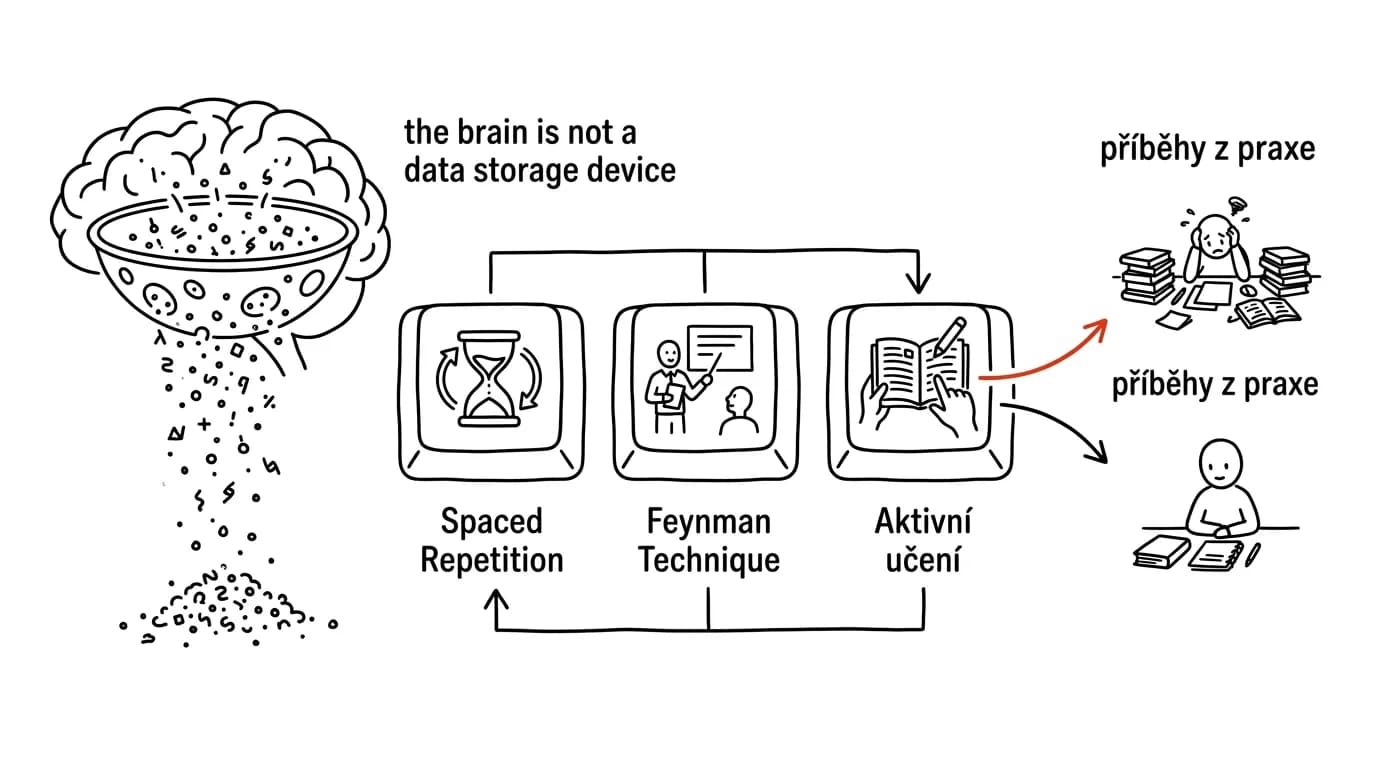
Studying stopped being about mechanically memorizing facts or mindlessly copying notes a long time ago. In a world drowning in information, the real art is the ability to think critically, learn efficiently, and process what you find in a meaningful way. Every student faces the same challenge — how do you turn an endless volume of information into genuine knowledge? The key isn't studying hard, it's studying smart.
Effective learning starts with understanding your own thinking. It isn't about how many hours you spend over your books, but about how well you can connect contexts, analyze information critically, and build your own intellectual structures. The brain isn't a data warehouse; it's a dynamic network capable of constantly re-evaluating and recombining what it knows.
That's why traditional methods so often fail. Long hours of memorization, one-way lectures, learning in isolation — these are leftovers from an educational model that doesn't match today's demands. The modern student needs to be an active co-creator of their own education, not a passive recipient of information. The successful student today is like a skilled surfer: able to use the energy of the information waves without being swallowed by their force.
Key principles of effective learning
1. Active learning instead of passive intake
Active learning means transforming information into your own words, analyzing it critically, looking for connections, and applying what you know in practice. Passive learning is mere copying and mechanical repetition — it leads to a surface-level grasp without any deeper insight. You can tell the difference easily: after active learning you can explain the material; after passive learning you can, at best, recognize it on a test.
2. Spaced repetition
A scientifically proven method built on the way human memory works. Information is reviewed at precisely set, gradually lengthening intervals. That prevents rapid forgetting and maximizes long-term retention.
- Day 1First reviewthe day after you first learn the material
- Day 3–4Second reviewjust before memory would start to fade
- 1 weekThird reviewconsolidation into long-term memory
- 1 monthFourth reviewfrom here on an occasional refresh is enough — it holds
You don't have to track the intervals yourself — apps like Anki or Quizlet do it for you and pull up a card at exactly the moment you're starting to forget it.
3. Multimodal learning
The brain takes in information through different channels: visual (images, diagrams, maps), auditory (listening, discussion), kinesthetic (hands-on activity), and textual (reading, writing). The more channels you engage, the more effectively you learn.
Concrete techniques: mind maps, sketchnoting, explaining the material out loud, hands-on experiments, and teaching others. The last one is the most powerful — explaining is the fastest way to find the holes in your own understanding.
4. The Feynman method
Inspired by Nobel laureate Richard Feynman, in five steps:
- Pick a topic.
- Explain it simply, as if you were teaching a child.
- Identify the gaps in your understanding.
- Simplify and connect the concepts.
- Verify that your explanation is correct.
If you can't explain something simply, you don't understand it.
5. Deep versus surface learning
Deep learning aims at understanding principles, finding connections, critical analysis, and your own interpretation. Surface learning is memorization without understanding, focused on reproduction — and on short-term retention. Both may get you through the exam; only one of them stays with you.
Practical strategies: environment, time, and tools
Preparing your environment. A separate place used only for studying, minimal distraction, plenty of light and fresh air, ergonomic seating. Your brain will associate the place with the activity faster than you'd expect.
Managing time and energy. Identify your own productive hours, break studying into shorter blocks, and take regular breaks. The Pomodoro technique works well — 25 minutes of study, a 5-minute break (in more detail in the Pomodoro and time blocking chapter).
Technology. Spaced repetition apps (Anki, Quizlet), mind mapping software (MindMeister, XMind), recording tools for explaining out loud, and collaborative platforms for studying together.
Psychology: motivation, mindset, and recovery
Techniques are only half the story. The other half is intrinsic motivation, a growth mindset, accepting mistakes as a natural part of learning, and focusing on the process rather than just the outcome. The best students don't ask “what do I have to learn?” but “how can I genuinely understand this?”
Recovery matters just as much: good sleep, regular movement, mindfulness or relaxation techniques, and a healthy diet. The brain consolidates what it has learned offline — during sleep and movement, not over one more page of lecture notes.
An academic project as intellectual navigation
A thesis or a term paper isn't just a box to tick. The first and most fundamental obstacle tends to be your own sense of helplessness when a large research task is staring at you. The secret to success lies in breaking that enormous whole into smaller, manageable steps.
- A clear goal. Many students start a project without understanding why they're doing it. Think of it as a chance to ask a new question or offer a unique perspective.
- Structure and flexibility. A firm schedule matters, but it mustn't become a straitjacket. Every project has natural fluctuations — periods of intense progress alternating with apparent stagnation.
- Research workflow isn't linear. It's more of a spiral, where every step raises new questions. Approach every source as an active interpreter, not a passive recipient.
- Communication with your supervisor. An underrated but essential aspect. It isn't about formal consultations but about a genuine partnership and regular, constructive feedback.
- Documentation. Not an administrative necessity — it's the way you capture your own intellectual journey, your trains of thought, the dead ends, and the unexpected discoveries.
- A closing reflection. What did you learn? What are the limits of your research? What new questions has the project opened up?
Anna's story: a thesis run as a project
Anna sat in a café staring at a blank document. Her thesis on the impact of artificial intelligence on education looked like an insurmountable mountain, and previous attempts had ended in frustration and postponement. This time will be different, she decided. The turning point came when she stopped “writing a thesis” and started running it as a project:
- A mind map. A big sheet of white paper and colored markers. “Artificial intelligence in education” in the middle, first branches around it: the current state of research in red, methodological approaches in blue, potential impacts in green. Each branch then branched further. For the first time she felt the project had a shape.
- A Notion source database. Every article got its place — title, abstract, key ideas, her own notes, and a complete citation in APA style, prepared the moment she added it. For online sources, she also recorded the access date and the exact URL. Colored labels kept her oriented: green for read, yellow for in progress, red for still waiting.
- A personal SCRUM board. The mind map's branches turned into concrete tasks with deadlines and effort estimates. The first sprint belonged to the literature review and had clear rules: every day from 8 to 10 in the morning, literature only, no social media, every relevant source recorded immediately, regular check-ins with her supervisor.
- A weekly review. What went well? What needs improving? Where are the gaps? A ritual that kept both her motivation and her head clear.
During the second week she began to notice the first signs of progress — not in the number of pages read, but in a deeper understanding of the topic. She started seeing connections she had missed before. By the end of the first month she had something she would once have considered impossible: a systematically processed literature review, clearly defined research questions, and the first outlines of a methodology.
What helped Anna most: mind mapping as a way to break through the mental barrier; SCRUM for structure; Notion for notes and sources; regular reviews for motivation; and flexibility — not being afraid to change the plan. Her project was no longer a terrifying mountain but an adventure she could pick up and push forward at any time.
Thomas's story: exam season without the panic
Thomas sat in the library, panicking. Four exams in the hardest subjects ahead of him — algorithms, database systems, software engineering, computer networks. Last time it had gone so badly he almost lost his scholarship. This time he built himself a system.
- 1MappingFor each subject: what I know, what I have no clue about, what's critical.
- 2Breaking it downAlgorithms = 4 manageable blocks instead of one mountain.
- 3Active learningAnki cards, explaining to an imaginary classmate, problems instead of reading.
- 4A scheduleHardest material in the morning, problem sets in the afternoon, lighter topics at night.
- 5Exam simulationA weekly mock test under real conditions with a time limit.
- 6Recovery7–8 h of sleep, movement, breaks, friends — the brain consolidates offline.
Mapping. A big sheet of paper, a section for each subject, and three columns under each: what I already know, what I have no clue about, what's critical to study. For the first time he felt the situation wasn't hopeless — chaos was turning into a plan.
Breaking it down. Algorithms looked like an insurmountable mountain, so he cut it into graph theory, sorting algorithms, dynamic programming, and computational complexity. Each part got its own plan and time estimate.
Learning techniques. In Anki he built his own cards — not just any cards, but ones with questions that forced him to think. Instead of reading passively, he rewrote his notes in his own words, explained the material to an imaginary classmate, drew diagrams, and above all worked through problems.
A schedule. The hardest material from 6 to 9 in the morning, ongoing review later in the morning, problem sets in the afternoon, lighter topics and rest in the evening. Every day had a defined main learning goal, specific material, a number of problems, and time set aside to rest.
Exam simulation was the most powerful tool in his preparation: every week a mock test under exact exam conditions, with a time limit, no materials and no help — followed by a thorough review of the results.
Recovery. Seven to eight hours of sleep, morning exercise, a healthy diet, regular breaks, and time with friends. The result: every exam passed, some with top marks. A dreaded exam season had turned into an almost enjoyable self-development project.
Where to find the original research
If you want to check the claims about learning and performance at the source — or cite them in your own work — here's an overview of the studies this guide draws on.
Productivity and work performance
- Ohly, S., & Fritz, C. (2010). Daily Work Experiences and Performance: An Integration and Review. Journal of Applied Psychology, 95(4), 737–759. Productivity isn't linear; it runs in natural cycles. DOI: 10.1037/a0020796
- Frese, M., & Zapf, D. (1994). Action as the Core of Work Psychology: A German Approach. In Handbook of Industrial and Organizational Psychology, vol. 4, pp. 271–340. The dynamics of work performance and the identification of 90-minute productive cycles.
- Randall, J. G., et al. (2014). Cognitive Control and Work Characteristics Predict Employee Productivity. Journal of Business and Psychology, 29(2), 213–231. Five key factors that shape productivity. DOI: 10.1007/s10869-013-9315-y
Cognitive science and neuroplasticity
- Draganski, B., et al. (2004). Neuroplasticity: Changes in Grey Matter Induced by Training. Nature, 427(6972), 311–312. Evidence that the brain changes its structure through learning. DOI: 10.1038/427311a
- Dosenbach, N. U. F., et al. (2008). Distinct Brain Networks for Adaptive Behavior. Nature, 453(7198), 83–86. The brain as a dynamic network of neural connections. DOI: 10.1038/nature06936
- Sweller, J., van Merrienboer, J. G., & Paas, F. G. (1998). Cognitive Architecture and Instructional Design. Educational Psychology Review, 10(3), 251–296. Cognitive load theory and strategies for effective learning. DOI: 10.1023/A:1022193728205
The quantified self
- Swan, M. (2013). The Quantified Self: Fundamental Disruption in Big Data Science and Biological Discovery. Big Data, 1(2), 85–99. DOI: 10.1089/big.2012.0002
- Fritz, C., et al. (2011). Embracing Ups and Downs: Reconceptualizing Mood and Performance in Organizations. Academy of Management Review, 36(3), 541–556. The key areas of personal tracking. DOI: 10.5465/amr.2009.0344
Biological rhythms, skills, and the mind–body connection
- Czeisler, C. A., et al. (1999). Regulation of the Human Sleep-Wake Cycle and the Influence of External Cues. Cold Spring Harbor Symposia on Quantitative Biology, 64, 371–381. DOI: 10.1101/sqb.1999.64.371
- Anderson, J. R. (1982). Acquisition of Cognitive Skill. Psychological Review, 89(4), 369–406. Systematic training and skill development. DOI: 10.1037/0033-295X.89.4.369
- Benson, H., et al. (2003). The Relaxation Response: Therapeutic Effect. Science. The link between mental and physical states. DOI: 10.1126/science.278.5338.1694
Books for deeper study: Carol S. Dweck — Mindset: The New Psychology of Success (2006); Charles Duhigg — The Power of Habit (2012); Daniel H. Pink — Drive: The Surprising Truth About What Motivates Us (2009).
Online resources: Quantified Self, the Center for Healthy Minds at the University of Wisconsin-Madison, MIT Sloan Management Review.
How to work with the studies: treat them as part of an ongoing process of inquiry, not as final truths. Follow newer research, evaluate the conclusions critically, experiment with your own strategies, and expect individual differences. This list is only a fraction of the research on productivity, learning, and human performance — for the wider context, see the The science of productivity chapter.
Find your own path
Every student is unique — with their own strengths, learning styles, interests, and challenges. Productivity isn't a uniform concept but a personal art of self-knowledge. Experiment with methods, track your own progress, adjust your strategies as you go, and respect your own learning style.
An exam isn't a punishment but a chance to show what you've learned. And studying in the digital era is an adventure — getting to know yourself, the world around you, and the possibilities of your own mind. A path full of challenges, mistakes, and unexpected discoveries. That's exactly where its beauty lies.
Related tips
Anki: learn in half the time with spaced repetition
Flashcards with an algorithm that quizzes you right when you're about to forget. For languages, exams, and professional knowledge alike.
NotebookLM: an AI that only knows your documents
A complete guide with prompts: how a notebook grounded in your own sources differs from a regular chat, how to pick and prepare documents, how to ask questions so answers can be checked, what audio overviews are good for, where the limits are — and when to reach for Claude or ChatGPT instead.
Close the book and recall: the most effective study technique
Re-reading your notes creates an illusion of knowledge. Closing the book and trying to recall the material from memory — that's learning that sticks.
Your own deadline: two days before the real one
Submit by your own D−2 deadline. You get a buffer for review, printer trouble, illness — and a calm night's sleep.
Want to keep the momentum?
One tip from the handbook by email each week — in an order that makes sense.
1 tip a week · no spam · unsubscribe in one click