Handbook · Foundations · 8 min read
The psychology of productivity: working with your own mind
Procrastination isn't laziness, it's emotion. Flow isn't luck, it's a skill. And burnout can be spotted before it arrives.
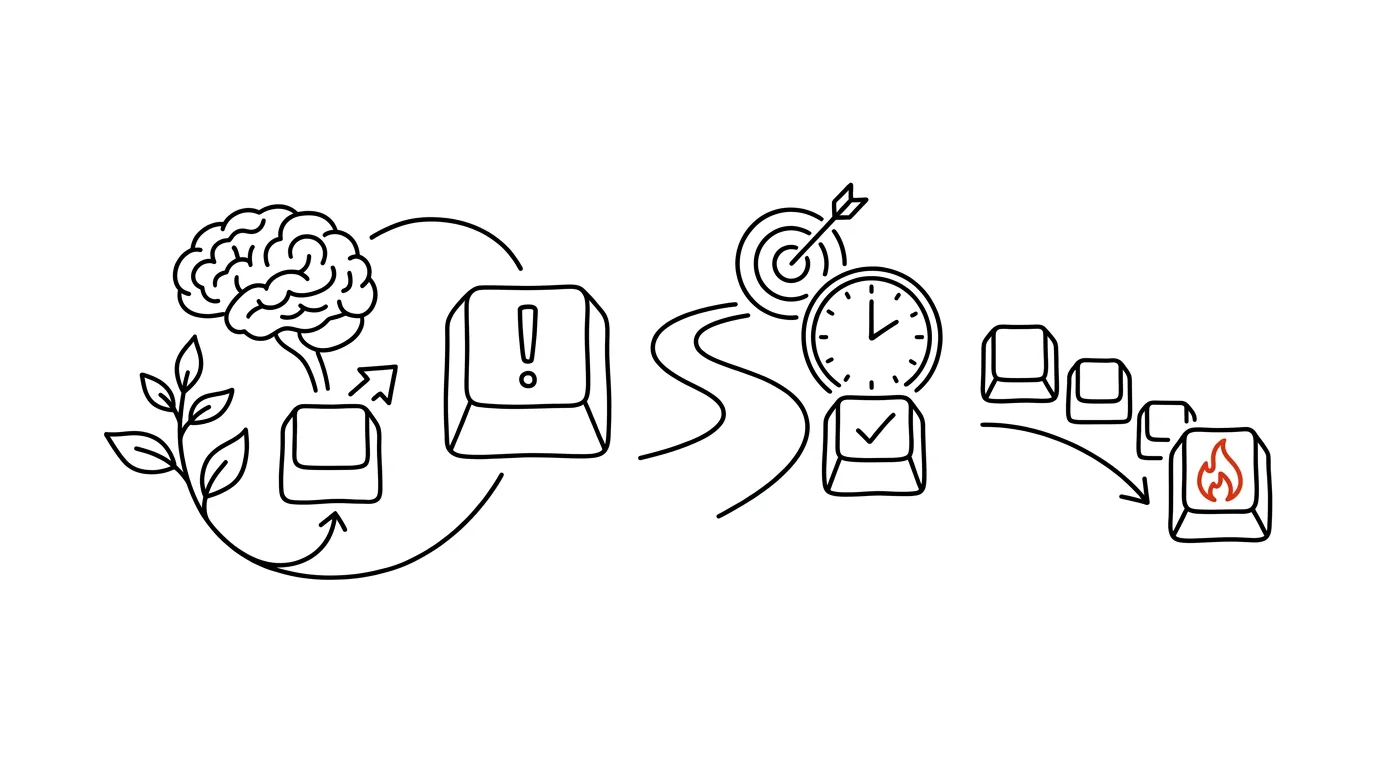
You probably know the feeling: you're at your computer with an important task in front of you — and yet you're scrolling social media or reading the news for the fourth time. It isn't because you're lazy. It's because you're working against your psychology instead of putting it to work for you.
Procrastination isn't laziness
Procrastination is an emotional response to a task that triggers fear of failure, perfectionism, uncertainty or a sense of overwhelm. That's why “just push through it” doesn't work — you're fighting an emotion, not a shortage of willpower. These three techniques do work:
- 1Swiss cheeseYou don't attack the whole task — you poke a small “hole” in it. Then another.
- 2The 5-minute rulePromise yourself just 5 minutes. Usually you'll find you want to keep going.
- 3A concrete stepNot “I have to write the report,” but “I'll open the document and write the first paragraph.”
Personal tip: When I don't feel like starting a big project, I open a blank document and give it a name. That small step alone is often enough to get the engine running.
Flow: your productivity superpower
Flow is the state where you're fully immersed in your work, time flies and the work seems to do itself. Like reading a gripping book and forgetting the world exists. You can't force it, but you can prepare the ground:
- Prepare the environment — remove distractions, set out your tools, find quiet.
- Set the right challenge — the task can be neither too easy nor too hard. Mild pressure yes, stress no.
- Protect your time — turn off notifications, put your phone on Do Not Disturb, tell your colleagues.
An entry ritual helps too: a favorite drink, a specific playlist, a clear desk. Your brain learns to associate the ritual with focus and switches gears faster.
Stress: a shield, not an enemy
Stress in small doses is motivating. The problem is when there's too much of it or it lasts too long. Three levels of defense:
- Prevention: regular breaks (the Pomodoro technique), clear boundaries between work and rest, realistic planning — the stress of falling behind is most often the stress of a bad plan.
- Instant relief: the 4–7–8 breathing exercise (inhale for 4, hold for 7, exhale for 8), a short walk, a change of scenery. The body can calm the nervous system faster than the mind can.
- Long-term solutions: regular exercise, quality sleep, mindfulness or meditation.
Start keeping a stress journal: what stresses you, how the stress shows up, what helps. After a few weeks you'll see patterns and triggers — and those can be solved systematically instead of firefighted.
Burnout: spotting it before it arrives
Burnout isn't just tiredness. It's a state of physical, emotional and mental exhaustion. Warning signs: chronic fatigue, cynicism, loss of motivation, reduced productivity, sleep problems, headaches or stomach trouble.
Prevention:
- Boundaries — working hours you actually keep; the ability to say no; delegation.
- Maintenance — weekly reflection, a monthly satisfaction check, regular (even short) time off.
- Resilience — hobbies outside work, social contact, personal growth.
First aid when things are already on fire:
- Immediate measures — take time off, cut back your commitments, seek support (colleagues, family, a therapist). Burnout isn't weakness and it won't disappear by gritting your teeth.
- Long-term solutions — reassess your priorities, change your work habits, build a sustainable way of working. Returning to the same regime that burned you leads to the same place.
Action plan
- Week 1Stress journal + flow ritualplus identifying your own procrastination triggers
- Month 1A system of breaks and boundariesregular breaks, a clear end to the workday, an accountability partner
- OngoingEvaluate and fine-tunecheck your stress level once a month, adjust habits as needed
Productivity isn't a sprint, it's a marathon. It isn't about one high-output day — it's about working healthily and effectively over the long haul.
Related tips
A distraction blocker: stronger than your willpower
Apps like Cold Turkey or Freedom block chosen websites for a set period. Decide once, and it holds for the whole morning.
Smart home scene: Deep Work Mode in one tap
Lights, do-not-disturb, a timer, and music with a single command. A ritual that tells your brain “it's work time now.”
A physical Pomodoro timer instead of an app
A mechanical kitchen timer or a TimeFlip cube. Visible, tangible — and it doesn't tempt you to pick up your phone.
The shutdown ritual: close the day so it doesn't follow you
Five minutes at the end of work: write down loose ends, glance at tomorrow, close the laptop. Work stays at work — even in your head.
Want to keep the momentum?
One tip from the handbook by email each week — in an order that makes sense.
1 tip a week · no spam · unsubscribe in one click