Handbook · At home · 14 min read
Parents and time: two calendars, and kids in between
A parent's time is chopped into pieces, and no technique will make it whole again. What does work is coordinating with the other adult, planning with a buffer, and no longer measuring parenting by hours logged.
In this article
Friday, 4:15pm. The calendar has an hour blocked to finish a proposal that has to go out Monday. In twenty minutes the phone will ring from daycare — a fever. At the same moment, a message arrives: practice has moved an hour later and the ride no longer works. And somewhere at the back of the mind, a reminder surfaces that Sunday is a birthday party and the gift still isn't bought.
None of this is a catastrophe. Each item can be handled in a few minutes. But together they reliably dismantle the rest of the day — and more to the point, they dismantle a plan that was built on the assumption that an hour would stay an hour. A parent trying to follow ordinary productivity advice keeps running into the same wall: most of that advice assumes a person who has control over their day. A parent doesn't have that control, and never will, because the other side of their day is a person who can't be scheduled.
Fragmented time isn't a planning failure — it's a permanent feature of this stage of life, and a system that doesn't take that as its baseline collapses at the first cold. That's the shift this entire chapter rests on: stop trying to have an unbroken day and start building a plan that survives being broken. What follows doesn't prescribe how a family should work — whether it has two adults, one, three, or splits care across two households is each family's own business. It describes the mechanics that hold regardless: where time gets lost, what can be coordinated, and what isn't worth fighting. It builds on the chapter The household as an operation, which covers dividing areas of responsibility; this one covers time.
Fragmented time is a fact, not a failure
Focused work has overhead. It takes about twenty minutes to actually get into a state of real thinking — and that toll gets paid again after every interruption. A day made up of four twenty-minute windows is therefore not the same as an hour and twenty minutes of work. It's substantially less, because the startup cost gets paid four times and nobody ever gets to the finish.
A parent's day looks exactly like that. Mornings are logistics, midday might be continuous, afternoons break apart around pickups, evenings are running the household, and whatever's left is the hour after the kids are asleep — the one time of day a person has the capacity for email but not for thinking. On top of that come inputs that can't be turned down: illness, a schedule change, a forgotten gym kit, a call from school. It isn't really about the quantity of time — it's about its shape. A parent often logs a decent number of hours and still feels like nothing real got done — because every one of those hours was fragmented.
Three practical consequences follow. First: an unbroken block is a rarer resource than time itself, and deserves to be protected first, not last. When a two-hour window can be negotiated once a week, it outperforms four scattered hours — and it doesn't matter whether it's negotiated with the other adult, a grandparent, after-school care, or your own employer. How to actually hold such a block in your calendar is covered in the tip Block off calendar time for focused work.
The second consequence: work needs to be sorted by what kind of window it requires. Some work tolerates interruption — admin, replies, small tasks — and some doesn't. When someone is tired, they make the mistake of filling a rare, unbroken window with the easiest task available, because they don't feel up to the hard one. That burns a scarce resource on something that could have been done anytime.
The third consequence is a kinder one: part of the day will always belong to logistics, and it's fine to plan it that way. A parent who pencils in eight productive hours manufactures, every single day, a fresh feeling of failure over something that was never achievable to begin with. A realistic plan with fewer hours and a bigger buffer paradoxically produces more finished work, because it doesn't fall apart. A related topic — working with your own energy instead of the clock — is covered in the chapter Working in sync with your own body.
Two calendars, one household
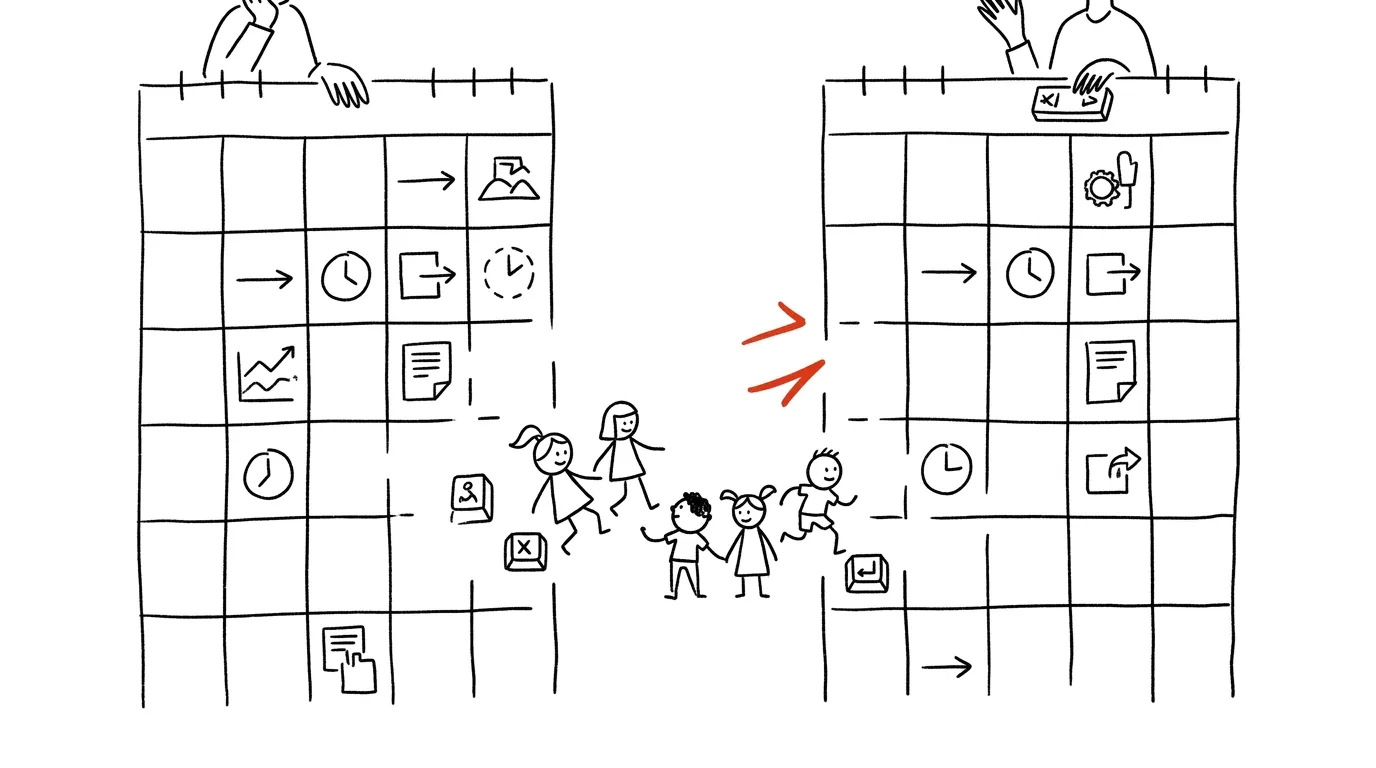
When more than one adult shares time, a problem emerges that neither of them has alone: their plans collide, but nobody sees the whole picture. Each person knows their own week perfectly and the other's only vaguely. Most time conflicts don't come from bad faith — they come from two people, both acting in good faith, planning the same afternoon.
The fix has three parts and all three are boring. A shared calendar for anything that affects more than one person. Not everything — private meetings don't belong there, and nobody has a right to a complete view of the other person's day. Three kinds of entries belong in a shared calendar: what blocks my availability (a business trip, an evening meeting, travel), what concerns the kids (activities, appointments, school events), and what concerns the household (a tradesperson, an inspection, a visit). Whoever can see this stops having to ask, and stops having to guess.
A short weekly check-in. Ten minutes, a fixed time, a fixed structure. It isn't a status meeting and it isn't a scorecard for who did more last week — the moment it turns into that, it stops happening within a month. It's one single question: what's different next week from the usual.
- 1What's differentGo through the week and find deviations from normal: trips, evening meetings, school events, visits. Regular routine doesn't need discussing — everyone already knows it.
- 2Who can't do what, whenSpecific times, not impressions. This is where ninety percent of future conflicts get caught before they explode on a Thursday afternoon.
- 3Who drives whomSort out rides and pickups for the whole week at once. Thinking it through once is cheaper than negotiating it seven times.
- 4What needs handlingGifts, payments, registrations, deadlines. The goal is to get them out of your head and into the calendar or a list — not to actually deal with them right now.
- 5Who's on call this weekDecide who's the backup for anything unexpected — and who, in turn, gets a protected block. This is the heart of the whole check-in.
A designated on-call person. The most useful element, and the least common one. Unexpected things — a sick kid, a call from school, a broken washing machine — tend in practice to land on whoever has the weaker voice or the worse day, and that's a source of quiet resentment. When it's decided in advance who's on call this week, or this day, the last-minute arguing disappears. The role doesn't have to be split evenly by week either; it can track work load, which is exactly why it's worth re-assigning at the weekly check-in rather than fixing it once and for all.
In a household with one adult raising the kids, this part doesn't happen internally — it happens outward: on-call coverage gets arranged with grandparents, the other household, other parents, a sitter. The mechanics are identical, and the stakes are even higher, because without a backup, every illness becomes a crisis. That's not an organizational question, it's a network — and it's worth building before it's needed.
Activities and logistics as a project
When a kid has two after-school activities and one regular therapy or tutoring session, the result is a schedule with dozens of dependencies: who drives, who picks up, what needs to be packed, what has to be washed by when, when the term fee is due, when the breaks are and what changes during them. Parents usually hold all of it in their heads and then wonder why they're exhausted on a Sunday evening without having done anything hard.
This is a classic project, and it behaves by the same rules as a project at work. It has recurring logistics, deadlines, costs, and one weak point: dependencies between people. The moment a ride depends on a single person whose unavailability stops the whole chain, the system is fragile no matter how well it's planned.
There are three practical steps. Write the whole schedule down in one visible place — a calendar, a spreadsheet, paper on the fridge, anything everyone can see, including the kid. A child who knows on their own what's happening when and what to pack takes a chunk of mental load off the parent, and picks up a skill that will serve them for life. Write down recurring prep once — what goes to swim practice, what goes to the music lesson — and post it where the packing happens. Repeated decision-making is the biggest hidden tax of the whole activity carousel; the tip A checklist for everything you do more than once shows how to get rid of it. Arrange a backup for at least one ride a week, ideally by sharing with another family — a rotating carpool is the one optimization that genuinely gives back hours.
And then there's a question parents ask too rarely and too late: how much of this should there even be. Every extra activity doesn't just cost its own hour; it costs the ride, the prep, the tiredness, and one fixed slot in the week that can no longer be used for anything else. How many activities a family can carry is a legitimate parenting decision, and nobody outside gets to prescribe a number. But it's worth making that decision on purpose and revisiting it once a term, instead of letting the schedule grow by the sheer momentum of sign-ups.
Working from home, family at home
Working from home is an ambivalent invention for parents. On one hand, it gives back commuting time and makes logistics possible — a 3pm pickup stops being a problem. On the other, it tears down the one boundary that used to work by itself: the physical distance between where work happens and where life happens. Whoever works from home loses both the natural end of the day and its natural start.
The result is a strange mix. Work leaks into family time — just one more quick reply, just one more quick look, the phone never leaving your hand. And at the same time family leaks into work — someone starts the washing machine between two calls and can't figure out by evening why nothing got done. The result is a day where work and non-work happened simultaneously, and neither finished work nor real presence with the kids came out of it.
The defense rests on boundaries that are visible, because invisible boundaries go unrecognized by children and unenforced by adults. A place helps — if it's at all possible to set aside a work corner, that works better than any resolution. A signal that even a small child understands helps: a closed door, headphones, a specific object on the desk. Time expressed as an event, not a clock time, helps: “I'm working until snack time” makes sense to a child; “I'm working until 4:30” doesn't.
And above all, an end-of-day ritual helps. Work from home has no commute, which used to function as a transition ritual between roles — without it, a person sits down to dinner with their head still in a spreadsheet. Ten minutes to close out the day — write down what's still open, decide three things for tomorrow, close the laptop — is the cheapest intervention available for a family evening. The tip A shutdown ritual covers it in detail, and the chapter The complete guide to effective remote work covers working from home as a whole.
One last, uncomfortable point on this topic: a child who sees a parent in the same room but unreachable experiences something worse than a child whose parent simply isn't home. Presence without availability is confusing. That's why a clearly separated work block followed by a genuine half-hour without a phone beats four hours of “I'm here, but don't bother me.”
Quality versus quantity: a false choice
The line “it's not about the amount of time, it's about its quality” gets used two ways, and both are problematic. As comfort for an exhausted parent, it's misleading, because shared time needs a certain volume before there's room for anything worth calling quality to happen inside it. As an accusation, it's cruel, because quantity isn't something many parents get to choose given their circumstances.
A more honest distinction: it isn't quality versus quantity, it's predictability and availability. A child doesn't remember an average number of minutes. They remember that there's reading after dinner, that something happens together on Saturday morning, that when they're telling a story, the parent turns to face them. A short, reliable ritual does more for a sense of security than an occasional big weekend event followed by ten distracted days.
Second thing worth knowing: conversations with kids can't be scheduled. They show up while something else is happening — in the car, doing dishes, on the way home from an activity, at night after the lights go out. What those moments have in common is that they're unstructured, and nobody in them is in a hurry. The practical conclusion sounds almost counterproductive: a week filled to the brim with no open space doesn't just create exhaustion — it also removes the openings where these conversations happen in the first place.
The third point is purely mechanical, and everyone already knows it. The difference between presence and half-presence mostly comes down to the phone. A half hour with no device within reach is a different half hour than one where the phone sits face-down on the table. This topic — and the fact that device rules have to apply to adults too — is covered in the chapter Digital hygiene for the family.
A parent's own time isn't selfishness
Most parents sacrifice, first, whatever has nobody to complain on its behalf: sleep, exercise, hobbies, friends, a moment alone. That's logical, because work demands time and so do the kids, while personal time stays silent. But it's also the worst possible place to cut, because it's exactly the resource everything else gets drawn from.
Especially in the first year with a child, and in single-adult households, it's worth saying this plainly: a parent's own time isn't a reward for good performance, and it doesn't have to be earned. It's maintenance. A parent with zero space of their own eventually reaches a state of being physically present but with nothing left to give — and that's worse for a child than a parent who was out for two hours on a Tuesday evening.
The practical form doesn't need to be grand. A fixed, recurring slot that sits in the calendar like any other commitment. Trading off with the other adult when there is one, symmetrically or not. A mutual arrangement with another family. And above all, clarity about what that time is meant to restore, because two hours of scrolling on the couch gives back noticeably less than two hours of exercise or an hour alone.
This is also where an often-overlooked topic belongs: sleep. During the years of small children, sleep is often in short supply, and no planning system fixes that. What is possible is not making it worse through your own choices — the hour after the kids fall asleep is the worst-used hour of the day, and routinely turning it into a work shift is the most expensive way to try to catch up. The connections between sleep, energy and performance are covered in the chapter Working in sync with your own body.
Buffers, illness, and the seasonality of the school year
A system that only works when everything is fine isn't a system. And in a family with kids, everything is never fine for long — illnesses in the preschool years add up to dozens of days a year and arrive without warning, usually during the worst possible week.
Buffer can be built at three levels. In the day: leave part of the capacity unscheduled. Whoever fills their calendar to the last slot has nowhere to shift even a small thing. In the week: keep one window set aside for whatever didn't get done, and don't assign anything to it in advance. And in commitments: deliberately carry fewer parallel things than could theoretically be managed, because every overlap raises the odds that everything collapses at once.
Part of this is a prepared response to illness, agreed on before it happens: who stays home for the first sick day, who for the second, who can be asked to cover, which work things simply won't get done on a day like that and who gets told. An hour spent on this agreement pays for itself the first time a cold hits. The same logic, incidentally, applies to meal prep — keeping two extra portions in the freezer is a form of buffer, not a culinary ambition; the meal planning covered in the tip A week's meal plan with AI serves exactly that purpose.
The last piece is seasonality. The school year has a recurring shape, and parental load follows it with a small lag. Whoever knows that shape stops planning December as generously as September.
- SeptemberKickoff and sign-upsNew schedules, activities, payments, supply lists. The busiest organizational month of the year — and the easiest one to replan the whole fall around.
- October–NovemberIllness seasonThe first big wave of sick days. This is where it becomes clear whether the household has an agreed process and a backup person, or is improvising.
- DecemberEverything at onceSchool shows, gifts, work deadlines, visits. Demands peak right when daylight and energy are at their lowest.
- February–MarchThe longest stretch with no breakA long period with no real milestone. This is where deliberately planned rest belongs, not heroic catch-up.
- April–JunePeak events and entrance examsField trips, events, exams, the end of the year. Also when summer plans have to get settled — camps fill up long before this.
- Summer breakA different operation, not a pauseSchool structure disappears, and with it the built-in supervision. Planning summer coverage in May is cheaper than scrambling for it in June.
The practical takeaway is the same as for any predictable unevenness: shift what can be shifted to where it's cheaper. Camp sign-ups in winter, gifts outside of December, big work commitments outside of September and December. It isn't about doing more — it's about not piling everything onto the same spot.
What to take away
- Fragmented time is a permanent condition of this stage of life, not the result of bad planning. A system that assumes uninterrupted days collapses at the first cold.
- An unbroken block is rarer than time itself. One protected two-hour window outperforms four scattered hours — and it's worth actively negotiating for.
- When more than one adult shares time, they need a shared calendar, ten minutes a week to align, and a clearly designated on-call person for the unexpected. A single parent needs the same things — just arranged outward.
- Activities are a project with dependencies. A schedule in a visible place, prep written down once, and an arranged backup for rides return more time than any app.
- Working from home needs visible boundaries and an end-of-day ritual. Presence without availability is worse for a child than absence.
- Instead of arguing quality versus quantity, focus on predictability and availability. A short, reliable ritual does more than an occasional big event — and conversations happen in unstructured moments that have to survive in the week.
- A parent's own time is maintenance for the resource everything else draws from. It doesn't have to be earned, and it shouldn't be the first line item cut.
- Plan with buffer in the day, the week, and your commitments — and know the shape of the school year. Illness isn't an exception nobody planned for; it's a regular part of the operation.
Want to keep the momentum?
One tip from the handbook by email each week — in an order that makes sense.
1 tip a week · no spam · unsubscribe in one click