Handbook · Learning · 13 min read
Adult learning: how to learn alongside a job
Adults have less time, but more context. Why project-driven learning beats courses, how to choose skills when everything keeps changing, and where the line sits between AI as a teacher and AI as a shortcut that costs you the skill.
In this article
- Adults start from different inputs than students
- A project instead of a course
- What to learn when everything keeps changing
- Practice with feedback as the condition
- The people around you: colleagues, mentoring, and when a course actually makes sense
- Learning as part of the working week
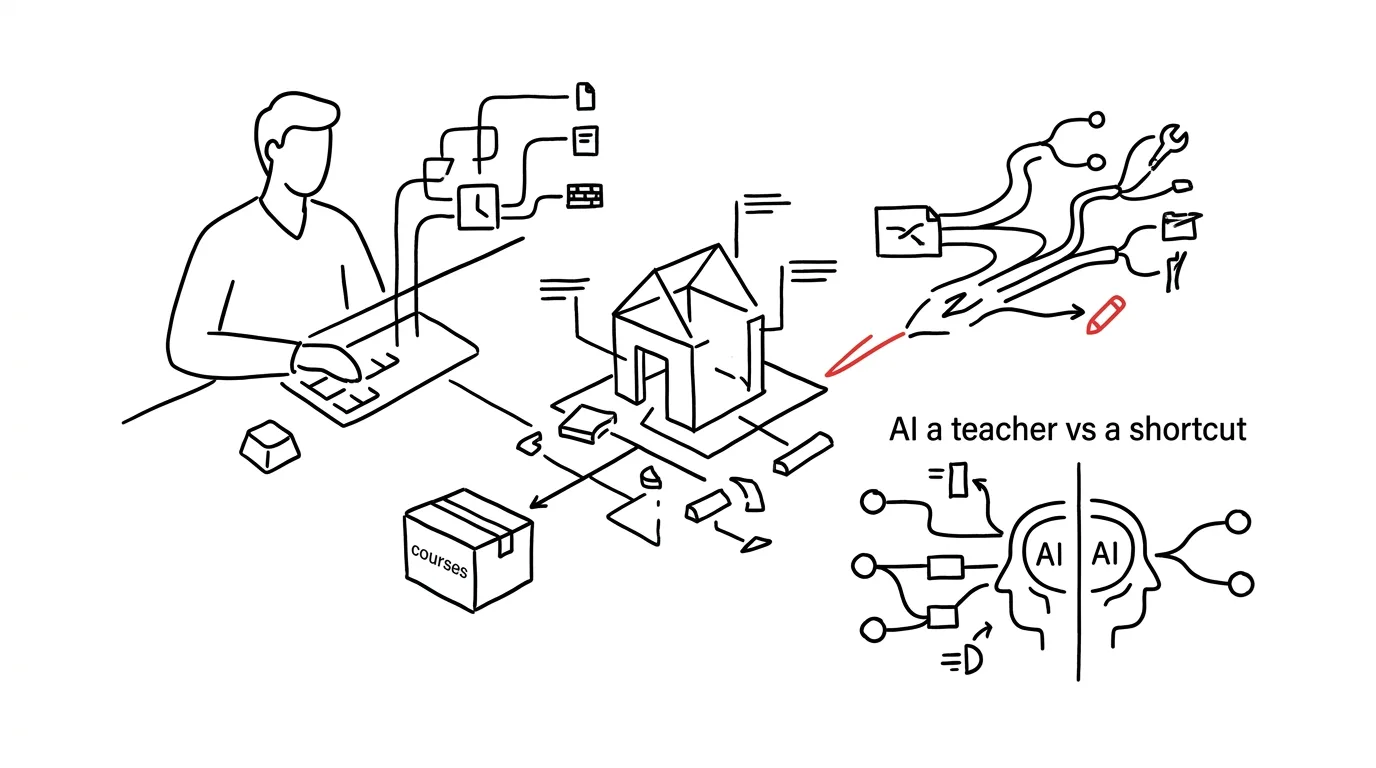
- AI as a patient teacher — and as a shortcut that costs you the skill
- Key takeaways
Around age thirty, the same thing happens to most people. They discover they need something at work they don't know how to do — a new system, a foreign language, data analysis, managing people — and they reach for the one tool they know from school: they buy a course. Fifty lessons, a hundred and thirty videos, a certificate at the end. The first week, three lessons a day; the second week, two; the third week, none. A year later, the course sits in their bookmarks as a reminder of their own lack of follow-through.
And yet that same person routinely learns things that are objectively harder. They handle a new project in an unfamiliar area, get their bearings in unfamiliar legislation for the sake of one contract, figure out how an undocumented internal system works. They learn it with no course, no plan, and often without even noticing they were learning.
The difference isn't effort. It's that in the first case, they were learning “for stock,” and in the second, they were learning in order to actually get something done. Adults don't learn badly because they have less time. They learn badly when they apply the school model of learning to a situation that doesn't resemble school at all.
Adults start from different inputs than students
An adult learner faces three handicaps and three advantages compared to a school student, and it's worth naming them, because practically everything else follows from them.
The handicaps are obvious. There's little time, and it's fragmented — instead of six hours in a row, it's two half-hours squeezed between meetings. Cognitive capacity is lower in the evening; after a day full of decisions, the head left over for studying has already been working for eight hours. And the competition is tougher: family, fatigue, and everything the day didn't get to are all up against your study time.
The advantages tend to get overlooked, but they weigh more than they seem to. First, context: an adult has something to hang new information on. Learning about contract types, they picture their own clients; learning about statistics, they think of the numbers they see in a report every month. Learning is mainly about connecting the new to the old, and an adult has far more of the old to connect to. Second, motivation, which is specific and personal — nobody's dictating what they need to know, and they usually know why they want it. And third, the chance to apply it right away. A student learns things they'll use in five years, or never. An adult typically puts a new skill to use within a week, and that use is exactly the moment learning gets completed.
The first practical conclusion follows: copying student strategies is a mistake. Long uninterrupted blocks, systematically working through a textbook front to back, learning “for stock” — these are strategies built on a resource adults don't have (large amounts of time), and they ignore the resource adults do have (context and the chance to apply it). The chapter Exams and deadlines describes what it looks like when the goal is a deadline. Here, the goal is something else: a skill you'll actually use.
A project instead of a course
The most reliable way for an adult to learn something sounds simple: learn it on something you need to do anyway.
This isn't a fallback for busy people. It's a better method. A project solves three problems a course wrestles with in vain. It solves content selection — you don't have to decide which of the fifty lessons matters, because the project dictates that on its own. It solves motivation — a project deadline is real, a course deadline is fictional, and a fictional deadline forces nobody to do anything. And it solves retention — a skill used in live production sticks differently than a skill practiced on an exercise, because it's tied to the exact context you'll need it in next.
In practice, that means flipping the usual order. Instead of “I'll learn to work with data, then use it,” you pick a specific output: “by the end of the month, I want a monthly revenue report that updates itself.” Then you chase down whatever's missing for that, and learn exactly that. You'll necessarily miss a lot of the material a course would have covered — and that's fine. That material doesn't disappear; you pick it up on the second and third project you run into it on, and by then it'll have somewhere to fit.
A good learning project has three properties. It's useful on its own, so it pays off even if you learn nothing from it. It's small enough to finish in a few weeks — a six-month project run alongside a job rarely survives that long. And it has a visible output you can show someone, because the prospect of a colleague or client seeing it holds the bar far better than your own resolve.
It's honest to mention this method's limits. In fields with a safety or legal threshold — healthcare, electrical work, accounting, aviation — you can't start with a live-production project; the fundamentals have to come first, and systematically. And for a complete beginner, a project can teach a lot, but it leaves holes in basic terminology that need to get patched deliberately, or a year later they'll show up as an inability to follow a professional discussion.
What about microlearning?
Ten minutes a day, one lesson in an app, a flashcard on the tram. Microlearning has real strengths: it's sustainable, it works well with spaced repetition, and it fits exactly the amount of time an adult actually has. For vocabulary, facts, terminology, or small habits, it's a very good tool.
But its limit is sharp. Ten minutes isn't enough to get into the state of focus real demanding work needs, and above all it isn't enough for integration — for turning individual pieces into a coherent skill. Someone who studies a language exclusively in ten-minute app sessions for a year knows plenty of words and still can't hold a conversation, because they never trained the hardest part: assembling it into a sentence in real time. Microlearning therefore works as a supplement and maintenance, not as a whole strategy. A sensible combination is a few ten-minute sessions a day for the memory component, plus one longer block a week for application and integration.
What to learn when everything keeps changing
The hardest question in adult learning isn't “how,” it's “what.” The supply is endless, the time is an hour and a half a week, and every six months some new technology shows up that someone insists you won't be able to take a step without in a year.
One distinction helps. Durable skills age slowly: writing clearly, understanding numbers, running a negotiation, structuring a problem, estimating risk, teaching someone else. Tool skills are tied to a specific product or version: this editor, this system, this library, this model. Tool skills usually pay back faster — you'll use them tomorrow — but they have a shorter shelf life. Durable ones pay back more slowly and last for decades.
The mistake isn't learning tools. The mistake is learning only tools, because then every version change wipes out a big chunk of what you know. A healthy ratio is roughly this: most of your time goes to the tools you currently need, and a smaller but steady share goes to one durable skill you're building over years.
Kvadrant „Důležité, neurgentní" je místo, kde vzniká skutečný pokrok — plánujte si pro něj čas dřív, než ho urgence sežerou.
A practical rule of thumb for deciding: what will my job demand of me in two years, and which parts of that don't I know yet? Not what's popular, not what's generically recommended. If you don't know the answer, that's a useful finding in itself — and it can usually be found out with two conversations with someone who's two years ahead of you.
And watch out for one quiet trap: the most common reason an adult ends up learning nothing isn't a bad choice of topic. It's switching topics. Three months of a language, then two months of coding, then a project-management course — each one reasonable on its own, together a year with not a single finished skill.
Practice with feedback as the condition
Watching videos is the most pleasant form of learning and one of the least effective. The reason is the same as with reading notes before an exam: it produces a feeling of clarity. The instructor moves smoothly, every step makes sense, the viewer nods along — and the brain mistakes that smoothness for their own ability. Try doing the same thing the next day without the video, and the gap is unpleasantly large.
Learning needs two things passive watching doesn't have. Your own attempt — you have to do it yourself, before you see the solution, even at the cost of getting it wrong. And feedback — someone or something has to tell you what's wrong and why, early enough that it can still be fixed. Without feedback, repetition doesn't reinforce the correct procedure — it reinforces whatever procedure you're currently doing, even if it's wrong. That's why three years of practice with no feedback is often just one year of practice repeated three times.
There are more sources of feedback than it seems. Reality itself (code either runs or it doesn't; a customer either buys or doesn't), a colleague willing to take a look, a community, an answer key, and these days even AI, which can answer “why doesn't this work” in a few seconds. Different sources vary in quality, but the worst option is having none at all.
You can train an active approach to any source without outside help. Pause a video before the solution and try to work it out. Close the book after a chapter and write down, from memory, what it was about. Explain it out loud to someone who knows nothing about the topic. All of these are variants of the same thing: forcing yourself to produce something, not just consume it. The tip AI explains the material is a practical help here, showing how to have an explanation tailored to your own level instead of searching for the perfect course.
The people around you: colleagues, mentoring, and when a course actually makes sense
The most underrated learning resource usually sits two chairs away. A colleague who does what you want to learn can hand you, in twenty minutes, things no course has: where the traps are, what doesn't actually get used in practice, how it's done at your company and why. The barrier is almost always just being embarrassed to ask and looking incompetent — when in fact a specifically framed question (“I approached it this way, here's where it doesn't fit, how do you handle it?”) has the opposite effect, because it shows you've been thinking about it.
Mentoring doesn't have to be a formal program. A regular short call with someone a few years further along is usually enough, and above all, a concrete ask: not “give me career advice,” but “here's my solution, what would you do differently.” The difference between a mentor and a colleague is that a mentor also sees what you should know and don't yet realize you don't. The chapter Knowledge that doesn't walk out the door with an employee covers the company side of this — why knowledge should be shared and how it gets captured.
So when is it worth investing in a course? When you need structure you couldn't build yourself — for a field that's completely unfamiliar, a guide who knows the order things make sense in is genuinely valuable. When the course offers feedback, not just videos: graded exercises, consultations, a project with an evaluation. When you need a formal credential that someone actually requires. And when a commitment device helps you — a paid slot and a cohort moving together holds up better than your own plan.
On the other hand, don't expect a course to teach you a skill by itself. A course supplies a map, a vocabulary, and an order. The skill only emerges from what you do with it afterward — and if no project follows the course, a year later all that's left of it is a certificate and a hazy impression. Before you buy, it's worth checking how much of the course is your own work, and whether someone actually evaluates it. A course without those two things is just a more expensive video.
Learning as part of the working week
Most learning plans fail in the same spot: learning gets scheduled for the evening, after everything else. So it gets the worst time available — a head that's already worked a full day, capacity drained by decisions, and a slot that's the first thing sacrificed the first day a crisis hits. No wonder it doesn't survive.
The solution isn't more discipline, it's a different slot. Learning meant to last for years has to be a line item in the working week, not a reward for a week well handled. That means a block in the calendar, ideally in the morning, ideally always the same day, with a length you can actually sustain — ninety minutes a week, kept up for a year, beats five hours a week kept up for six weeks. When learning is tied to a project that also has work value, it's even defensible to your manager — and a good number of companies explicitly support time like this, nobody just ever asks.
Two more things help. A visible record of what you learned and what it was for — notes that can answer questions, not an archive you never look into; the tip A second brain that answers shows how to build a record like that, and the chapter Your second brain covers it more broadly. And regular review, even a short one: once a week, go over how far you've moved and whether it still makes sense. The tip The weekly review describes a practical version of a ritual like that.
One last note on pace. Learning alongside a job naturally runs unevenly — weeks will come when it doesn't happen at all. The difference between someone who learns a lot over five years and someone who doesn't isn't that the first person never drops out. It's that they come back after dropping out, instead of treating it as proof they don't have what it takes.
AI as a patient teacher — and as a shortcut that costs you the skill
For an adult learning on their own, a language model is probably the most useful thing to come along in years. Not because it knows more than a book, but because it has properties no book has: it's available the moment you get stuck, it can explain the same thing five different ways, it takes a dumb question with no sigh, and it can build an explanation around your own example instead of a generic one. That's exactly the thing that most often kills self-study — you hit a spot you don't understand, have nobody to ask, and the project dies right there.
The good use is as a teacher. Having a concept explained with an example from your own work. Having it ask you questions about what you just read, and trying to answer from memory. Having it find the weak spots in your own solution — the opponent role described in the tip AI as an opponent. Having it generate practice problems with gradually increasing difficulty. In all these cases, AI is creating work for you, not doing the work in your place.
The treacherous use looks almost identical, and differs in exactly one thing: who does the hard part. When you let the model solve a problem and just read the solution, you get the familiar feeling of clarity — and zero skill. When you let it write the text you were trying to learn to write, you save an hour and pay for it by never learning it at all. The uncomfortable part is that the shortcut is always beneficial in the short run: the output is done, the quality is decent, nobody notices anything. The bill arrives later, at the moment you have to judge, fix, or defend someone else's work — and have nothing to do it with.
The practical rule is simple. Ask yourself whether you're using AI right now for something you already know how to do and don't want to, or for something you don't know how to do and are learning. In the first case, it's legitimate acceleration. In the second, you're taking out a loan against your own competence. That's why learning runs the opposite order from work: your own attempt first, and only then the model — as a proofreader, an opponent, or an explainer, never as the first author. The site's basic rule applies here too: AI proposes, a human approves. For learning, add one more clause: approving something you don't understand isn't actually approving it.
One thing is easy to forget: what you're actually pasting into the model. Work materials, internal documents, and personal data belong only in an account with contractually protected data handling, and following your company's rules. The chapter AI and automation offers a framework for deciding what to hand to machines and what not to.
Key takeaways
- Adults have less time, but more context and better motivation. Copying student strategies is a mistake — long blocks and learning for stock rely on a resource you don't have.
- Learn on a project you need to do anyway. A project selects the content, supplies a real deadline, and stores the skill in the context you'll actually use it in.
- Microlearning is a good supplement for facts and maintenance, not a whole strategy — ten minutes a day will never train the assembly of individual pieces into a skill.
- Distinguish durable skills from tool skills. Most of your time belongs to the tools you use, but a smaller, steady share going to one durable skill decides where you'll be in ten years.
- Without practice and feedback, you're not learning, just watching. An hour of your own attempt with correction beats three hours of video.
- Give learning a block in the working week, not the evening leftovers. Ninety minutes a week for a whole year beats five hours a week for six weeks.
- AI is an excellent teacher for things you're learning, and a dangerous shortcut for things you're supposed to be learning. Your own attempt first, then the model.
Want to keep the momentum?
One tip from the handbook by email each week — in an order that makes sense.
1 tip a week · no spam · unsubscribe in one click