Handbook · Foundations · 9 min read
The science of productivity: when the brain and performance speak in data
Neuroscience, cognitive psychology and the quantified self — what research says about performance, and how to use it in practice.
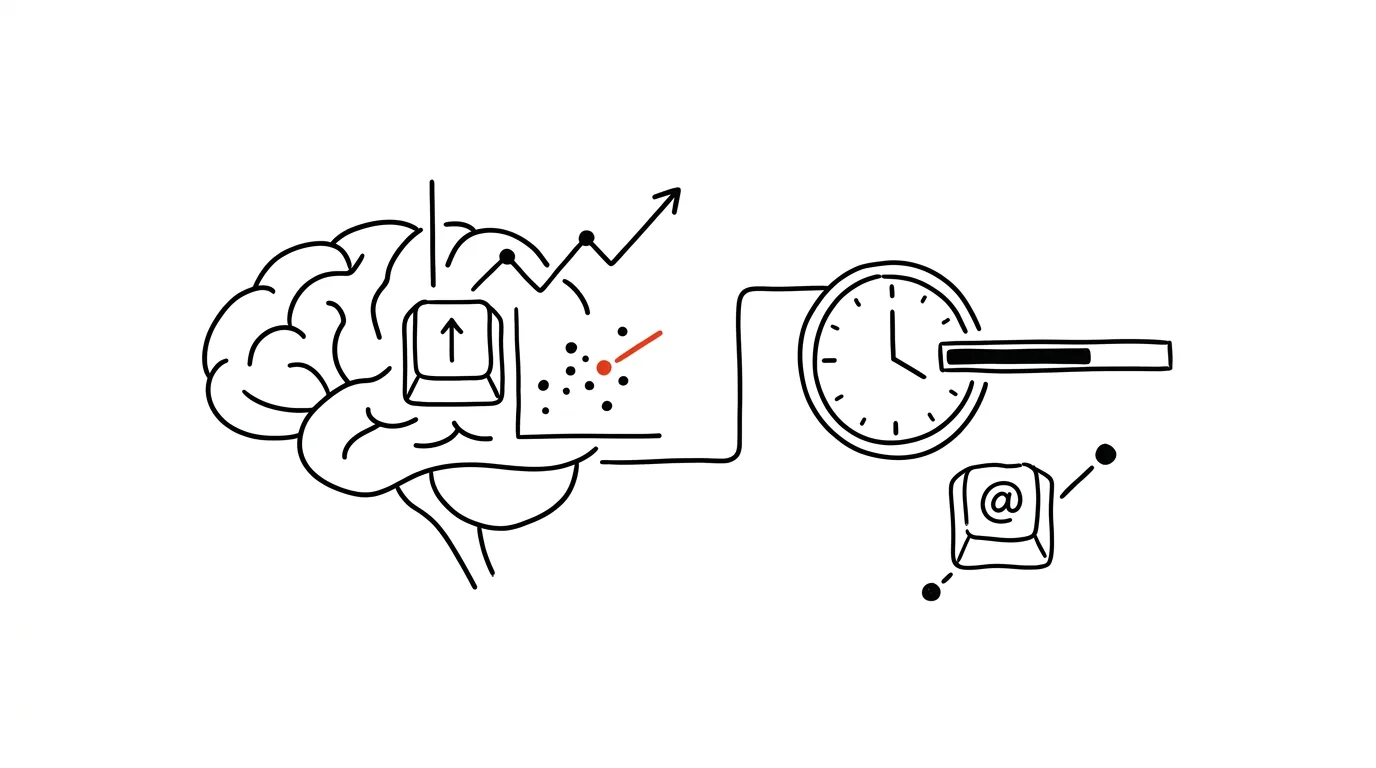
Productivity is ceasing to be an intuitive concept built on personal impressions. It's becoming a scientific field where neuroscience, psychology, cognitive science and other disciplines intersect. Modern research is uncovering the mechanisms of human performance, learning and self-development — and plenty of it is usable first thing tomorrow morning.
Evidence-based productivity: when the data speaks
Traditional ideas about productivity rested on subjective impressions and inherited myths. The scientific approach offers something fundamentally different — a systematic investigation of what actually works, backed by data and rigorous research.
A longitudinal study published in the Journal of Applied Psychology (Ohly and Fritz, 2010) shows that productivity isn't merely a matter of willpower or talent. It's a complex system of interactions between cognitive processes, physiological states and external stimuli. Researchers at Harvard Business School have tracked teams and individuals for years and keep uncovering surprising regularities in human performance.
One key finding: productivity isn't linear. The brain works in natural cycles, alternating periods of intense focus with periods of recovery. The point isn't to work as long as possible, but to work with maximum effectiveness at the right time.
What the research found specifically:
- Productivity cycles (Frese and Zapf, 1994) — productivity doesn't run in a straight line; average daily performance fluctuates in waves of roughly ninety minutes. The practical implication: you manage energy, not hours.
- Factors of cognitive performance (Randall et al., 2014) — five variables that matter more than any technique: sleep quality, stress level, physical activity, nutritional status and mental state.
The practical consequence of those 90-minute cycles: don't plan four-hour focus marathons. Work in waves — block, break, block — and put the hardest work at your energy peak (more on that in The body and productivity).
Cognitive science: the brain as a dynamic system
Key research in cognitive science reveals the brain as an extraordinarily flexible and adaptable system. A study published in Nature Neuroscience (Dosenbach et al., 2008) shows that it isn't a static organ but a dynamic network of constantly reshaping neural connections. Every activity, every thought leaves a trace — some connections strengthen, others fade.
And the five factors above aren't isolated variables but a complex ecosystem of interlocking influences. Poor sleep raises stress, stress kills your appetite for exercise, lack of exercise degrades sleep. Touch one point and the effect propagates to all the others — which is good news, because it means you can start anywhere.
The other side of the coin is cognitive load theory (Sweller et al., 1998). The brain has a limited capacity for processing information, and effective learning requires managing that capacity strategically. The best-known tool is “chunking”: grouping information into meaningful units. It's why you remember a phone number in groups of three rather than digit by digit — and why it pays to break a big task into named blocks before you start on it.
Neuroplasticity: the brain as a muscle you can train
Neuroplasticity is one of the most consequential discoveries of recent decades. Landmark studies (Pascual-Leone et al., 2005) show that every activity creates new neural pathways. The brain isn't a fixed structure but an organ in constant flux. The key finding: your potential isn't predetermined.
- 7–14 daysFirst structural changesthat's how long research says intensive, targeted training takes to show up measurably
- 3 monthsGray matter up by 4–6%the largest changes in areas tied to learning and memory (Draganski et al., 2006)
- At any ageNew neural connectionsthree factors decide: regularity, intensity and focus of the training (Lovden et al., 2010)
Systematic training — whether learning a language, mastering complex tasks or developing a specific skill — literally reshapes the physical structure of the brain. But quality and regularity are essential. Random or superficial activity has minimal impact; what works is targeted, deliberate, systematic development.
The quantified self: measurement as a path to self-knowledge
The Quantified Self movement is transforming personal development. A study published in Personal and Ubiquitous Computing (Swan, 2013) shows the potential of systematically tracking personal data — from physical parameters through cognitive performance to emotional states.
Research on personal tracking (Fritz et al., 2011) identified twelve areas worth measuring:
- sleep cycles
- heart rate
- cortisol levels
- time spent focused
- quality of rest
- physical activity
- nutritional intake
- mental state
- creative output
- stress level
- social interaction
- overall well-being
Systematic tracking increases motivation, with reported average performance improvements of 22–35% (Wolf, 2010) — but only under one condition. The decisive factor is regular reflection and adjustment of strategy. Collecting numbers isn't enough on its own; data without interpretation is just another notification.
- 1MeasureSleep, focus, energy, stress — a watch and a couple of apps handle it these days.
- 2ReflectTen minutes a week with the data: where are the patterns? what precedes the good days?
- 3AdjustOne change based on the data — and keep measuring.
Where to start: sleep cycles (a watch or an app), focus time (RescueTime), energy and mood (a simple 1–10 journal). You don't have to track twelve metrics — pick the two that relate to your biggest problem. The point isn't quantification for its own sake, but finding deeper patterns. Every person is a unique experiment that can be studied systematically.
A note on data: the more sensitive the metrics you collect (sleep, heart rate, location), the more carefully you should watch who you hand them to. Before you connect anything to a cloud service or an AI assistant, check what happens to the data — doubly so for health information.
The practical implications of the science
- Work with your natural cycles — respect your biorhythm (circadian rhythm research, Czeisler et al., 1999), schedule demanding tasks for your highest-performance periods, and build in regular recovery breaks.
- Targeted development — skills are built through systematic training (Anderson, 1982). You're consciously building neural connections; the brain adapts to whatever you do repeatedly.
- A holistic approach — the physical and the mental are connected (mind-body research, Benson et al., 2003). Prevention beats damage control, and the emphasis belongs on overall well-being, not on a single metric.
A complete list of the studies and advice on how to work with them can be found in the chapter on studying productively.
Productivity as a scientific adventure
Productivity is ceasing to be merely a tool for output. It's becoming a path to self-knowledge, continuous learning and conscious development. Because real productivity doesn't start with technique, it starts with self-knowledge: it isn't about how much you get done, but about how well you understand yourself. Learning to recognize your own energy cycles and finding a way of working that resonates with you — that's the essential art.
A systematic approach isn't a straitjacket, it's a bridge between vision and reality. It's a flexible framework that lets you adapt, learn from mistakes and grow. Productivity is a dynamic dance between structure and creativity, between the plan and the ability to improvise.
The key isn't chasing perfection, but patiently, systematically and kindly exploring what you're capable of. The science is clear: your potential is greater than you think. Stay curious, stay open, and be kind to yourself.
Related tips
A physical Pomodoro timer instead of an app
A mechanical kitchen timer or a TimeFlip cube. Visible, tangible — and it doesn't tempt you to pick up your phone.
Close the book and recall: the most effective study technique
Re-reading your notes creates an illusion of knowledge. Closing the book and trying to recall the material from memory — that's learning that sticks.
Pomodoro: 25 minutes of work, 5 minutes of break
Studying in short blocks with breaks holds your attention longer than heroic three-hour marathons. And starting is easier — it's just 25 minutes.
Study 5 times for an hour, not once for 5 hours
The same amount of time spread over more days means you remember multiples more. Your calendar is the strongest study tool you have.
Want to keep the momentum?
One tip from the handbook by email each week — in an order that makes sense.
1 tip a week · no spam · unsubscribe in one click