Tips & tricks · AI · Everywhere · ~peace of mind in the staff room
AI in the Classroom: Teaching Students Who Have ChatGPT in Their Pocket
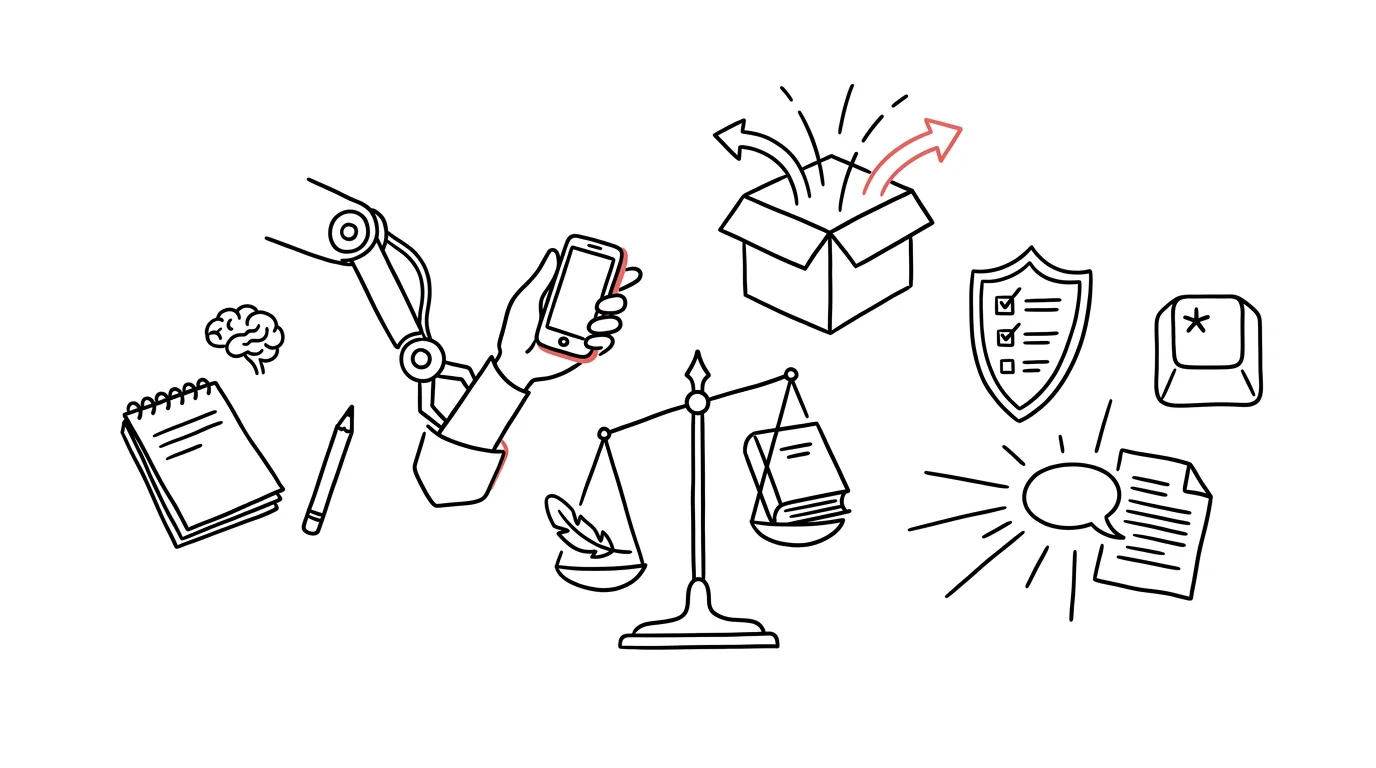
There are kids sitting in your classroom who carry a tool in their pocket that can write an essay, solve a word problem, or summarize a book they never read, all in thirty seconds. It doesn't matter whether you're okay with that. They're using it and will keep using it, because it's free, it's on their phone, and it works. Asking "should students be allowed to use it?" is a little like asking whether it should rain.
A ban is the first reaction, and it's understandable. It also doesn't work. You have no way to enforce it, because you can't prove the tool was used; it creates two groups of students — those who break the rule and those who follow it and pay the price; and above all, it puts you in the role of detective instead of teacher. A more useful goal than "keep them from using it" is "make sure they keep learning something." That's achievable — not through policing, but through redesigning assignments, a clear agreement, and conversation instead of accusation.
This guide moves from the reality in your classroom through rules, redesigning assignments, and what to do with suspicious work, to using AI directly in instruction and media literacy. Every section has copy-paste prompts — just fill in the brackets. You don't need to change everything at once; redesigning one assignment a month beats writing a sentence into the student handbook that nobody enforces.
A typical scenario
Marek teaches language arts in 9th grade. On Monday he collects essays on "My most powerful summer memory," and one of them stops him cold. It's flawless, has balanced paragraph structure, uses words that student has never used before, and contains the sentence "I experienced it as a moment when time seemed to stand still." There's no actual memory in it. There's a description of a memory, the kind anyone could have.
Marek knows two paths, and both are wrong. First: let it go, because he has no proof. The student walks away having learned it worked, and sends the next essay straight from his phone. The rest of the class knows by the next day. Second: mark it failing with a note saying "AI wrote this." No proof, a real risk of being wrong, and a guarantee that an angry parent will show up asking what evidence he has. The detector he tried in the meantime flagged another girl's essay as AI-written too — one he knows for a fact she wrote in class, in pen.
Marek takes a third path. He doesn't grade the essay, and on Friday calls the student in for ten minutes after class — no accusation, no detector. He asks about the text: why that particular memory, what happened at that moment, who else was there, what does that line about time standing still actually mean. The student stumbles after three questions and eventually admits he wrote it "with some help." Marek doesn't turn it into a disciplinary case. They agree on one thing: the next essay gets written by everyone in class, in a notebook, on a topic assigned that day — and once it's turned in, each student stands up and talks about it for two minutes. And one more thing: the next assignment is worded differently. Not "your most powerful summer memory," but "describe five minutes that happened to you and could not have happened to anyone else in this class, using at least three concrete details nobody could make up." A model can't write this assignment for a student — it has nothing to draw on.
Phase 1: The reality you're working with
Why a blanket ban doesn't work
Three reasons, and all three are practical.
You have no way to enforce it. Homework gets done at home, on a device you don't control. The only thing you'd actually be enforcing is the skill of hiding the tool's use — and students pick that up within a week.
It punishes the honest ones. A rule that can be broken without consequence disadvantages whoever follows it. When ten students turn in a text from a model and five turn in their own, weaker work, those five are the ones who take the hit.
It misses what actually needs teaching. These students will, in a few years, work in an environment where AI is a routine tool. The gap between someone who uses it well and someone who blindly trusts it is a skill — and it gets taught in school, or nowhere.
None of that means it should be used everywhere, all the time. The opposite, actually: there are assignments where using AI is as pointless as a calculator during multiplication-table drills. Being able to tell the two apart, and saying so out loud to the class, is the rest of this guide.
Find out what's actually happening in your classroom
Before you change anything, find out where you stand. Most teachers estimate their students' usage rate either well below or well above reality.
I teach [language arts] at [middle school] and want to
anonymously find out, in my [9th grade] class, how students
are actually using AI tools.

Prepare a short anonymous survey, max 10 questions, that
takes five minutes to fill out on paper or a form.

Requirements:
- questions must be worded so that admitting something isn't
  admitting to a wrongdoing — nothing that accuses or triggers
  defensiveness
- ask about specific situations ("the last time you...," "for
  what kind of assignment"), not general attitudes
- find out: what they use, for what, how often, what they think
  about it, what they'd like to learn, what worries them
- no question that could identify a specific student in
  hindsight
- add instructions for how to go over the results with the
  class in a way that doesn't feel like an interrogation

Also add two questions that tell me whether students even know
a model can make things up.
You get back a survey you can run in a single class period. Go over the results with the class out loud — it's the best possible opening for a conversation about rules, because the rules then come from real numbers instead of your gut feeling. The last two questions tend to be the surprise: the share of students who have no idea a model can confidently lie is usually high, and that's your main topic for Phase 6.
Phase 2: Classroom rules students can actually follow
Three tiers instead of a ban
A workable agreement doesn't answer "is AI allowed?" — it answers "for what, and how." The simplest version that works is three tiers, and for every assignment you say which one it falls under.
No AI. In-class work, tests, skill practice, where the point is precisely for the student to do it themselves. This covers anything graded as a skill.
AI with disclosure. Homework prep, research, brainstorming, practice, checking your own writing. The student can use the tool and attaches two sentences to the work: what they used and for what.
AI freely. Assignments where the tool is the topic or a genuine aid: idea generation, generating variations, spell-checking your own writing, working with data.
Three tiers are enough. A more complicated system, nobody will remember or follow.
An agreement you work out with the class
A rule the class helped write gets followed noticeably better than one handed down finished. Have a draft prepared, then rewrite it together in class.
I teach [language arts], class [9th grade], [24] students.
I want to work out simple AI-use rules with them for my
subject. Not a school policy — a one-page agreement they'll
actually read and understand.

Build the draft like this:
- three tiers of assignments: no AI / AI with disclosure /
  AI freely, with 3-4 concrete examples from my subject
  for each
- what disclosure looks like: a two-sentence formula, write
  3 sample versions
- what happens if the rule is broken — graduated, starting
  with the mildest consequence (redo the work, not a penalty)
- two sentences on WHY the rules exist, in language for
  [fifteen-year-olds], without moralizing

Add a 25-minute lesson plan for going over the agreement
with the class: what to say, what to ask students, where to
leave room for them to change the rule, and where I actually
can't budge.

Write it short and free of bureaucratic language.
You get back a draft agreement plus a lesson plan. Watch two things: make sure consequences start with redoing the work, not a grade penalty (otherwise you create exactly the kind of competition you're trying to avoid), and make sure students can genuinely win something in that class period. If the whole space is just for show, they'll notice, and the agreement becomes a piece of paper.
The disclosure formula should be short: "I wrote this myself. I used AI to look for ideas and to check my spelling." Two sentences under the work, twenty seconds of effort. Make it longer and people stop writing it.
Coordinate with your department
The worst version is when every teacher has different rules and a student has to remember four systems. You don't have to agree on content — math and language arts have different needs — but agree on the form: three tiers, the same disclosure formula, the same procedure when something's suspected. Half an hour at a department meeting saves a whole term's worth of confusion.
Phase 3: Assignments AI can't do for a student
Four principles
An AI-resistant assignment isn't built by making it harder. It's built by putting something into it the model doesn't have access to.
Personal experience and local context. A model doesn't know what happened in your classroom on Tuesday, what the walk from school to the train station looks like in your town, or what a specific student's grandmother said. An assignment anchored in something that exists only here is safe by design.
In-class work. The simplest and most effective measure. For skills you're grading, write in class, by hand, on a topic assigned that day.
Process instead of result. When you also grade the mind map, the outline, the first draft, and the revision notes, you're grading the journey. The journey can be faked too, but it's far more work than actually thinking it through — and that's the whole trick.
Defense. A submitted text isn't done until its author has talked about it for two minutes. This single measure changes classroom behavior the most, because it applies to anything.
Redesigning an existing assignment
You don't need to invent new topics. Just rewrite the ones you already have.
I teach [language arts], [9th grade]. Here's an assignment
I use that students are now having AI write for them:

[paste the exact assignment wording]

Rewrite it into three variants that resist a language model
generating the work:
1. a variant built on the student's personal experience
2. a variant built on local or classroom context (something
   that happened here, which the model knows nothing about)
3. a variant that grades process — list which intermediate
   deliverables the student should turn in, and in what order

For each variant, write:
- exactly what it grades (which skill)
- why the model can't do it for the student
- where it's more work for me to grade
- how a student could get around it if they tried hard enough

Take that last point seriously — I don't want to fool myself
into thinking anything is bulletproof.
You get back three usable variants and an honest account of their weaknesses. That last point is the most valuable one — it shows you that no assignment is one hundred percent safe, and saves you a false sense of security. The goal is to lower the payoff from cheating, not eliminate it: when the honest path is faster than the dishonest one, most of the class takes the honest one.
Process instead of result
Splitting the work into stages has a side effect worth having even without AI in the picture: students who used to write everything the night before start working steadily.
Break this assignment into stages I'll collect one at a time.
Assignment: [description, e.g., a two-page book report],
time allotted: [3 weeks], class periods per week: [4].

Suggest:
- 4-5 intermediate deliverables I'll collect on specific class
  days (exactly what, how many minutes of work, handwritten
  or digital)
- for each, what it reveals about the student's understanding
- for which stages it makes sense to allow AI, and which not,
  and why
- how to grade the deliverables quickly — I have 24 students
  and want max 30 minutes per stage

The stages need to fit together so the final piece grows out
of them. I don't want five unrelated extra tasks.
You get back a layout you can put into practice right away. Watch that last requirement: the most common reason teachers abandon process grading isn't pedagogical, it's time. When one stage takes an hour to grade, the system collapses within a month.
Defending your own writing
A two-minute defense at the board or your desk is the cheapest measure that exists. You don't need technology, just questions. And since you're asking about the text in front of you, a model can prepare the questions for you.
Here's an essay turned in by student [S], [9th grade],
subject [language arts], the assignment was [describe the
assignment]:

[paste the essay text]

Prepare 8 questions for a two-minute defense of this specific
essay. The questions must:
- target the content of THIS essay, not the topic in general
- ask about the author's choices (why this example, why this
  order, what did you consider and reject)
- include at least two questions about the meaning of a
  specific word or sentence used in the text
- be the kind an author can answer in ten seconds, while
  someone who just turned the text in can't

Don't say whether you think AI wrote the text. Just the
questions. For each, note what a good answer would reveal
about their understanding.
You get back a set of questions tailored to the text. The ban in the second-to-last paragraph matters: if the model had to guess authorship, you'd get an estimate with no real weight, and it would just bias you. Defense is also worth introducing across the board, not just for suspicious work — when everyone defends their work, it isn't an accusation, it's a normal part of turning something in.
Phase 4: Detection doesn't work. Here's what to do instead
Why not to trust detectors
Tools that claim to recognize AI-written text don't have the reliability a grading decision would require. They flag false positives on text written tersely and in polished style, text by students writing in a language that isn't their first, and text that's been through editing. And they're trivially easy to get around: run the text through a paraphraser or rewrite it in different words. On top of that, use of the tool can simply be denied, and you have nothing to prove otherwise.
The practical takeaway: a detector must never be the basis for a grade or a disciplinary measure. At most, it's a nudge to ask a question — and you can ask that question without one too.
Where a real clue actually lies is in a mismatch. The text doesn't match what that student can do in class. It contains nothing from what you covered. It mentions a book the class never read. It's factually wrong in the way a model gets things wrong, not the way that child gets things wrong — a made-up citation, a nonexistent author, a confidently stated number that doesn't add up. These clues aren't proof, though — they're reasons for a conversation.
Conversation instead of accusation
A script that works has four rules. Talk one-on-one, not in front of the class. Don't accuse — start by asking about the text because you're curious how it came together. Ask about specific spots in the work, not whether they used AI. And leave a door open: "if something was helping you with this, tell me — we'll handle it differently than you might think."
Most of these conversations end with the student volunteering how the text came together — because questions about the content of your own work can't be answered if you didn't write it. And if they answer everything, they probably did write it and you were wrong. That's also a valid outcome, and a better one than grading based on a detector.
When it turns out AI wrote the text
Whatever you agree on, it should have three qualities. The work gets redone — a new deadline, a different assignment, a defense. The response is proportionate — for a first offense in a term, the goal is a change in behavior, not a punishment. And it's written down in advance in the Phase 2 agreement, so the student gets exactly what was announced, not whatever occurs to you in the moment.
What not to do: don't handle it in front of the class, don't turn it into an example for others, and don't email parents about "cheating" before you've talked to the child. For a repeat case or a final project, it belongs with administration or the school counselor — with a description of what you found, not a detector printout.
Phase 5: AI as a classroom tool you control
When it belongs in the lesson
The decision rule is simple: AI belongs where it removes an obstacle to learning, and doesn't belong where that obstacle is the learning. A student who can't understand a word problem because they struggle with the text moves forward from an explanation. A student who has the model solve the equation for them moves forward nowhere, because computing was the thing they were supposed to learn.
The second rule is organizational: in class, you control the use. You decide what the student writes to the model, and you decide what happens with the answer afterward. An open-ended "go ask AI" means half the class gets an answer they don't understand and the other half does something else entirely.
And then there are rules that can't be worked around: AI services have age limits and terms of use — some require you to be eighteen or have a parent's consent, and it varies by tool. Check them for the specific service and with your school administration before you put students in front of an account. Student personal data doesn't belong in these tools, not even when preparing an activity. When in doubt, work so that you're the one talking to the model and students work with the output.
A student gets something explained — with a frame
The most useful in-class use of AI is individual explanation. For it to work, the student needs a ready-made prompt that you give them — not a blank box.
You are a patient tutor for a [9th grade] student.
Topic: [factoring a quadratic trinomial].

Rules that apply the whole time:
- You don't solve problems for me. You guide me with
  questions so I arrive at the solution myself.
- You explain one step, then ask whether I understand it,
  and wait for my answer. You don't move on before that.
- If I answer wrong, you don't give me the correct answer —
  you ask a different way or give me an easier example.
- You speak briefly, max 5 sentences at a time, in plain
  language, no jargon.
- If I miss it three times, tell me which topic I should
  review, in one sentence.

Start by giving me one simple example and asking where I'd
begin.
You get back a mode where the student works instead of copying. Hand students this prompt ready-made — printed out or in a shared document. Without the frame, it turns into "just solve it for me" within a minute. This approach is covered in more depth in the tip AI as a private tutor, which is worth having older students read.
The model as an opponent to a student's argument
This works great in subjects built on argument. A student writes their opinion, and the model's job is to challenge it.
I'm a [9th grade] student. I wrote this argument on the
topic [topic]:

[paste your own text]

Be a factual opponent. Don't correct my spelling and don't
praise me.

1. Find the three weakest points in my argument and explain,
   for each, why it's weak.
2. Write what someone with the opposite view would say — in
   its strongest form, not a weak caricature.
3. Ask me three questions my text doesn't answer.
4. Finally, write what actually holds up in my argument.

Don't rewrite my text and don't suggest wording. I'll rewrite
it myself.
You get back counterarguments the student then works with. The ban on rewriting is the crux of it: the moment the model corrects the text, it stops being the student's own. More detail in AI as a devil's advocate.
Prepping activities and mini apps for class
Where AI saves the most time isn't work with students — it's your prep. A set of differentiated problems, three versions of a worksheet by level, ten questions on a text — that's an hour of work you can do in ten minutes.
Prepare a worksheet for a [45-minute] class.
Subject [history], [8th grade], topic [the Industrial
Revolution]. I have [24] students, [4] of whom need a
shorter version and [3] can handle harder problems.

I want:
- 3 versions of the worksheet (standard, shortened, extended),
  same topic, same goal, different difficulty
- 5 tasks in each version, at least 2 requiring independent
  judgment, not fact recall
- one task that can't be solved by searching or by AI, because
  it requires working with an attached text
- an answer key with what to accept as partially correct
- a time estimate for each task

Only use facts I can easily verify, and for dates and numbers,
tell me what I should double-check.
You get back a set you adjust and use. Take that last paragraph seriously — check facts from the model, especially dates, names, and numbers; see fact-checking with AI. And if you want to go further, you can have a small interactive classroom aid built too — a practice quiz or a visualization — via artifacts.
Phase 6: Media literacy — hallucinations, hands-on
A lesson where you catch the model lying
Explaining that a model makes things up has almost no effect. Showing it has a huge effect — especially the moment students try it themselves and the model confidently lies right in front of them.
Prepare a lesson plan ([45] minutes) for [9th grade] where
students hands-on discover that a language model makes things
up while sounding exactly as confident as when it's right.

I want:
- 3 types of questions this reliably shows up on (e.g., a
  question about something that doesn't exist, a detail of
  local history, a quote from a book) — for each, explain WHY
  the model gets it wrong
- the exact wording of the questions students will ask, and
  what they should write down
- instructions for verifying the results — where and how to
  look it up
- 4 questions for a closing discussion that lead to the rule
  "what I always have to verify myself"
- what to do if the model's answer happens to come out correct

Also include a one-sentence summary for me: how to explain to
[fifteen-year-olds] in a single sentence why this happens.
You get back a lesson plan with one advantage over a lecture: students remember their own experience. That last point is necessary — the model occasionally answers correctly, and the lesson would lose its point without a prepared response. That point isn't "you can't trust the model" — it's "you can't tell from the result alone whether it's trustworthy, so you always verify."
Fabricated sources, firsthand
The second half of the topic is citations and references. It's the most vivid type of fabrication, because it can be verified within five minutes.
Prepare a [25]-minute activity, [9th grade], subject
[language arts]. Goal: students discover firsthand that a
model can invent a source that doesn't exist and write it up
so it looks credible.

Steps I want covered:
1. What students should ask the model to produce a list of
   sources on topic [topic] (exact wording).
2. How they verify the sources — concrete steps, where to look
   (library catalog, search engine, publisher's website).
3. A table they fill in: source, exists / doesn't exist /
   exists but different, how I found out.
4. What to do when a source exists but doesn't say what's
   attributed to it.
5. Wrap-up: 3 rules they take away from the lesson, phrased
   in their own words.

The activity has to work even for students who've never used
AI before.
You get back a ready-made activity. Point 4 is the best part: a source that exists but doesn't say what it's credited with is a type of error that students — and not only students — tend to miss. For older students facing a research or capstone paper, it's a good follow-up to pair with an honest AI workflow for a capstone project.
A conversation about why it sounds so convincing
The last piece of media literacy is understanding that fluency isn't truth. A model generates the probable continuation of a text — and probable-sounding text sounds exactly like text that happens to be right. Students are used to judging credibility by form (correct grammar, confidence, structure), and that's exactly the instinct that lies to them here. "It sounds smart, so it must be true" is the biggest risk they can walk away with, and it's worth saying out loud and unpacking in class.
Common mistakes
- Betting everything on a ban and a detector. You're not enforcing a rule, just punishing whoever's worse at hiding it — and you risk falsely accusing a student who wrote their own work.
- Accusing in front of the class. Suspicion gets handled one-on-one, with questions about the text. A public accusation with no proof is a conflict neither you nor the student comes back from.
- Letting students use AI with no frame. "Go ask AI" in class ends with half the class copying an answer they don't understand. You're the one who prepares the prompt for the model.
- Assuming students already know about hallucinations. Most don't, or don't believe it until they see it. One lesson with a hands-on demonstration outweighs ten warnings.
- Uploading student work with names to a tool. Personal data doesn't belong in AI services; if you need to work with student texts, strip names and identifying details first.
- Changing everything at once. One redesigned assignment, one defended essay, and one lesson on hallucinations do more than a big reform you abandon by November.
The best tools
- A chat tool on a paid or school account — preparing assignments, worksheets, and defense questions; check the service's terms before putting students in front of it.
- Artifacts (mini apps inside a chat) — an interactive aid or practice quiz for class, built in a few minutes and ready to project.
- Paper and a school notebook — still the most effective measure for graded skills. In-class work, by hand, on a topic assigned that day.
- A two-minute defense — a tool that needs no technology, works on any submitted work, and is introduced across the board, not just for suspicious cases.
- A shared document with prompts for students — ready-made frames (tutor, opponent) you hand to students so use doesn't turn into "just solve it for me."
What you get out of it
- Peace of mind: instead of policing and proving, you have assignments where who had help isn't something you need to figure out, and a procedure for the cases where you still do.
- Time: prepping differentiated worksheets and comprehension questions drops from hours to minutes — and the time you save goes into working with the class.
- Better instruction: defense and process grading show understanding better than a submitted result would, even if no AI existed at all.
- An extra skill: students leave knowing how to use the tool and also when not to trust it. That's something they won't learn anywhere else.
Pro tip
An advanced trick that changes the whole classroom dynamic: have students correct AI. Give the assignment to the model yourself, print the output, and hand it to the class with the task of finding its mistakes, weak points, and unsupported claims. A student correcting the work has to understand the material better than if they'd written it themselves — and a side effect is that the tool stops being an authority. It works on essays, explanations of material, and argumentative writing, and takes five minutes to set up.
And a final rule: the teacher decides, not the tool and not the detector. You give the grade, based on what the student can actually do and explain to you. Software that claims a text was AI-written isn't proof — the proof is a conversation that shows whether there's someone standing behind the work.
Want to go deeper? The handbook has a whole chapter on it — AI and automation.
Similar tips
Role, context, task, format: anatomy of a prompt that gets work done
A complete guide with prompts and a fill-in template: the same request broken down in three versions from bad to best, how to pick a role, how much context is enough, and three real-world rewrites — an email to your boss, a brief for a designer, a budget request.
A long document? Let AI make an excerpt with page numbers
A complete guide with prompts: four types of summaries by purpose, working with documents too long for one pass, extracting risks and obligations from contracts, comparing two versions, and checking that nothing essential got lost.
Small scripts without coding: AI writes them for you
A complete guide with prompts: how to describe a task, get a script written and explained in plain language, run it safely on a copy of your data, fix an error message, and build your own library of ready-made tools. Without writing a single line of code yourself.
Liked this tip?
I send one like it every week by email. Two minutes to read, hours saved.
1 tip a week · no spam · unsubscribe in one click