Tips & tricks · AI · Everywhere · ~half the review time
Flashcards and Review: Anki + AI at Full Power
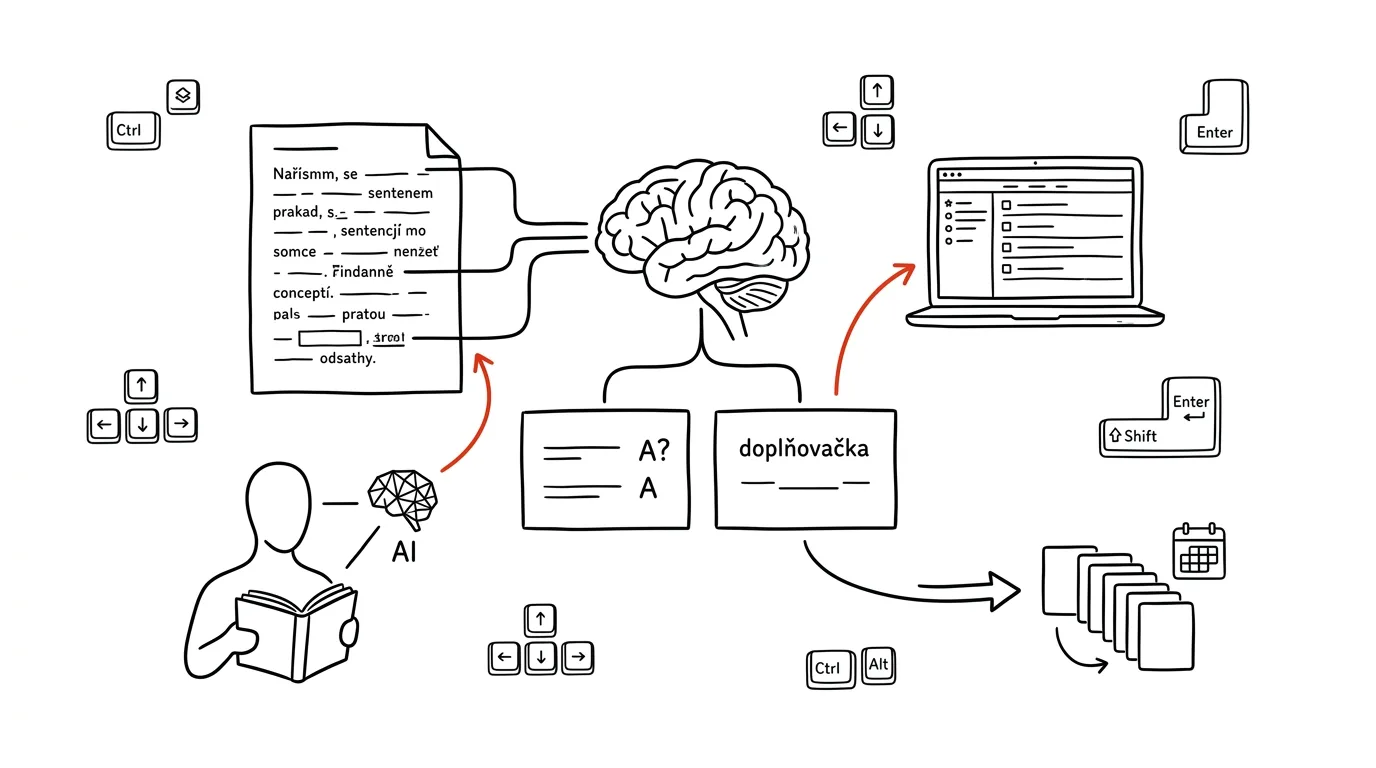
Reading your notes for the fourth time is the most pleasant and least effective way to study there is. It feels good while you're doing it — the text is familiar, everything makes sense — and then the next day, called up to the board, you find out that familiarity and knowledge are two different things. Flashcards cancel out that illusion: either you remember, or you don't, and you find out immediately.
This guide rests on one sentence: a flashcard isn't a note, it's a question you have to recall. Nine out of ten people who say flashcards “don't work” for them have a deck full of textbook paragraphs pasted onto the back of the card. AI speeds this work up tenfold — but only if you tell it exactly what a good card looks like. Otherwise it'll hand you a hundred beautifully formatted cards that are impossible to actually learn from.
This guide moves through phases: why spaced repetition works and how many cards you can realistically handle per day, how to tell a good card from a bad one (the most important part), building cards from your own notes, cloze deletions, images and mnemonics, importing into Anki, and finally two modes — a last-minute crunch before a test and a year-round routine. Just copy the prompts and fill in the brackets. It builds on the basic tip Anki: spaced repetition and on spaced learning.
A typical scenario
Adéla is a junior at a gymnázium, taking biology, history, and German — three subjects where you simply have to memorize things. Her routine so far: read her notes the night before a test, once more on the bus in the morning, and in class she remembers about two-thirds of it. Grades hovering around a C, a nagging feeling of “I'm studying constantly and I still don't know it,” and worst of all: a month later none of it sticks, so before the next quarterly test she's learning everything again from zero.
The new approach takes more work up front and much less afterward. After every biology class she photographs her notes, has fifteen to twenty flashcards generated from them following rules saved as a ready-made prompt, spends fifteen minutes reviewing and fixing them (she doesn't delegate that part — it's exactly where she discovers what she doesn't understand), and imports them into Anki. Then she spends twenty minutes a day reviewing all her subjects together, mostly on her phone on the bus.
The difference after two months: the night before a test she only reviews the cards flagged as problems, which is twenty minutes, not three hours. Material from October still holds up in January, so the quarterly test is a review, not new learning. And most importantly, she knows exactly what she doesn't know — Anki shows it to her in black and white instead of a vague sense that “I probably know this by now.”
Phase 1: why it works and how many cards you can handle per day
The forgetting curve in three sentences
When you learn something new and then don't touch it again, that knowledge fades fastest on the very first day and progressively more slowly after that. If you measured how much you remembered over time, you'd get a curve that drops steeply at first and then gradually flattens out — which is why it's called the forgetting curve. This is your brain running normally, not you doing something wrong: information you never return to is, as far as your brain can tell, obviously not needed.
The trick is that every review flattens that curve. After the first review you remember the material a bit longer, after the second even longer, after the fourth, months — so the number of reviews it takes to make something stick until exam day is surprisingly small, it just has to be spread out. Five reviews in one evening gets you one solid evening's worth of memory. Five reviews spread across six weeks gets you a year.
All Anki does is run that math for you. After every card you rate how hard it was, and the algorithm schedules the next encounter — a week out, a month out, half a year out for things you're solid on, tomorrow for anything you hesitated on. You're not deciding what to review; you just sit down and work through whatever the app serves up.
The two mechanisms driving this
Spacing is only half the story. The other half is active recall: the act of retrieving a memory strengthens it far more than rereading it does. That's why a flashcard beats reading the answer — and why the habit that kills flashcards is flipping the card before you've actually recalled anything. That uncomfortable pause, when the answer won't quite come to you, is exactly the moment you're learning. More on this in the tip active recall.
That gives us the one rule for the rest of this guide: you have to be able to answer a card from memory within a few seconds. If the answer can be expanded on, explained further, or taken off on tangents, it's not a flashcard — it's an essay question, and those are studied a different way.
The budget: how many cards you can realistically handle per day
The fastest way to make yourself hate flashcards: import eight hundred cards at once and discover the next day that review took an hour and a half. Rule of thumb: for every new card you add per day, budget roughly eight to ten reviews a day once things settle into a steady state. Twenty new cards a day settles, after a few weeks, into a review queue of roughly one hundred fifty to two hundred cards, which for well-written cards is twenty to thirty minutes. Fifty new cards a day is already an hour a day, and nobody keeps that up long-term — so work out your budget before you start dumping cards into a deck:
I'm about to study [subject] using flashcards in Anki, and I want
to work out whether my plan is actually realistic.

Inputs:
- The exam or test is on [date], today is [date].
- The material I need to know: [e.g. 12 chapters, 40 pages
  of notes total / list of topics].
- I estimate that's about [200] cards, but feel free to
  challenge the number.
- I realistically have [20] minutes a day for review, [40]
  on weekends.
- I'm also studying [other subjects] at the same time.

Work out for me:
1. How many new cards a day I need to add so I've introduced
   all of them at least [10] days before the deadline.
2. How many minutes a day this will cost me in week one, week
   two, and week four, assuming roughly 8 reviews per new card.
3. Whether this fits my daily limit. If not, tell me specifically
   what to do: cut cards, start earlier, or postpone part of
   the material.
4. Where the plan has slack for days I don't get to it.

Don't sugarcoat it. If the plan doesn't work out, I want to know
now, not in three weeks.
You'll get a budget in minutes, and usually the unpleasant discovery that you wanted to start too late. The card-count estimate from a range of material is a rough guess — after you've actually worked through the first chapter, recalculate the rest based on reality.
Phase 2: a good card versus a bad card
This is the core of the whole guide. Flashcards don't fail because of the algorithm — they fail because of what's written on them. Walk through the four most common failure modes; you'll spot them in AI-generated cards too.
Failure 1: the card is actually a note
WRONG
Front: Mitochondria
Back: Mitochondria are double-membrane organelles in eukaryotic
cells involved in cellular respiration. The inner membrane is
folded into cristae, and inside is the matrix with its own DNA
and ribosomes. The Krebs cycle and the electron transport chain
take place here, producing ATP. According to the endosymbiotic
theory, they arose from an engulfed bacterium.
There's no answer you could actually recall for this card — it's a paragraph. You flip it, read it, nod, and learn nothing.
RIGHT (broken into atomic cards)
How many membranes does a mitochondrion have? → two
What are the folds of the inner mitochondrial membrane called?
→ cristae
What molecule is the main product of the mitochondrion? → ATP
Which cycle takes place in the mitochondrial matrix? → the Krebs
cycle
According to which theory did mitochondria arise? →
the endosymbiotic theory
What's unusual about mitochondrial DNA compared to nuclear DNA?
→ it's circular, it's the organelle's own, and it's inherited
from the mother
Six cards instead of one. It sounds like more work, but you'll blow through all six in thirty seconds combined, and you'll see exactly which one trips you up. One card = one piece of information. This is called atomicity, and it's the single most important rule in the whole field.
Failure 2: the question is vague
WRONG
Front: What's important about Charles IV?
Front: The French Revolution
Front: Explain photosynthesis
There's no correct answer to “what's important,” so you'll always end up agreeing with yourself. A question needs one answer, and you need to be able to tell when you've gotten it right.
RIGHT
In what year was Charles IV crowned Holy Roman Emperor? → 1355
Which university did Charles IV found, and in what year? →
Charles University in Prague, 1348
What event started the French Revolution, and exactly when?
→ the storming of the Bastille, July 14, 1789
What two inputs does the light-dependent phase of photosynthesis
need? → water and light energy
What's the output of the light-dependent phase of photosynthesis?
→ ATP, NADPH, and oxygen
Failure 3: passive phrasing that only tests recognition
The card “1348? → the founding of Charles University” looks fine, but it only trains you to recognize a date. On the test you need the opposite direction: you see a question about the university and have to recall the year. Phrase your cards in the direction you'll actually need them, and if you need both directions, make two cards (Anki has a note type built for two-way cards — use it deliberately, not for everything). You can spot active phrasing by the verb: “list,” “write the formula,” “translate,” “identify,” “calculate” are better openers than “what is” and “describe.”
Failure 4: a list crammed onto one card
WRONG
Front: List all the kings of the Přemyslid dynasty
Back: Vratislav II, Vladislav II, Přemysl Otakar I,
Wenceslaus I, Přemysl Otakar II, Wenceslaus II, Wenceslaus III
You'll never recall all seven items on a list like this, so you'll keep rating the card a failure and Anki will keep shoving it back at you. Lists get learned differently: through cloze deletions (Phase 4), through questions tied to individual items (“Which Přemyslid king was the first to hold a hereditary royal title?”), or through a mnemonic.
Prompt: auditing your existing deck
If you already have some cards, get them checked against the rules above before you add any more:
You're an expert in writing flashcards for spaced repetition in
Anki. Below is my existing deck for [subject], in the format
question; answer, one per line.

[paste your cards]

Go through them and write a verdict for EACH ONE against these
rules:
- one card = one piece of information (no paragraphs or lists),
- the question has exactly one correct answer,
- the answer can be said from memory in under 5 seconds,
- the question is phrased actively (list, identify, calculate),
  not "what is",
- the direction of the question matches how I'll need the
  material on the test,
- no two cards are similar enough to be confused with each other.

Output as a table: number | verdict (OK / REWRITE / SPLIT /
DELETE) | what's specifically wrong | proposed new version.
For cards marked for splitting, write out all the resulting cards.
Don't add anything beyond what's already in my cards.
You'll get back a list where usually about half the cards need rewriting — normal for a first deck. It sometimes overdoes the splitting and turns one perfectly reasonable card into five trivial ones; cards with the answer “yes” or something completely obvious, just delete outright.
Phase 3: cards from your own notes and from the textbook
The basic generator: from notes to deck
This is the prompt you'll use most often. Save it in your notes or in a project so you don't have to retype it.
You're an expert in writing flashcards for spaced repetition.
From the text below, produce flashcards for Anki for [a high
school student, subject: history, junior year].

TEXT:
[paste your class notes or a chapter]

Rules you must follow:
1. One card = one piece of information. Never a paragraph on
   the back.
2. The answer must be sayable from memory in under 5 seconds,
   ideally 1-5 words.
3. The question must have exactly one unambiguous answer.
4. Use active phrasing: list, identify, calculate, translate.
5. Don't add anything that isn't in the text. If the text only
   mentions a term without explaining it, don't make a card
   for it.
6. Avoid pairs of cards that are easy to mix up with each other.
7. Skip anything that's obviously common knowledge.

Output format: a plain list of lines, question;answer
No numbering, no headings, no intro or summary.
At the end, after a separator line, write:
- what you left out of the text and why,
- which passages don't lend themselves to flashcards and are
  better learned through a connected explanation.
You'll get back fifteen to thirty cards from a single chapter. Don't skip the last block of the prompt — the list of what got left out flags the material that can't be learned through flashcards (connections, causes, processes), and you're better off having it explained and then narrating it out loud in your own words.
And a hard rule that can't be dropped from this workflow: go through the generated cards line by line before you import them. The model occasionally adds a claim that wasn't in your notes, and learning something wrong is worse than not learning it at all — and crucially, that review is itself a form of studying: you'll spot which question you don't understand before you even start drilling it.
From a photo of your notebook or textbook
Your phone can handle the scanning, and the models can read handwriting — even your own illegible version. The process: photograph the pages straight-on in good light, upload them to the chat, and add this prompt.
I'm attaching [4] photos of my handwritten notes from [subject],
topic [topic]. The handwriting is illegible in places.

Work in two steps:
1. First, transcribe the content of the pages into text exactly
   as you read it. Where you're not sure about a word or a
   number, write [?] and your best guess in parentheses. Don't
   fill anything in from your own knowledge, even if it would
   make sense.
2. Wait for me to confirm the transcript is correct.

Only then turn the transcript into flashcards following the
rules: one piece of information per card, answer under 5
seconds, active phrasing, format question;answer per line,
nothing extra.
The two-step process is there because of numbers. In handwriting, 1 and 7 get confused most often, along with 3 and 8 and diacritics — and a date or a constant's value that you learn wrong is worse than a gap. Compare the transcript against your notebook, and only then let it generate the cards.
Coverage check: is anything missing?
A deck built chapter by chapter tends to have holes exactly where you missed class. You can check this against your topic list:
Here's the official list of topics for the [test / end-of-term
exam] in [subject]:

[paste the topics]

And here's the list of questions from my flashcard deck (fronts
only):

[paste the questions]

Do a coverage analysis:
1. For each topic, note how many of my cards relate to it.
2. Flag topics I have no coverage for, or only one or two cards.
3. Flag topics where I have unnecessarily many cards because
   they overlap.
4. For uncovered topics, note what types of questions are
   missing — but don't invent the cards yourself, you don't
   have my source material for that.

Output as a table: topic | card count | status | what to add.
You'll get a map of the gaps. Point 4 is deliberately limited — cards for a topic you don't have notes on don't get made up out of the model's head, they get made from the textbook. Given unfamiliar material, a model will invent plausible-looking details, and you'll then drill them with real enthusiasm.
Phase 4: cloze deletions, images, and mnemonics
Cloze deletions: when a sentence only makes sense as a whole
A cloze card is one where a word gets removed from a sentence and you fill it in. It's a good fit wherever a question-and-answer format would feel forced: definitions, formulas, dates in context, and lists that can't be recalled all at once. In Anki, a cloze deletion is written with a tag inside the sentence, and one sentence can carry several deletions — each one becomes its own card:
Photosynthesis takes place in the {{c1::chloroplasts}}, and its
product is {{c2::glucose}} and {{c3::oxygen}}.
This one line produces three cards. The rule is the same as for ordinary cards: delete at most three to four things per sentence, or you'll be left with a sentence so stripped of context that nothing can be inferred from it.
Turn the text below into cloze flashcards for Anki.

TEXT:
[paste definitions, formulas, or a passage]

Rules:
- Even after deletion, the sentence must retain enough context
  that exactly one correct answer exists.
- Maximum 3 deletions per sentence, each a different number.
- Delete load-bearing words (terms, numbers, names), not
  conjunctions and prepositions.
- For lists, make one sentence with deletions across successive
  items, not one card for the entire list.
- Don't rephrase my material more than necessary.

Format: each cloze on its own line, Anki syntax with curly
braces and c1, c2, c3. Nothing else.
You'll get lines ready to import. Check whether the rest of the sentence gives away the answer — most often this happens when a synonym of the deleted word is left sitting right there.
Image cards: diagrams, maps, graphs
Biology, geography, and chemistry are poorly served by text alone, because the exam tests the picture: describe the structure of a cell, point out a mountain range, recognize a structural formula. The strongest technique here is called image occlusion — you place little rectangles over the labels on a diagram, and the card asks what's hiding underneath. Newer versions of Anki support this natively. AI can't occlude the image for you, but it can do the other half of the work: break the diagram down into a list of labels and tell you which ones are worth occluding.
I'm attaching an image [a plant cell diagram / a blank map of
Europe / a reaction progress graph] from a [subject] textbook.

1. List every label and element you see in the image, from
   most important to minor. Where a label is illegible, write
   [illegible] instead of guessing.
2. Suggest which of them are worth occluding as flashcards and
   which are unnecessary detail.
3. For each element you'd occlude, write a follow-up question
   about its function or meaning, not just its name — for
   example "what happens in this part."
4. Suggest 3 questions that test relationships between elements
   in the image, since occlusion alone won't produce those.

Don't make anything up. Whatever isn't in the image doesn't
belong on the list.
You'll get a list you can click through in Anki's occlusion editor in a few minutes, plus function questions — by far the most common thing you'll get asked when quizzed in class. With maps, watch out on point 1 — models sometimes add a country or a river that isn't actually on your specific map.
Custom mnemonics
Some things don't have a logic you can understand your way into — the order of the planets, exceptions to spelling rules, the signs of trigonometric functions in each quadrant. That's what mnemonics are for, and AI is surprisingly good at generating them, because it's fundamentally a wordplay task. Three types are worth knowing: an acronym (first letters strung into a sentence), a story (items woven into an absurd little scene, because absurdity sticks in memory better than sense does), and a memory palace (items placed at locations along a route you know by heart — say, from your room to the kitchen — that you walk through when recalling them).
I need to memorize this list [in exact order / regardless of
order]:

[paste the list]

Context: I'm a high school student, subject [subject].
Give me three different mnemonics:

1. ACRONYM: a sentence in English where the first letters of
   the words match the items in order. The sentence must be
   meaningful and easy to remember, not a random jumble of words.
2. STORY: a short absurd scene (max 6 sentences) in which the
   items appear in order. For each one, note what image
   represents it.
3. MEMORY PALACE: place the items at [8] locations along the
   route [from my room to the kitchen], and for each one write
   a vivid, exaggeratedly specific scene.

For each variant, note who it suits and where its weak point is.
No foreign languages, no profanity.
You'll get three variants, one of which usually clicks. For acronyms, check them letter by letter — models slip up here and produce a sentence whose order doesn't actually match. And a mnemonic is a crutch for a list, not a substitute for understanding: you'll remember the order of the planets, but the sentence won't tell you why the inner planets are rocky.
Phase 5: importing into Anki without the headache
Format: why a semicolon
Anki can import a plain text file with one card per line, where fields are separated by a single consistent character — a semicolon, a tab, or a comma. A comma is the worst choice, since it shows up naturally in answers and splits the card into pieces; stick with a semicolon. Save the file with a .csv or .txt extension in UTF-8 encoding, or you'll end up importing garbled characters nobody wants to see. Newer versions of Anki read header lines that state the separator and target deck up front:
#separator:semicolon
#deck:Biology::Cell
How many membranes does a mitochondrion have?;two
What are the folds of the inner mitochondrial membrane
called?;cristae
What molecule is the main product of the mitochondrion?;ATP
The import is then one click away: choose file import in Anki, check the preview (Anki shows you how it split the fields), and confirm. If the preview looks scrambled, the fault is almost always the separator, or an answer that happens to contain a semicolon.
Prompt for output ready to import
The easiest approach is to have the output produced so it doesn't need any editing at all:
Take the cards below and prepare them as a file ready to import
into Anki.

[paste your cards, or have them generated by the previous prompt]

Format requirements:
- first line: header with a semicolon separator
- second line: target deck [History::Modern Era]
- then one line per card, in the form question;answer
- if a semicolon shows up in the card text, replace it with a
  comma or a dash so the import doesn't break
- no quotes around fields, no numbering, no blank lines
- keep all accents and special characters, don't strip them
- don't comment on anything at the end, I want the raw file
  content

Finally, in a separate message, tell me how to save the file as
UTF-8 and how to import it into Anki.
You'll get content you can paste into a text editor and save. Final check before importing: the line count matches the card count, and no line contains two semicolons.
When the import breaks
Three failure modes cover almost every case. Garbled accents mean the wrong encoding — resave the file as UTF-8. Cards fused into one mean the separator wasn't recognized correctly — check the header and the settings in the import dialog. Duplicate cards Anki usually flags on its own; when re-importing the same material, set it to update existing cards instead of adding new ones. And turn on syncing through AnkiWeb right from the start — that way you have the same cards on your computer and your phone, and a broken phone doesn't wipe out six months of work.
Phase 6: two modes — crunch time and year-round
The “test in four days” mode
Spaced repetition over four days doesn't work the way it's supposed to — but flashcards are still the best way to find out what you don't know, so you're not wasting time on what you already do. In practice: only make cards for what will actually show up on the test (based on the topic list, not the whole textbook), raise your daily new-card limit so you can introduce them all within two days, and spend the rest of the time reviewing; a filtered deck comes in handy here, pulling cards for practice outside the normal schedule. And the day before the test, only study the cards you're failing — leave everything else alone.
I have a test in [4] days on [subject], topics are [paste
the topics].
I have a deck of [180] cards, and according to Anki:
- [40] cards I know solidly (long intervals)
- [90] cards are still in progress
- [50] cards I haven't introduced yet

I have [60] minutes a day to study, [90] the day before the test.

Suggest a plan for these 4 days:
- how many cards, and which ones, to go through each day,
- when to introduce new cards and when to switch to review only,
- what to do the evening before the test and the morning of,
- what's better to give up on if it turns out I can't keep up —
  specifically, which topics have the best ratio of points to
  time.

Keep in mind that flashcards won't cover question types that
require explaining or calculating something. Tell me how much
time to leave for that and how to practice it.
You'll get a four-day plan, including unpleasant but correct advice on what to sacrifice. That last paragraph of the prompt is there because flashcards tempt you into a single mode of studying — and for calculations and open-ended questions, they won't save you on their own.
The year-round mode
Long-term, the routine looks different, and it's more comfortable: twenty minutes a day, new material added continuously as classes happen, and no big cramming session before a test — just a check. Three habits hold this together. Make cards right after class, not before a test — your notes are fresh, you know what the teacher emphasized, and it takes fifteen minutes; a deck for an entire semester built all at once is a weekend's worth of work, and nobody ever actually does it. Attach review to an existing routine (the commute to school, the lunch line, after dinner) — Anki on your phone works offline too, and anything without a fixed slot gets skipped. And prune the deck once a month: delete trivial cards, and rewrite the ones that keep failing (Anki calls these leeches) — the problem is almost always the card, not your memory.
Here are my flashcards that keep failing repeatedly in Anki —
Anki flagged them as leeches after [8] failed attempts:

[paste the cards with their answers]

For each one, figure out why it won't stick. Pick from these
causes:
a) the card is too complex, it should be split into several cards
b) the question is ambiguous, it can be answered more than one way
c) I keep confusing it with another similar card (name which one)
d) I'm missing context, I need to understand the connection first
e) it's just a dry fact with nothing to hang it on, it needs
   a mnemonic
f) the card is unnecessary, I can delete it

For causes a-c, write out the corrected version of the card
directly.
For cause d, tell me what I need to have explained before
memorizing it.
For cause e, suggest a specific mnemonic.

Format: original card | cause | what to do about it.
You'll get back exactly what you'd never figure out on your own — the most common finding is a confusable pair of cards. When two cards get mixed up, it usually helps to add distinguishing context to the question (“in biology,” “in mammals”) instead of fighting your own memory.
The most common mistakes
- Cards from someone else's deck. A downloaded deck is written in different words, for a different textbook, and for a different test — and you lose half the learning value, which is writing the question yourself. This only makes sense for content that's the same everywhere (vocabulary, chemical symbols, dates), and even then, throw out whatever doesn't match your material.
- Cards you never open. Building a deck feels satisfying and looks like work; without daily review it's just a well-organized list. If you know you won't keep up with review, study a different way instead.
- Flipping the card before you recall the answer. That uncomfortable pause is the effective part. Flip it right away and you're doing slow reading with a nicer interface.
- Rating a card “easy” out of politeness. If you hesitated, it was a hard card. False-positive ratings push the next review two months out, and you won't see that card again before your test.
- Importing AI output without checking it. A generated card with a made-up date gets learned just as thoroughly as a correct one — and by the time you catch the mistake, it'll be locked in. Checking before import isn't optional.
- Flashcards as your only method. They'll teach you facts and terminology. They won't teach you to explain a process, work through a problem, or write an argument. For those you need talking things through out loud, working problems, and writing — flashcards complement those, they don't replace them.
The best tools
- Anki — the spaced-repetition engine itself: free on desktop, syncing through AnkiWeb, a mobile version for studying on the go. Supports both cloze deletions and image occlusion.
- Claude — generating and, more importantly, auditing flashcards from your notes, reading photos of your notebook including handwriting, mnemonics, and analyzing cards that keep failing.
- NotebookLM — when you want cards built exclusively from your own material: it only answers from the sources you upload, so it won't invent material you haven't actually covered. More in the tip your own sources.
- A phone with a camera — the path from notebook to flashcards runs through a photo; the scan handles even crooked handwriting, just double-check the numbers.
- A text editor with UTF-8 support — Notepad, VS Code, anything that saves a file in UTF-8; the only step standing between AI output and import.
What you get out of it
- Time: making cards from a chapter drops from an hour to ten or fifteen minutes including review, and pre-test cramming shrinks by roughly half, because you're not reviewing what you already know cold.
- Quality: atomic cards with active phrasing get learned noticeably faster than paragraphs on the back — you'll see the difference in how many cards you get through in twenty minutes.
- Calm: the night before a test stops being a last chance and becomes a check.
- Durability: material from the fall still holds up in the spring, so a quarterly test isn't new learning. Across your final-exam subjects, that adds up to a whole year of work saved.
Pro tip
Once your deck is up and running, add a habit that costs two minutes and doubles what you get out of your cards: after every review session, take three cards you got wrong today and explain out loud why the answer is what it is. Not the answer — the reason. A flashcard tests whether the fact is in your head; the explanation reveals whether you understand it, and that's exactly what you get asked when you're quizzed in class. If you can't put the explanation together, you've found your next topic for explaining material with AI.
And the closing rule that governs the whole guide: AI proposes the cards, you approve them. No sentence you haven't read should make it into your deck — partly because the model sometimes adds a fact that wasn't in your notes, and partly because that review is the cheapest studying you'll get for free anywhere in the whole process.
Want to go deeper? The handbook has a whole chapter on it — AI and automation.
Similar tips
From a meeting recording to notes with tasks in a minute
A complete guide with prompts: from recording consent through cleaning up the transcript to notes that separate decisions from discussion, list tasks with who-what-deadline, and admit what's still open.
Meetings that write themselves up — down to the tasks in your task list
A complete guide with prompts for a fully automatic chain: recording and transcription, extracting who-what-deadline tasks, creating them in your task list through a connector, a searchable archive of decisions, and the rules you shouldn't turn this on without.
Claude Code: a personal automation engine, not just for developers
A complete guide with prompts: installation, the first half hour, five typical tasks (cleaning up folders, bulk renaming, extracting data from PDFs, reports, running a website), CLAUDE.md as permanent instructions, and safety rules. Case study: this is how this website gets made.
Liked this tip?
I send one like it every week by email. Two minutes to read, hours saved.
1 tip a week · no spam · unsubscribe in one click