Tips & tricks · AI · Everywhere · ~a whole afternoon of planning
A custom travel itinerary: day by day, without hours of planning
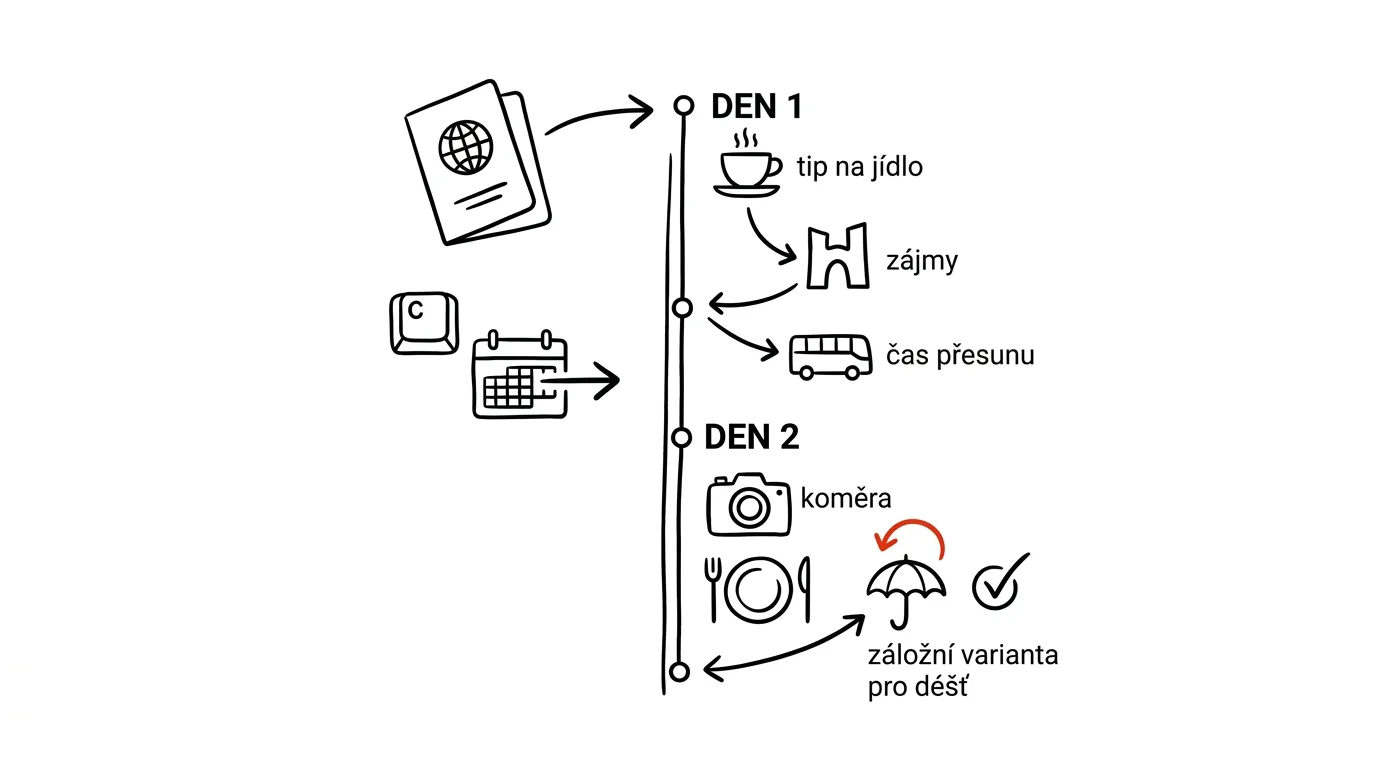
Trip planning is fun for about twenty minutes. Then come fifteen open tabs, three blogs with contradictory recommendations, a map where you can't quite picture how far apart those points actually are — and two hours later you have a list of places, but still no plan. A list of places is something anyone can generate. A plan is something else: it has an order, it has transfers, and above all it has an awareness of what won't fit into the day.
AI can handle this part in a few minutes: it builds a skeleton laid out by day, in which the transfers make geographic sense and you can see exactly when a day is going to overflow. But a skeleton isn't a timetable and must never be mistaken for one. Opening hours, ticket prices, connections, and reservations are all data that changes and that the model sometimes makes up — which is why this guide devotes an entire phase to what you have to verify at the source. The rest is work nobody enjoys doing, and that you no longer have to do.
The guide is built so you go through it in the order a trip actually gets planned: first the brief with constraints, then the skeleton, then backups and reservations, then verification, and finally things for the road. Every phase has copy-paste prompts — just fill in the brackets. The last two phases are worth reading even if you already have a plan: the difference between an itinerary sitting in a conversation and an itinerary on your phone with no signal turns out to matter a lot once you're actually there.
A typical scenario
Sarah is a student heading to Lisbon for five days in September with a classmate, with a budget of roughly 12,000 Kč for local spending — about 2,400 Kč a day for food, admission, and transport combined. She wants to see the city, not check it off a list: one museum and an hour in a café over three sights in a day. She'd already planned two evenings herself; the rest was up in the air. Her previous trip took three afternoons to plan and she still ended up walking clear across Copenhagen every day for no reason.
This time she starts with a brief that isn't just a destination. She writes the dates, the address of her lodging in Alfama, a pace of “relaxed, at most two bigger things a day, nothing before nine in the morning,” her interests (architecture, food, views), a daily budget, and one hard constraint: on day four there's a concert at six in the evening that the rest of the plan has to be built around. Two minutes later she has five days broken into half-day blocks, each transfer with an estimated time and mode of travel, and two food recommendations per day at her price level.
The first version crams day three with a trip to Sintra plus half of Belém, so she writes “day three is too packed, cut it in half and move Belém to day five.” The second version fits. Then she has it add three things she wouldn't have thought of herself: an indoor alternative in the same neighborhood for each outdoor block in case of rain, a list of everything that needs booking and how far ahead, and a packing list derived from what's actually in the plan. Verifying opening hours and making the reservations took her an hour — the only hour she actually spent on planning. In the end she shared the itinerary as a single page she can open on her phone without signal, and her mom read it back home too.
Phase 1: a brief with constraints
Ninety percent of the difference between a usable itinerary and a useless one is in the brief. “Plan my Lisbon trip” returns the same list you'd find in any article — because you haven't told the model anything else, and it has no way of knowing you're traveling with a seven-year-old, that your knees are recovering from surgery, or that you don't care about a single museum but won't skip the markets for anything.
A plan is built from constraints, not interests. Interests say what you'd enjoy; constraints say what fits into a day. And constraints are exactly what people forget to write down.
Seven things the brief must include
Dates and length. Not just “five days” but actual dates — the season decides opening hours, weather, and whether you can sit outside in the evening. Factor in when you actually land and take off: a day with a six a.m. flight isn't a full day.
Who's traveling. Number of people, children's ages, mobility, stamina. “Two adults” and “two adults and an eighty-year-old grandmother” are two different trips through the same city. For kids, write the age in years, not “young kids” — a plan for a three-year-old and a plan for a nine-year-old have almost nothing in common.
Where you're staying. An address, or at least a neighborhood. Without it, the plan will send you across town every single day, and you won't find out until you're there.
Budget, and what it covers. An amount per person per day, and crucially what it's meant to cover: just food and admission, or transport and lodging too? A budget set up front keeps the plan at the price level you actually want.
Pace. How many “bigger things” a day, whether you want an afternoon break, when you get up, whether it's fine to plan an evening program. This is the one thing travel articles have no way of knowing about you — and exactly why they're useless for this.
Interests — and anti-interests. Write down what you don't want too. “No churches,” “no shopping malls,” “nothing with a line longer than twenty minutes” saves half your iterations.
Fixed points. A concert, a wedding, a meeting, visiting relatives, a booked restaurant, arrival and departure times. The plan gets built around these, not the other way around.
Plan a trip to [destination] for [number] days, dates [start
date—end date]. Don't give me a list of sights, I want a day-by-day
plan.

Who's traveling: [e.g. 2 adults (32 and 34) and kids aged 5 and 9]
Where we're staying: [neighborhood / address / name of lodging]
Getting around: [public transit / car / on foot, how much we're
willing to walk per day]
Budget: [amount] per person per day, covering [food, admission,
local transport]
Pace: [max 2 bigger things a day, afternoon break 1—3 pm, nothing
before 9 am, evenings dinner at most]
Interests: [architecture, food, views, markets]
What we don't want: [long lines, shopping malls, anything not
stroller-friendly]
Fixed points: [day 4 at 6 pm concert downtown; arrival day 1 at
2 pm, departure last day at 11 am]

Before you start planning, do two things:
1. Repeat back in your own words which constraints you understood.
2. Write 5 questions that, if I answered them, would make the plan
   noticeably more precise.

Only then, once I've answered, propose the plan.
It returns a summary of the constraints and some questions — and that's the whole point. It typically asks about things you hadn't considered: whether the last day should be kept free for packing, whether you want one day outside the city, whether it should build in real time for lunch or assume you'll eat on the go. When something in the constraint summary is off, correct it right away; a brief the model misunderstood produces a plan you'll end up rewriting from scratch.
How much actually fits into a day
Most homemade plans are overstuffed because people count the time at each place and forget the time between them. A useful rule of thumb: a day in a city can absorb roughly six to eight hours of active program, but one to two hours of that go to transfers and waiting — and with kids or seniors it's considerably less. Have it run the numbers before you accept the plan.
Here's my plan for [day X]:

[paste the day's plan]

Calculate it realistically:
- how many hours the program itself takes (excluding transfers)
- how many hours of transfers between points, noting for each what
  mode of transport and how long
- how much time is left for food, breaks, and unexpected delays
- what time this plan would have me back at my lodging in the evening

Then give a verdict: is this day realistic for [who's traveling and
at what pace]?
If not, say exactly what to cut so the point of the day survives.
Don't phrase it as a suggestion — phrase it as a cut: what goes.
It returns a time budget for the day and, more often than not, a verdict of “doesn't fit.” Treat the transfer-time estimates as approximate — they're usually close for public transit and walking routes, but not reliable for rush-hour driving or train and ferry schedules; verify those with the carrier, see phase 5.
Phase 2: a day-by-day itinerary
This is where the actual plan gets built. The key is to request a specific format: without it you'll get a wall of prose that's hard to cut down and impossible to carry on your phone.
A skeleton in half-days with transfer times
Based on the brief and answers above, build a day-by-day itinerary.

Format for each day:
### Day [number] — [date], [the day's theme in one sentence]
- Morning: [what, where, how much time]
- Transfer: [from where to where, by what, how many minutes]
- Afternoon: [what, where, how much time]
- Transfer: [from where to where, by what, how many minutes]
- Evening: [what, where]
- Food: 2 tips at our price level, each with neighborhood and what
  it is
- Bonus if there's time left: [1 nearby thing]
- Estimated spend for the day: [amount per person, broken into
  admission / food / transport]

Rules:
- Points within one day must be close to each other. Never send me
  from one end of the city to the other and back.
- Respect the fixed points; build the rest of the day around them.
- Leave at least 90 unscheduled minutes in every day.
- For each point, note whether it's suited to rain (indoor /
  outdoor / mixed).
- Don't make anything up. If you're not sure a place exists or is
  open, say so instead of guessing.

At the end, give a list of everything that needs verifying or
booking.
It returns a structured plan you can actually work with. Keep an eye on two things right away: the “indoor/outdoor” tag on each point is the foundation for the plan B in phase 3, and the spending estimates are rough — the model doesn't know current prices, so treat them as an order of magnitude and verify the key items on the venue's own website.
A geography check: where the plan is traveling for no reason
The most common mistake in generated itineraries is a day that's “fun but sprawling.” A simple test: have it regroup the points by neighborhood and see what comes out.
Take my whole itinerary and regroup it purely by geography:
1. Cluster all the places by neighborhood or area.
2. For each cluster, note how long it would take to see it in full.
3. Show me which points are currently on a different day than they
   geographically should be — and how many extra minutes a day
   that's costing me.
4. Propose a regrouped version where each day = one or two
   neighboring clusters, keeping my fixed points intact.

Give me a comparison: total transfer minutes in the original versus
the new version.
It returns a version that often saves an hour a day. Don't accept it mechanically, though — a plan where every day is “efficient” can be boring, and some transfers are worth it (a view, a tram ride, a neighborhood you just want to walk through). That call is yours.
Iterate — don't start over
The first version is raw material. The mistake most people make when they don't like the plan is writing a new, long prompt from scratch — and losing all the context in the process. It's faster to have a conversation; see talk to AI, don't shoot blind.
Adjust the plan, leave the other days unchanged:
- Day 3 is too packed — keep it to two things at most, and make
  sure there's a relaxed lunch.
- Drop [place] entirely, we don't want to go there.
- Add a half-day outside the city, ideally within 60 minutes by
  train.
- Leave evenings 2 and 4 completely free, we don't want the whole
  vacation scheduled into the night.
- Cut the spend: nothing with admission over [amount] per person —
  propose a cheaper alternative that serves the same purpose.

Give me the whole itinerary again in the same format, and above it
a short list of exactly what you changed.
The list of changes at the end matters more than it looks — without it you'll lose track of which version is current by the fifth iteration. If the plan starts drifting into nonsense, go back to the last good version by pasting it in again as the starting point.
A budget check for the whole trip
Here's the full itinerary:

[paste the itinerary]

Put together a budget for the trip for [number of people]:
- break it down by day: admission, food, local transport, other
- list one-time items separately (airport transfers, day passes,
  trips outside the city)
- add it all up and compare it to my limit of [amount]
- if I'm over, propose 5 specific cuts ranked from least to most
  painful

For every price, say whether you're estimating it or whether I
should verify it. Don't present anything as a current price —
prices change and you don't know them.
It returns a budget that's usable as a skeleton, not as an actual calculation. The last paragraph of the prompt is there on purpose: models will happily state a specific admission price that's two years out of date. Verify the important items — the few most expensive admissions and any multi-day passes will decide the budget more than everything else combined.
Phase 3: a plan B for weather and unexpected setbacks
This is the phase nobody writes for themselves when planning — and the one that decides, once you're there, whether a rainy day means improvising under an awning or just turns into a different, equally nice day. It takes five minutes and uses information you already requested in the skeleton: the “indoor / outdoor” tag on every point.
An indoor alternative for every outdoor block
For every outdoor point in my itinerary, add a backup option for
rain or extreme heat.

Requirements for the alternative:
- must be in the same neighborhood or at most 15 minutes from the
  original point
- must be indoors and open on the day I'd be there
- must take roughly the same amount of time as the original point
- must be at the same price level

Format: day | original point | replacement | how to get there from
the original spot | why this replacement makes sense.

At the end, tell me which days are the most weather-sensitive and
which ones I should swap with each other if the forecast turns bad.
The last paragraph is the valuable part. Once you know day three is entirely outdoors and day five entirely indoors, checking the forecast the night before and swapping the days is enough to get a vacation the rain barely touches.
What to do when something falls through
It's not just about weather. A museum closed for a public holiday, a transit strike, a sick kid, a delayed train. All of it can be prepared for in advance with one prompt — but it's even better to have it on hand while you're out there.
I'm at [place], it's [time], and [what happened: the museum is
closed / it's raining / the subway isn't running / we're feeling
sick from the heat].

My plan for the rest of the day was:
[paste the rest of the day]

Suggest 3 alternatives:
A) something similar nearby, so the day stays in the same spirit
B) a low-key option — a café, a park, something with no walking
C) reshuffling the schedule: what from the following days could get
   moved up so the rest of the trip doesn't collapse

For each option, note how far it is from here and how to get there.
Then tell me what I should verify right now, before heading over.
Treat this as an emergency prompt for your phone, not as prep — it's meant for the moment you're standing in front of a locked door. The last line matters: before you cross town, confirm the destination is actually open, ideally by phone.
Phase 4: a booking checklist with deadlines
The most expensive mistakes on a trip aren't bad decisions — they're missed deadlines. Tickets to a popular sight sold out three weeks ahead, a restaurant that only takes reservations by phone, a train where you need to buy a seat reservation in advance, a timed entry slot that can't be bought on the spot. All of these are things you can find out in advance — and none of them can be made up for later.
A list of everything that needs arranging ahead of time
Here's my finished itinerary:

[paste the itinerary]

Traveling [start date—end date], [number] people.

Give me a checklist of everything that needs to be arranged before
departure. A table with columns:
what to arrange | why | how far ahead | where it's done (website /
phone / on site) | deadline (specific date) | done

Include:
- timed-entry tickets and anything with limited capacity
- restaurant reservations where those are typically needed
- tickets and seat reservations for trains, ferries, and long-
  distance buses
- day or multi-day transit passes — worth it or not
- insurance, documents, passport validity, visas, any required
  registrations
- car rental, downtown parking, toll roads
- anything on my plan that has a fixed time

Sort by deadline, most urgent first.
For each item, note how I'd confirm it still applies for my
specific dates — those details I need to verify on the official
website.
It returns a list that's typically longer than expected and includes two or three things you would have forgotten. One important warning: deadlines and conditions are the model's estimate, not fact. Use the checklist as a list of questions to answer on official websites — the “how far ahead” column is a guideline, not a commitment. Transfer the deadlines into your calendar as events with reminders — they get forgotten inside a conversation.
Documents and what to print
I'm traveling [date] to [country], [number of people, including
children's ages].
I'm traveling [by plane / by car].

Put together a checklist of documents and things to arrange:
- what I need to carry (ID, confirmations, cards)
- what's worth having printed as well as on my phone, and why
- what I should email myself as a backup
- what I should photograph in case of loss

Write it as a checkable list. For items governed by specific rules
by country or carrier, don't give me a claim — tell me exactly
where to verify it. I don't want binding statements from you about
visas, document validity, or carriage conditions.
Rules about documents, visas, and carriage are exactly the kind of information you can't trust the model with: they change, they differ by citizenship, and a mistake here can cost you the trip. Ask for a list of questions and find the answers on the foreign ministry's and carrier's websites. More on why and how to verify is in the tip fact-checking with AI.
Phase 5: verify at the source
This is the one mandatory step in the whole process, and the one place you must not cut corners on time. Language models state inaccuracies with the same confidence as facts, and opening hours are among the details that change most often — seasonal hours, a weekly closing day, a public holiday, renovations, last entry an hour before closing. A closed museum eats half your day.
The rule is: AI proposes, a human verifies and books. The tool doesn't make the reservation or the payment for you — not even when it technically could.
What to always verify, and what a spot check covers
Always verify: opening hours and last entry for every place you're going to specifically; the existence and terms of any reservation; train, ferry, and long-distance bus schedules; the prices your budget is built on; and anything with a fixed time.
A spot check is enough for things where a mistake is cheap: a café, a park, a viewpoint, a neighborhood to walk through. If the café is closed, you find another one.
Never verify through the model something the venue's own website exists to answer. The question “is this museum open on Mondays?” asked in a chat returns an answer that sounds equally confident whether it's true or not.
Here's my itinerary:

[paste the itinerary]

Build me a verification list. For every place I'm going to
specifically according to the plan, one line:

place name | day and time I'm supposed to be there | exactly what
to verify (opening hours, last entry, reservation needed, price) |
where to verify it (official website, phone, carrier)

Sort by day. Put the 5 places where a mistake is most expensive at
the top — where being closed would cost me half a day or an
excursion.

Don't state opening hours or prices yourself. I want a list to
verify, not answers.
The last line of the prompt is the whole trick: the model tends to just write the opening hours in for you, and you accept them without noticing. Ask for a list of questions instead of answers, and verification takes an hour — an hour after which you can actually trust the plan.
Schedules belong to the carrier
Trains, ferries, boats, long-distance buses, and seasonal connections are the riskiest item in the entire itinerary, because a whole day hangs on them. The model talks about them fluently, but it makes up the route numbers and departure times. Always verify these with the carrier or in an official journey planner — and do it again the day before, because seasonal timetables and service outages change.
When you verify through an AI search tool, ask for a source on every claim and click through the link; the approach is in the tip research with verifiable sources. A link to the official page is information; a claim with no link isn't.
After verifying: write down what changed
The verification pass will almost always change something — a museum is closed on Tuesdays, last entry is earlier than expected, a train only runs in the morning. Those changes have to go back into the plan, or you end up with two itineraries and follow the wrong one.
I verified the opening hours and connections and here's what
doesn't match:

- [Place A] is closed on [day].
- [Place B]'s last entry is at [time], not what I had planned for.
- The train to [place C] only runs at [times], not throughout the
  day.
- [Other finding.]

Rework the itinerary so it reflects these facts. Change as little
of the rest of the plan as possible — I want to see exactly what
shifted because of this.
Give me the whole itinerary again, with a list of changes above it.
Phase 6: three kinds of trips, three different plans
Same process, different priorities. The difference between a family vacation, a city weekend, and a road trip isn't the destination — it's what the plan has to hold up under.
A family vacation with kids
With kids, rhythm decides more than the number of experiences. The plan has to assume you'll head out later in the morning, that afternoon fatigue is coming, and that one bad hour can ruin the whole day. Write ages precisely.
Planning [number] days in [destination] with kids [age and age] and
[number] adults. We're staying [where]. Budget [amount] per day
total.

Build an itinerary that respects a kid's rhythm:
- we head out no earlier than [time], we need a break in the
  afternoon [times]
- at most one “big” thing a day, the rest looser
- for each day, note where there's a playground, a park, or
  somewhere to just sit nearby, and where the public restrooms are
- for each point, note whether it works with [a stroller /
  a tired five-year-old], and roughly how long kids can handle it
- food: places where kids will actually eat, and what to do if they
  refuse a restaurant
- one indoor rain alternative per day

At the end, give me 5 things not to do with kids in [destination],
and why.
The last item is usually the most useful. Treat the stroller-friendliness answers with caution — terrain, stairs, and paving are exactly the kind of detail the model doesn't know; verify them for specific places or in reviews from other parents. Similar logic applies to trips with seniors: instead of children's ages, write mobility, how many kilometers a day is manageable, and whether you need to plan around elevators and frequent breaks.
A city weekend
Two days and a desire to see a lot. Here it's a game of minutes and sequencing, because every unnecessary transfer eats into the little time you have.
I only have [2] days in [city] — arriving [day, time], leaving
[day, time]. Staying [where]. We're [who]. A brisk pace is fine.

Build a plan that makes the most of the time:
- start from the fixed points (arrival, departure) and tell me how
  many hours I actually have
- split the city into 2 areas, one per day, so we're not crossing
  back and forth
- put 3 things into the plan I'd regret missing, and flag them as
  priorities
- for each point, note how many minutes are enough to make it worth
  visiting, and what's visible from outside for free
- where lines tend to form, note what time has the smallest crowds
- an evening program for both days near our lodging

At the end, tell me what I had to sacrifice given the time, and
what would fit if I stayed one more day.
The priority flags are the reason this works: when the day starts slipping, you know what to sacrifice and what not to. Treat the line-time info as approximate — check whether the venue sells timed-entry tickets, since that often solves the line problem entirely.
A road trip
For a car trip, time behind the wheel is the main variable. A plan that looks beautiful on a map can mean five hours a day in the car.
Planning a road trip: [start] — [destination / loop], [number]
days, by car, [who's traveling]. Lodging [booked in advance / as we
go]. At most [3] hours of driving a day, with kids we need a stop
every [90] minutes.

Break the trip into legs:
- each day: from where to where, how many kilometers, how many
  hours of actual driving
- stops along the way: what, where, how much time, why it's worth
  stopping for
- where to sleep each night and why there specifically
- for each leg, note the last sensible spot for gas, food, and
  a break
- how many nights to spend in one place — favor longer stays over
  driving every day

Note separately:
- what I should verify about parking in each town
- where the plan suffers most if I'm running an hour behind

Driving times are your estimate — tell me which stretches I should
verify on a map, since the estimate could be way off there.
Verify the driving-time estimates on a map for the actual day and time; mountain passes, ferries, seasonal closures, and city rush hour can all add hours. And look up rules on highway vignettes, tolls, and low-emission zones on official websites, not in a chat.
Phase 7: the itinerary on the road
A plan you can't get to once you're there isn't a plan. This last phase is about getting it out of the conversation and into your phone, into your travel companions' hands, and into a form that works without signal.
One page you also have offline
The simplest route: have the itinerary rewritten into a single standalone page. In Claude this works as an artifact — a mini app right inside the chat that you open on your phone and share as a link.
Turn my finished itinerary into one clean page I can open on
my phone.

Requirements:
- a summary at the top: dates, lodging with address, emergency
  contacts, reservation numbers (leave these blank, I'll fill them
  in myself)
- then the days one after another, each collapsible
- for each point: name, time, address, how to get there
- outdoor points clearly marked with their rain alternative
- checkboxes for things that get checked off (reservations,
  tickets)
- large, easy-to-read-in-sunlight text, works on mobile
- no outgoing links, has to work with no connection

Keep the text exactly as it is in the itinerary, don't add anything.
It returns a page you save to your phone. Before you leave, open it in airplane mode and confirm it actually shows up — that's the only test that counts. If you prefer notes, have the itinerary rewritten into the format your note-taking app uses and download it for offline reading.
Sharing with family and travel companions
An itinerary usually has two audiences: the people traveling with you, and the people staying home who want to know where you are. Each needs a different version.
Make two condensed versions of my itinerary:

1. For travel companions: what to bring, where and when we're
   meeting up each time, what needs to be on hand and when (tickets,
   documents), and each other's phone numbers. No sightseeing
   descriptions.

2. For family staying home: where we're sleeping each night,
   lodging address and phone number, a one-sentence daily program,
   arrival and departure times, and when we'll likely be
   unreachable.

Make both as short as possible so they fit in a single message.
Don't put reservation numbers or anything else that shouldn't be in
a message into the version for family.
The last line is worth underlining. A travel itinerary is a sensitive document: it reveals when you're not home, who you're traveling with, and flight numbers. Share it with people you trust, and send reservation numbers, codes, and documents by some other channel than a group chat.
Packing based on the forecast and the plan
A packing list derived from what's actually in the itinerary works better than a generic list off the internet — because it knows about the full-day hike as well as the one dinner at a restaurant with a dress code.
Here's my itinerary and here's the weather forecast for
[destination] for [dates], which I looked up myself:

[paste the itinerary]
[paste the forecast: daytime and nighttime temperatures,
precipitation]

Build a packing list for [who's traveling], [number] days.

Split it into: clothing | footwear | electronics | toiletries and
first aid | documents | carry-on | buy there.

Rules:
- base it on what's actually in the plan: where there's a lot of
  walking, where I need to dress up, where I'll be sitting outside
  in the evening
- for each item, note why it's there (which day or weather it's
  for)
- flag what can be bought there in a pinch and what can't
- assume [an 8 kg carry-on / a checked bag]
- no generic advice, only things tied to my specific plan

At the end, give me 5 things people most often forget for this kind
of trip.
Enter the forecast by hand from a weather site — the model doesn't know the weather, and a seasonal guess isn't a forecast. Go through the list and cut things; packing lists tend to balloon past what you can actually carry.
Phrases in the local language
Ten phrases you'll actually use beat an app you'll never open once you're there.
I'm going to [country] and don't speak [language]. Put together a
phrase card with phrases I'll realistically use based on my plan —
it's mostly [restaurants, public transit, markets, museums].

For each phrase:
- what I'm saying, in English
- how it's written in [language]
- how to pronounce it, transcribed so an English speaker would read
  it right

Include:
- greetings, please, thank you, excuse me
- ordering in a restaurant, the bill, an allergy to [what]
- buying a ticket and asking about a connection
- “I don't understand,” “do you speak English?,” “I need help”
- 3 phrases that are useful in [country] and that foreigners
  usually don't know

At most 20 phrases, ordered by how often I'll use them.
No table, a plain list stacked vertically so it fits on a phone.
Treat the pronunciation transcription as a rough aid, not a course; for tonal languages or tricky phonetics, don't expect to be understood based on it alone. For allergies and health information, don't rely on a chat translation — have a trusted source verify the key sentence, because mixing up a word around an allergy has real consequences.
Common mistakes
- A brief with no constraints. “Plan me a trip to Rome” returns the content of the first article on the internet. Without pace, budget, lodging, and who's traveling, the model has nothing to build a plan from — and you end up rewriting something that can't be rewritten.
- Taking opening hours and prices straight from the chat. The most expensive mistake in the whole process. The model states an opening hour with the same confidence as a street name; seasonal hours, closing days, and last entry belong on the official website, not in a conversation.
- Leaving the plan with no slack. A day packed from nine to nine falls apart at the first delay. Ninety unscheduled minutes a day isn't laziness — it's a structural feature.
- Ignoring geography. A plan can be great content-wise and still send you across town and back every single day. A cluster check takes five minutes and saves an hour a day.
- Forgetting booking deadlines. A timed-entry ticket sold out a month ahead can't be caught up on-site. A checklist with deadlines belongs in a calendar, not in a conversation.
- Leaving the itinerary in the chat. Abroad, a conversation won't open without data, and scrolling through it on the street is misery. The plan has to end up as one page or a note you have offline.
The best tools
- Claude — the whole process in one conversation, including reading a pasted lodging listing or a photo of a timetable; it can turn the plan directly into an artifact, a clickable page with each day laid out that you open on your phone and share with travel companions via a link.
- AI search tools with citations — for the verification pass, where you see the source behind every claim and can click through the link.
- Maps with custom layers — drop the itinerary's points into your own map and download the area for offline use. Seeing them together instantly shows you which day has nonsensical transfers.
- Official websites of venues and carriers — the only valid source for opening hours, prices, and schedules. Everything else is a guess.
- Notion — if you're traveling in a bigger group: one page with the plan, a packing checklist, and reservation links all in one place, accessible to everyone.
- Your phone's camera — photograph a timetable, a price list, or a map at a stop and have it read and transcribed into the plan; models are good at reading photos and scans, even handwritten signs.
What you get out of it
- Time: a whole afternoon of searching shrinks to roughly twenty minutes of input, ten minutes of iterating, and an hour of verification. On a longer trip with more stops, the savings are even bigger, since most of the work is precisely in laying out the legs.
- Money: a budget entered up front keeps the plan at the price level you want, instead of finding out on the ground. A booking checklist also catches things that get more expensive — or unavailable — at the last minute.
- Peace of mind: a rainy-day backup, ninety minutes of slack a day, and one bonus point per day mean the trip doesn't fall apart when something doesn't work out. And when it does, you have an emergency prompt on your phone.
- Quality: you set the pace. A plan “with two kids, an afternoon break” looks nothing like a plan for “we want to see as much as possible” — and that distinction is exactly what generic travel articles can't offer. The result is a trip that actually matches how you travel.
Pro tip
Save the brief as a template, not the itinerary. Plans are one-off, but the paragraph of constraints — who's traveling, at what pace, what you don't want, how far you'll walk a day — holds for years. Write it out carefully once, save it into a project with persistent context, and on the next trip you just add the destination and dates. The second trip will be planned in ten minutes and will be better than the first, because the template gradually fills up with everything that didn't work last time (“never anything before ten,” “one day a week completely free”).
And watch your data: a travel itinerary reveals when you're not home, who you're traveling with, and flight numbers. Use a paid account with contractual data protection, not a free chat, and never put scanned passports, boarding passes, or card numbers into the conversation at all. The closing rule of this whole guide is simple: the machine builds the skeleton, a human verifies and books. Everything with a fixed time or a cost must pass through your own eyes and the official website — only then is it a plan, not just nice-looking text.
Want to go deeper? The handbook has a whole chapter on it — AI and automation.
Similar tips
Dictate your thoughts, let AI turn them into text
A complete guide with prompts: how to dictate so the transcript is actually usable, how to tidy it into an email, meeting notes, or a draft with a single prompt, how to handle long texts block by block, and how to turn walks and commutes into writing time.
Excel and Sheets with AI: Formulas, Errors, Structure, and Macros
A complete guide with prompts: how to describe a formula in plain English and get a working solution on the first try, how to have an inherited formula explained, how to debug #REF! and #N/A, how to design a table that won't fall apart, and when to reach for a macro instead of a formula.
The follow-up watchdog: AI remembers who never replied
A complete walkthrough with prompts: how to set up a routine that finds threads without a reply, tracks the deadline by message type, drafts a reminder pitched at the right level of politeness, and once a week lists every open loop. AI drafts it, you always send it.
Liked this tip?
I send one like it every week by email. Two minutes to read, hours saved.
1 tip a week · no spam · unsubscribe in one click