Tips & tricks · AI · Everywhere · ~confidence you can't buy
Rehearsing a hard conversation: AI plays the other side
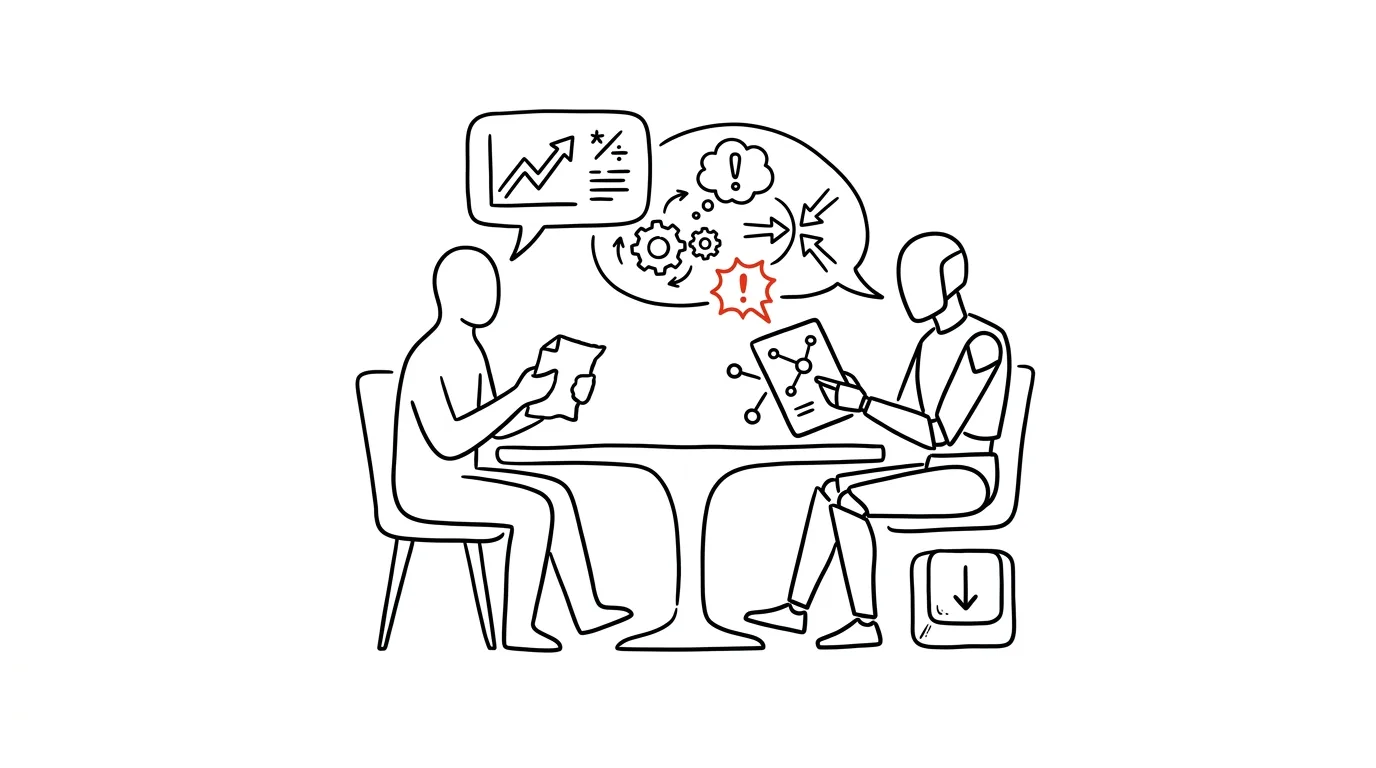
Hard conversations can't be avoided, only postponed. A talk about pay, feedback nobody wants to give, a client who's gotten used to you always backing down, or a layoff you've been replaying in your head for the third week straight. Most people prepare by running it over in their heads — except in your head you always get the last word, and the other side answers exactly the way that suits you. Real practice needs an opponent who doesn't follow your script. AI will play that opponent, as many times as you want, without taking offense, and it's available at 11 p.m. the night before the meeting, when no colleague is going to role-play with you.
This guide is a step-by-step process, not communication theory. It walks you through preparing your position, setting up the other side, running the rehearsal itself, breaking down your argument, a second round done for real, and a cheat sheet you take into the actual meeting. Each phase comes with a copy-paste prompt — just fill in the brackets. The last third is a set of ready-made setups for six specific types of conversations; feel free to jump straight to yours.
Two rules apply across the whole guide. Rehearsal is practice, not prophecy — you'll never know the other person's actual answers; you're training flexibility, not memorizing a script. And the setup itself tends to involve salaries, evaluations of specific people, and business terms: sensitive data belongs only in a paid or business account with contractual data protection, so replace names with roles and round off numbers. The rehearsal works just as well with “the account manager” as it does with a real name.
A typical scenario
Jane leads an eight-person team and has been putting off two things for four months: asking for a twenty-percent raise, and giving Peter feedback that he missed three deadlines last quarter and the team is starting to feel it. In both cases, she knows exactly what she wants to say. What she hasn't tested is what she'll do if the other side reacts differently than she expects — and that's precisely what's kept her stalling.
One evening she gives herself fifty minutes. First she has her own position mapped out: what she wants, the minimum she'd still accept, and what she'll do if she gets nothing. She discovers she has no answer to that last question — and that's the first useful thing to come out of the evening. Then she sets up the other side: she describes her position, her results for the year, who her boss is, how he usually reacts, and adds the instruction “play it tough, open by saying the budget is closed, and don't back down until you get a concrete reason.”
She loses the first round. She has no answer to the closed-budget line and slides into apologizing. She has her argument evaluated and learns that three-quarters of her sentences were about how hard she's been trying, and not one was about what she actually delivered for the company. The second round goes differently, with the instruction “be accommodating, but push for a six-month delay” — and it turns out she has no prepared response to a delay at all. She replays the sentence that tripped her up five times in a row until it finally sits right, and does the last round out loud in voice mode.
At the end she has three sentences written out on paper: how she'll open, what she'll say to “the budget is closed,” and how she'll close the meeting if they don't reach an agreement. She walks into the meeting having already heard the worst sentence once, and answered it once. Nobody knows the outcome in advance — but the difference between a four-month postponement and a calm fifty-minute prep session is the whole story of this guide.
Phase 1: Preparation — what you need to know before you start playing
The most common reason a rehearsal goes nowhere is starting without a clear position. When you don't know exactly what you want and where your limit is, the simulation degenerates into chit-chat. Ten minutes of preparation raises the value of the whole evening more than three extra rounds of practice would.
Three things you need to have written down
What I want. Not “better conditions,” but a specific number or a specific change in behavior. “65,000 starting in January” is a goal. “Having my work appreciated” is a feeling.
What my minimum is. The lowest outcome you'd still accept and walk away satisfied. Without it you'll end up negotiating against yourself mid-conversation.
What I'll do if I get nothing. The most uncomfortable question, and the only one that will actually give you calm during the conversation. The answer can be “I'll stay and revisit it in June” or “I'll start looking for another job” — but it has to exist. Whoever doesn't have one is speaking from a position of pleading.
You can write this out yourself on paper. When you get stuck, have your position broken down for you — the model will ask about things you'd never bring up on your own.
I'm preparing for a hard conversation and want to get my own position
clear first, before we start rehearsing. Don't play any role yet.

Situation: [describe in 5 sentences — what it's about, with whom, why now]
What I'd ideally want: [goal]
What I have as backup: [facts, numbers, results, deadlines]
Relationship with the other side: [how long, what kind, what history we have]

Do four things:
1. Rephrase my goal as one specific sentence I could actually say
   in the meeting, with measurable content.
2. Ask me 5 questions about things I've clearly not thought through
   in my own position — be specific, not generic.
3. List what the other side likely wants in this situation and what
   they're afraid of. Distinguish what we know from the background
   and what's just a guess.
4. Write three versions of what I'll do if I get nothing — from
   mildest to toughest, with the consequences of each for me.

Don't give me any encouragement, and don't judge whether I deserve this.
You'll get back a map of your position, and the most valuable part is point 2 — the questions you don't have an answer to are exactly the spots where the conversation will throw you off. Watch out with point 3: the model is guessing the motivation of a person it doesn't know. When it writes “your boss is probably under budget pressure,” treat that as something to verify, not as fact.
Facts and anonymization
Rehearsal is meant to train your phrasing, not looking up numbers. Before you start, have on hand what you delivered during the period in question, what numbers that involves, and what exists about it in writing. Without that background, the rehearsal turns into an exercise in generic phrases — and that's exactly what you'll hear back in the real meeting as “that sounds nice, but specifically?”
Full names, specific clients, exact salaries, and colleagues' health or family details don't belong in the scenario description. Replace them with roles and ranges: “the account manager,” “a client, annual volume around [X] thousand,” “salary around [range].” The other side needs to know it's about money and roughly how much — not the figure down to the last dollar.
Phase 2: Setting up the other side — role, personality, difficulty
This is where the quality of the whole rehearsal gets decided. “Coach me through a salary negotiation” gets you a generic communication textbook. A usable opponent needs three layers: who they are (role and situation), what they want and fear (interests), and how they behave (personality and difficulty). Skip the third layer and you get an accommodating partner who agrees with you after your second sentence — and that's a rehearsal that leaves you worse prepared for the real meeting than if you'd done nothing at all.
Anatomy of a good setup
Write the setup like a director, not an interviewer: describe the character, the setting, the rules of the game — and only then hit go.
We're going to run a scene. You play the other side, I play myself.

YOUR ROLE: [e.g. my direct manager, runs a department of 20 people,
8 years at the company, is himself under pressure from above over costs]
YOUR PERSONALITY: [businesslike, dislikes talking about money, avoids
conflict by promising "we'll come back to it"]
WHAT YOU WANT: [keep me on the team, but not set a precedent for others]
WHAT YOU'RE AFRAID OF: [that if you give in to me, three more people
will ask]
WHAT YOU KNOW ABOUT ME: [a year of good results, two extra projects,
no previous raise request]

SITUATION: [a 30-minute meeting I requested, your office, Thursday
afternoon]

RULES OF THE GAME:
- Stay in character until I write "STOP" or "step out of the role."
- Only answer as your character, in one to three sentences.
- Don't comment on my performance and don't coach me during the scene.
- Don't start backing down just because I said something politely —
  only back down when you get a substantive reason.
- Play it tough: try to deflect the topic first.

You start: welcome me and ask what I want to talk about.
It'll return the opening line in character and the conversation gets going. Two common problems: the model sometimes appends a stage direction in parentheses to its line (“looks uncertain”) — that's fine, even useful, but if it bothers you, add “no behavior descriptions, direct speech only” to the rules. And second: after a few exchanges it starts softening. The fix is in the next subsection.
Difficulty: ask for a tough game, or you won't get one
Models tend toward accommodation — it's their default setting, and it hurts a rehearsal. So state the difficulty explicitly, and set it a notch higher than you expect from reality. Four variants work well: friendly (listens, but has substantive objections — good for the first round), tough (doesn't budge, repeats one blocking line like “the budget is closed”), evasive (agrees with you, praises you, promises nothing, and tries to end on “we'll come back to this” — the most common and hardest one in practice), and emotional (raises their voice, takes offense, blames you — useful for one round, not five).
Staying in character, and what to do when it breaks
When the other side softens for no reason, you don't have to start over. A short stage direction, written in all caps so it's clearly separate from the dialogue, is enough:
DIRECTION: You broke character — you backed down without me giving
you a real argument. Go back one line and play it again, this time
tough: insist the budget is closed and demand specific numbers from
me. Continue in character, don't comment on this note.
Feel free to use this micro-prompt three times over a conversation. It also helps you notice exactly where the other side “gave in for free” — usually a spot where your argument wasn't actually strong, just politely phrased. It also helps to keep the whole setup saved in a project with persistent context, so you're not rewriting it before every round.
Phase 3: Running the rehearsal — how to have the conversation for real
You've got the setup — now it has to actually happen. The most common mistake in this phase is that people describe the conversation instead of having it.
Speak in the first person, not in descriptions
“Then I'd explain my reasons” isn't a line, it's a plan. Write exactly what you would say: “I want to talk about my pay. Over the past year I've taken on two extra projects, and I want to discuss 65,000 starting in January.” Practice only pays off when you actually say the real phrasing out loud — those are the exact words that will then come out of your mouth in the meeting too. The moment you catch yourself in the conditional, rewrite the sentence in the declarative.
And keep it short. The length of your lines is itself diagnostic: anyone who needs ten lines to defend their position ends up talking too much in the actual meeting.
Round length and how to end it
One round shouldn't run longer than ten to fifteen minutes — roughly twelve to twenty exchanges. Longer simulations fall apart: the model starts repeating its arguments and you get tired and conciliatory. Three short rounds with a debrief in between beat one long one.
Always close a round properly, even when it went badly: “I understand a decision isn't happening today. Let's agree we'll revisit this on [date], and in the meantime I'll send you [document].” Most people rehearse the opening and forget that hard conversations are lost at the end, where no next step gets agreed on.
When you get stuck partway through
You don't have to push through it. Getting stuck is information, not failure.
STOP, I'm pausing the scene.

I got stuck on your last line: [repeat the sentence that stopped
you].

Don't give me a ready-made answer right away. Do this instead:
1. Explain in one sentence what that line is actually doing —
   is it an objection, a deflection, a test, or shifting blame
   onto me?
2. Write 3 different directions I could respond in, each in one
   sentence, with a note on the risk of that direction.
3. Ask me which direction I want to pick.

Once I choose, we'll go back to exactly that line and play it again.
You'll get back a typology of that blocking line and three ways out. Point 1 matters more than it looks: most sentences that stop us in a conversation aren't arguments at all, just deflection techniques — and the moment you name one, it stops working. Just don't have it write the final line for you and copy it verbatim; a phrasing you didn't choose yourself won't come out of your mouth in the real meeting.
Phase 4: Feedback on your argument
This is the step the entire rehearsal exists for. Not “how did I do,” but how did I argue — the outcome of the simulation is fiction, while the quality of your sentences is real and transferable. A live colleague will rarely give you this kind of feedback: they're either too nice, don't have the time, or don't remember exactly what you said.
Stepping out of the role for a breakdown
STOP. Step out of the role and switch to being a negotiation coach.

Go through our whole conversation and evaluate MY argument. Don't
evaluate the outcome of the scene — that's fictional. Give me:

1. The three strongest sentences I said, and why they worked.
2. The three weakest sentences — quote them verbatim and write
   exactly what's weak about them (defensive posture, apologizing,
   needless hedging, an argument about effort instead of results).
3. Where I caved: places where I stopped holding my ground before
   I had to. For each one, say what led me to do it.
4. What I had and didn't use — facts from my setup that would have
   helped my argument and I left on the table.
5. The ratio: what percentage of my sentences talked about what I
   delivered versus my effort, feelings, or needs. Give examples.
6. Verbal filler: filler words and hedges I keep repeating.

Be specific and quote me. No encouragement, no preamble.
You'll get back a breakdown that's usually uncomfortable and accurate. Points 4 and 5 are the most useful: facts you had on hand and didn't use, and the “delivered versus effort” ratio, which reveals whether you're speaking from the position of a partner or a supplicant. The model sometimes praises sentences just for being polite, even when they delivered nothing — take its praise with a grain of salt and focus on the criticism.
Drilling a single sentence
When the breakdown surfaces a specific weak passage, don't generalize it. Take exactly that one sentence and fix it into a form you'll actually be able to say.
Take this sentence of mine from the rehearsal: "[exact wording]"

1. Write what doesn't work about it — specifically, not generically.
2. Produce 5 variants of the same sentence, each in a different mode:
   businesslike and short, accommodating, tough, ending in a question,
   silence instead of an argument (what I'd do if I just said nothing).
3. For each variant, note when it fits and what its risk is.
4. Then put that objection to me again and let me answer in my own
   words. Once I answer, tell me which variant I seemed to be
   attempting and how well it landed.

Don't push your best variant on me as the only correct one.
Point 4 is the reason the prompt is shaped this way: the goal isn't to collect five clever sentences, it's to say one of them out loud several times. Pick the variant that sounds like you — a sentence you'd never actually say will betray you under pressure.
Phase 5: A second round, done differently
One round prepares nobody. Being prepared isn't knowing one answer — it's being able to handle three different directions the conversation could take, and for that you need the same situation with a different opponent.
Change the personality, not the scenario
The situation stays the same; who's sitting across from you changes. The friendly boss who makes promises. The tough one who blocks. The quiet one who lets you talk until you hurt yourself — the variant most people never rehearse, even though in practice it hurts the most.
We're playing the same situation again, from the top. Same setup,
but change your personality:

This time you're [the evasive type]: you agree with everything,
praise me, keep hinting that "this is definitely something for
next time," and try to end the meeting before any commitment gets
made. You never say a direct no — you just keep deferring.

Same rules as last time: stay in character, don't coach me, answer
briefly. You can only back down once I've squeezed a concrete
commitment with a deadline out of you.

You start, same situation as last time.
You'll get a round in which most people discover for the first time that they can't actually hold someone to a deadline. After two or three personalities, you'll notice your strengths stay the same and so do your weaknesses — and that's the real output of the rehearsal.
Voice mode: the last round out loud
Written rehearsal trains content, not delivery. But in the actual meeting you'll be speaking — and there's a gap between “I have it written down” and “I can say it,” a gap where half your preparation gets lost. So do the last round in voice mode, where you talk out loud and hear the answers.
Let's switch to spoken rehearsal. The setup and your role stay
the same — we just talk.

Adjust it like this:
- answer briefly, one to two sentences, like a real phone call,
- don't leave me room for long monologues: if I talk too long,
  cut in and ask for a specific number,
- don't help me out when I falter — leave the silence for me to
  fill,
- at the end, step out of the role and tell me where I talked too
  much, where I raised my voice, and where I saved it.

You start, in one sentence.
The most valuable part is the instruction about silence. In reality, an uncomfortable question is followed by a pause, and most people fill it by lowering their own ask. Once you live through that in a dry run, you'll be able to sit through the silence the second time. Without voice mode, at least read your lines out loud off the screen.
Phase 6: Six types of conversations, six ready-made prompts
Every type of hard conversation has its own trap. The prompts below are ready-made setups — pick yours, fill in the brackets, and run it. The process around them (breakdown, second round, cheat sheet) stays the same.
Salary negotiation
The trap: you talk about yourself instead of the value you deliver, and show up with no answer to a deflection.
Play my manager in a salary negotiation. I play myself.

Me: [position], at the company [duration], salary [range], I want
[goal].
Background: [3-5 concrete results from the past year with numbers].
You: run [department], your own budget was approved a year ahead,
you can raise my pay but have to justify it to your own boss. You're
afraid of setting a precedent for the rest of the team.

Play it tough, in this order of defenses:
1. "The budget's closed, it's not happening this year."
2. "Everyone's working hard, that's not an argument."
3. "We can come back to this mid-year."
4. Only once you get concrete numbers about what I've delivered,
   start discussing a figure — and try to talk it down.

Stay in character, answer briefly, don't praise me.
Start: "So, what did you want to talk about?"
You'll get a conversation where you run into all four standard defenses. Prepare your answer especially for point 3 — deflection is the most common real-world outcome, and most people have nothing for it but “okay.” A good response includes a date and a condition: “Let's agree, then, on [date] and on what I need to deliver by then for the answer to be yes.”
Feedback nobody wants to give
The trap: you wrap the criticism in so much padding that the other person walks away thinking everything's fine.
Play my direct report. I play myself, his manager, and I'm giving
him uncomfortable feedback.

Him: [role], on the team [duration], previously reliable.
Problem: [specifically — 3 missed deadlines this quarter, impact
on others, the latest case from last week].
His personality: takes criticism personally, first explains external
circumstances, then pushes back that it wasn't such a big deal, and
finally asks whether he should "expect to be let go."

Play it like this: don't admit the problem right away. First explain
external causes, then object that nobody told him before. Only back
down once you get concrete examples with dates.

Stay in character. Start: "Did you want to talk to me?"
You'll get exactly the type of conversation that in practice degenerates into reassurance. Watch two things about yourself: whether a concrete example with a date came out in the first two lines, and whether you said by the end what needs to change and by when. Feedback without an agreed next step is just an unpleasant feeling for both sides — for a regular format to build on, see the tip on one-on-one meetings.
A difficult client
The trap: the client has gotten used to you backing down, and you act as if the relationship matters more than the terms.
Play my client. I play myself, the vendor.

Client: [industry], we've worked together [duration], order volume
[range].
Situation: [e.g. repeatedly changes the scope after sign-off and
expects it to fit inside the original price; the latest change
means two extra days of work].
Their personality: friendly, but uses the relationship as leverage —
"we're partners, after all," "it wasn't a problem last time,"
"someone else would do it cheaper."

Play it so that you first downplay the change ("it's just a small
thing"), then appeal to the relationship, and finally hint you'll
shop around with a competitor. Only back down once you get a clearly
defined rule for the future, not just a complaint.

Stay in character, answer briefly.
Start: "Hey, thanks for the quick turnaround last time. I need one
more small thing."
The goal of the round isn't to beat the client, but to walk away with a rule — “changes after scope sign-off get billed as a separate line item” — said out loud and without an apology. If the rehearsal shows you said “sorry” three times, you have something to work on.
Layoffs and ending a working relationship
The trap: you try to justify the decision and end up opening a discussion that's no longer on the table.
Play the person I'm laying off. I play myself.

Context: [role, how long, reason — e.g. the position is being
eliminated / sustained underperformance even after two rounds of
feedback].
What I have prepared: [end date, severance per applicable law,
handover of work, a reference].
Their reaction: first shock and silence, then "why me specifically,"
then an attempt to negotiate a second chance, finally anger and the
line "you never told me this."

Play it realistically, don't soften it. Don't reassure me when I
phrase something clumsily. If I start defending the decision with
arguments, seize on them and push back.

The decision is final and isn't meant to change in this scene.
Stay in character. Start by sitting down and staying silent.
Train a single skill: state the decision in the first thirty seconds, clearly and without small talk, then move on to the practical matters. Every extra justification opens up negotiation over something that isn't up for negotiation. And a caution — this is an area with legal consequences: the rehearsal covers phrasing; consult HR or a lawyer, not a model, on the actual terms of termination.
Conflict on the team
The trap: you take sides before hearing both versions, or, at the other extreme, decide nothing at all.
We're going to run a conflict mediation. You play both members of
my team, and label each line with the role's name so I know who's
speaking. I play their manager and run the meeting.

Conflict: [description — e.g. two people are doing the same job,
one keeps going around the other and coming straight to me].
Person A: [role, personality — loud, speaks for both, blames].
Person B: [role, personality — stays quiet, and when prompted
dismisses their own complaint with "it doesn't matter, I don't
mind"].

Play it so that A keeps cutting B off, and B withdraws.
Don't settle it yourselves — the conflict continues until I set
rules and a concrete division of responsibility.

Stay in character, and once it's over, tell me how each character
experienced the meeting separately.
You'll get a three-way conversation that's demanding to run — which is exactly why it's worth trying in a dry run first. Watch whether you gave the quiet person space, and whether the meeting ended with a concrete division of responsibility, not a vague agreement to “communicate better.”
A personal conversation
The trap: people forbid themselves from preparing for a personal topic as something calculating — and then handle it the worst of all.
Play [the role of someone close to me — e.g. a sibling] in a
personal conversation. I play myself.

Topic: [e.g. dividing care for a parent, money owed, repeatedly
canceling plans we'd made].
History: [what led up to this, how long it's been going on, what
we've already tried].
The other side's personality: [e.g. responds with guilt-tripping
about the past and turns the topic to what I've done wrong].

Play it so that you avoid the topic through guilt-tripping and
tangents into the past. Not outright angry, but don't let the
topic go until you get a concrete proposal, not just a complaint.

Stay in character, answer like a person, not like a counselor.
You start, with an ordinary sentence, as if nothing's going on.
Here you're mainly training one thing: coming back to the topic after the other side has steered you elsewhere. The phrase “I'm happy to get to that, but I want to finish this first” sounds easy in your head and is surprisingly hard to say out loud. Keep the setup general, without identifying details — other people's personal matters don't belong in a chat any more than a colleague's salary does.
Phase 7: What to take away from the rehearsal
The worst way to end a rehearsal is “that was useful” and closing the laptop. In three days you won't remember any of it. What you need to walk away with is something that fits on a piece of paper and that you read five minutes before the meeting.
The three-point cheat sheet
Step out of the role. Based on all the rounds we've played, build
me a one-page cheat sheet. Format:

1. OPENING — one sentence I'll start the meeting with. Specific,
   no apology, no small talk about the weather.
2. TOUGHEST OBJECTION — write out, verbatim, the one I got most
   stuck on during rehearsal, and my answer to it in two sentences,
   phrased the way I ended up actually saying it.
3. CLOSE WITHOUT AGREEMENT — one sentence I'll close the conversation
   with if we don't reach an agreement; it must include a concrete
   next step and a date.

Underneath, add:
- three numbers or facts I need to keep in my head,
- two words or phrases I should cut (my filler from the rehearsal),
- one sentence for what I'll do if I get nothing.

Write it in my own words from the rehearsal, don't invent new
phrasing. The whole thing has to fit on half a page.
You'll get back exactly what you'll print out or copy into your notes. The last line of the prompt is the key one — the moment the model starts polishing your phrasing, you get elegant text you won't use in the actual meeting. The cheat sheet should sound like you in round five of the rehearsal, not like a communication manual. And you don't need more than three points: a full script slows you down, because the moment the conversation goes off-script — and it will — you keep trying to stick to it.
After the real meeting, write down three sentences: what the other side said differently than you expected, and which of your prepared lines worked and which didn't. When you're preparing for a similar conversation a year from now, that note is worth more than the whole rehearsal.
The limits of simulation: what AI can't play
Stay clear-eyed about this method — it has real limits, and a rehearsal that gives you false confidence is worse than no rehearsal at all.
It doesn't know the person or the company context. The model plays the type you described, not your actual boss. Who has what history with whom, what happened at last year's meeting, why now is a bad time — all of that decides the real outcome, and you never capture all of it in the setup. If the other side backs down after the third line in rehearsal, that says nothing about reality.
It has no body. Tone of voice, pauses, eye contact, the other person glancing out the window after your line — none of that gets captured. That's why voice mode beats typing, and a live colleague beats both, for at least one round.
It goes easy on you even when it's supposed to be tough. Even with a good setup, the model tends to root for you. Expect the real opponent to be a notch less accommodating than the one in the chat.
It's no substitute for professional help. For layoffs, discrimination, bullying, debt, or family disputes, the rehearsal handles phrasing — not your rights and obligations. Those belong with HR, lawyers, and, for personal matters, relationship professionals.
Common mistakes
- A setup with no personality and no difficulty. “Coach me through a negotiation” gets you a textbook. Without a description of personality, interests, and the instruction “play it tough,” you get an opponent who agrees with you — and a false sense that you're prepared.
- Describing instead of speaking. “Then I'd explain my reasons” isn't a rehearsal. Practice only works when you say the actual sentences; the conditional tense is a sign that you're the one who broke character, not the model.
- One round and done, or the same round five times. Round five is usually the valuable one — but only if you change the other side's personality between rounds. And ask about your argument, not the outcome: “did I win?” is a meaningless question, because the other side is fictional.
- Having it write you a script and memorizing it. Someone else's phrasing falls apart under pressure and sounds fake. Take the direction from the breakdown and choose your own words — the three-point cheat sheet should be your own voice.
- Dumping real names, salaries, and evaluations of people into the setup. Personnel data belongs only in a paid account with contractual data protection, and even there in anonymized form: roles instead of names, ranges instead of exact figures.
- Mistaking the rehearsal for the decision. AI proposes, a human approves. Whether to hand someone a layoff notice, whether to ask for a raise, whether to let a client go — that's your call; the model only rehearses how to say it.
The best tools
- Claude — holds a role through a longer conversation, returns to it after a stage direction, and on request steps out into a coach who breaks your argument down sentence by sentence.
- An AI app's voice mode — the last round out loud: you speak in real time, hear the tone, and live through the silence after an uncomfortable question. See AI voice mode.
- A project with persistent context — the saved role setup, your background material, and notes from past rounds, so you're not starting from zero before every rehearsal (projects and context).
- AI as a critical opponent — for finding holes in your position before you even start rehearsing; see let AI find the holes in your proposal.
- Meeting prep — when it's not just about phrasing but the whole meeting with supporting material: prepping for a meeting in twenty minutes.
- A colleague for the last round — AI catches weak points in your argument, a live person catches body language and tone.
What you get out of it
- Time: fifty minutes of focused rehearsal replaces weeks of turning it over in your head — and, above all, shortens the delay. Conversations people put off for four months usually happen within a week of one evening of preparation.
- Quality of your argument: you find out that three-quarters of your sentences are about effort instead of results, that you're apologizing for a question you have every right to ask, and that “actually” or “just” shows up in every third sentence.
- Calm: you've already heard the worst sentence you're afraid of once, and answered it once. That's the entire difference between nerves and calm.
- Money: in a salary negotiation or a negotiation over client terms, the difference between a prepared and an unprepared argument runs into real money over a year. Nobody can guarantee that — but a request you never voice is guaranteed to bring in nothing.
Pro tip
Flip the roles once: have AI play you with your arguments, and play the other side yourself. Hearing your own argument from across the table is uncomfortable and fast — within three exchanges you'll notice which argument doesn't land as convincingly as you thought, usually the one you were leaning on the most. And rehearse conversations that aren't coming yet, too: twenty minutes once a quarter on a scenario that's still hypothetical (a client announces they're leaving; your boss asks about a project that isn't working). When the real situation arrives, you're not starting from zero.
And one closing rule: AI proposes, a human approves — and in hard conversations that goes double. The model can show you where your argument is weak, but the decision whether to have the conversation at all, what to offer in it, and where your limit is stays yours, and it doesn't delegate. Rehearsal trains the form. You bring the substance, the courage, and the responsibility yourself.
Want to go deeper? The handbook has a whole chapter on it — AI and automation.
Similar tips
Gmail from the keyboard: E archives, R replies
E
Turn on keyboard shortcuts in Gmail and clear your inbox several times faster — without a single click.
Mute the conversation that's no longer about you
M
An endless “reply all” thread? The M key mutes the conversation — new replies go straight to the archive.
Schedule your email to send at the right time
An email written Saturday evening can go out Monday at 8 AM. Scheduled sending respects the recipient's time — and your reputation.
Liked this tip?
I send one like it every week by email. Two minutes to read, hours saved.
1 tip a week · no spam · unsubscribe in one click