Tips & tricks · Shortcuts · Everywhere · peace of mind while presenting · 2 min read
Jump to any slide while presenting: type the number, hit Enter
Last reviewed:
In this article
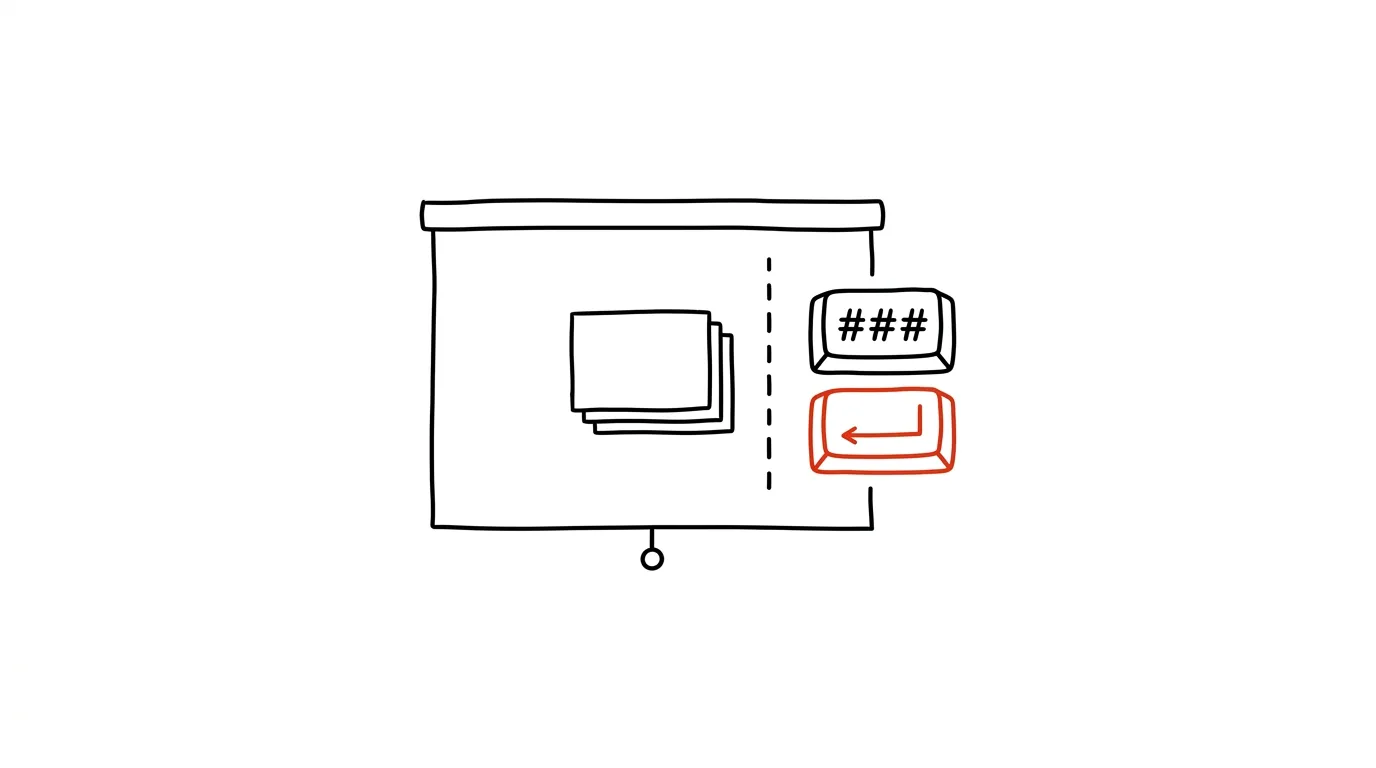
“Could you go back to that chart from the beginning?” And the presenter clicks the back arrow through fifteen slides while the audience watches the deck run in reverse and the thread of the talk falls apart. Yet both PowerPoint and Google Slides can jump blind to any slide mid-show: just type its number and press Enter. The audience sees only an instant cut — as if you'd rehearsed it.
How to do it
- During the slideshow, type the slide number on your keyboard (say, 4) and press Enter. This works in both PowerPoint and Google Slides, even though you don't see any input field on screen.
- To know the numbers of your key slides, print the outline and jot them into your presenter notes — or just remember three: the opening agenda, the main chart, the closing summary. For an important presentation, it's worth keeping a sticky note with five numbers next to the keyboard.
- If you don't know the number, an overview of all slides helps: in PowerPoint during a slideshow, right-click → See All Slides (in newer versions also the G key) shows a grid of thumbnails you click to jump to. Careful — the audience sees this overview too; jumping by number is more discreet.
- Getting back is the same move: type the number of the slide where you paused and continue from there.
Jumping by number also opens up a useful backup-slide tactic: put details you'll only show on request — a detailed table, methodology, more sensitive figures — after the last slide of the deck. In normal clicking you'll never reach them, but when the question comes, you jump there by number and look prepared for anything.
A typical scenario
You're presenting quarterly results to leadership. At slide 18, someone asks about the calculation methodology you explained on slide 5, and the person asking doesn't remember it anymore. You type 5, Enter — the chart's on screen, you answer, type 18, Enter — and continue where you left off. The whole thing took five seconds, and nobody saw any confused flipping or your email inbox flash on screen.
What you get out of it
Composure in the most exposed part of presenting — unexpected questions. The discussion can jump around the deck however the audience needs, and you come across as having the material completely in hand. No wasted time, no rewinding in front of the room — and none of the loss of rhythm rewinding usually causes for you too.
Pro tip
Two more keys belong in a presenter's toolkit: B fades the screen to black when you want attention on you instead of the slides, and Ctrl + L in PowerPoint turns the cursor into a red laser pointer — you then point with your mouse right on screen.
Want to go deeper? The handbook has a whole chapter on it — The app categories that matter.
Similar tips
In-depth guide · 21 min
Rehearsing a hard conversation: AI plays the other side
A complete guide with prompts: set up the other side's role, run the rehearsal for real, and handle six of the toughest talks — from a raise to a layoff.
Set up your chair in a minute: elbows, knees, feet
Most people sit in their chair exactly as it arrived from the store. Three checkpoints — elbows at desk height, knees at a right angle, feet on the floor — take a minute to fix.
In-depth guide · 17 min
Newsletter from Zero: Growth, Content, Automation
A complete guide with prompts: a lead magnet people want, a welcome sequence, drafts in your voice, deliverability, and GDPR consent — with a case study.
Was this helpful?
Liked this tip?
I send one like it every week by email. Two minutes to read, hours saved.
1 tip a week · no spam · unsubscribe in one click