Tips & tricks · AI · Everywhere · ~an hour a day when studying
Notes that do the learning for you: capture, structure, review
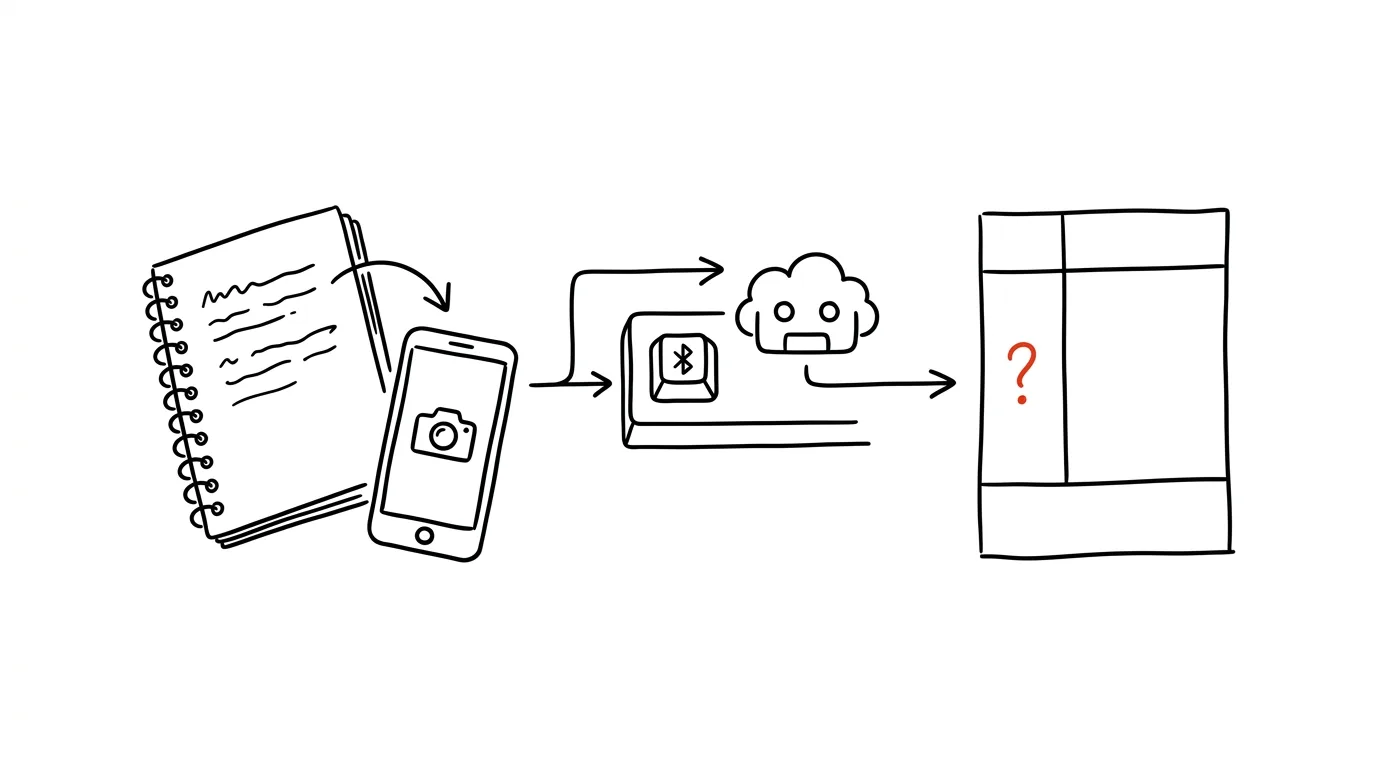
High school notes have one weird property: almost everyone writes them, almost nobody uses them. The notebook fills up, class after class goes by, and a week before the test you find out that half of October's lecture is missing because you couldn't write and listen at the same time. So you end up studying from whatever a classmate lends you, or straight off the internet — seeing the material for the first time the day before the test.
Notes aren't an archive, they're a tool. A good set of notes isn't the prettiest one — it's the one you can actually study from three months later, because it has questions in it, not just answers. And that's exactly where AI helps: it can read your handwriting off a photo, turn two minutes of rambling into structured text, and turn notes into quiz questions. What it can't do is learn the material for you. That part stays on you, and it's fair to say so up front.
This guide is a system for a whole semester. First you'll set up a capture habit that takes a few minutes a day instead of frantic copying during class. Then you'll turn it into structured notes. Then you'll add a twenty-minute Sunday routine that leaves your week actually processed. Finally, you'll build test prep and a shared system for the whole class out of it. Just copy the prompts and fill in the brackets. And one thing up front: check what your school's policy on AI actually says — rules vary school to school, and in some cases you're expected to disclose that you used it.
A typical scenario
Adéla is a junior at a Czech gymnázium. She has nine subjects she's tested on, and her notes look like this: history is in a notebook, but the last two lessons are missing because she was sick. Biology is photographed off the board, buried in her phone among a thousand other photos. Literature lives in a Google Doc she types into when she can keep up. Chemistry isn't anywhere — supposedly the textbook covers it.
Before a history test, it went the same way every time: two evenings retyping someone else's notes, one evening reading, a feeling in the morning that she basically had it — and then a test question about a connection she'd never seen before. Roughly ten hours per test, and a grade hovering around a C.
Now it's different, and it hasn't actually taken more time — just different time. After every history class, she dictates two minutes into her phone about what she remembers. She photographs the board. At home, once a day, usually while waiting for dinner, she feeds both into chat and has it turned into notes with questions alongside. On Sunday she spends twenty minutes on the whole week: an overview, what it all hangs together on, and twenty questions to review. Before a test, she doesn't retype anything — she just runs through the questions and fills in what she didn't know.
The main change is that studying now starts on the day of the lecture, not three days before the test. A history test now costs her two evenings instead of four, and her grades have moved up. And, just as important: she can actually listen in class, because she's not copying.
Phase 1: capture — getting the class into text
The first problem isn't studying, it's that the class disappears. What you don't write down stops existing after a few days. But writing everything down means you're not paying attention — and listening to the lecture is worth a lot more than having it on paper.
The fix is splitting it into two parts: capture rough and fast during class, process it afterward. There are three ways to capture, and the best approach is to use all three depending on the situation.
Photos of your notebook and the board
AI can read handwriting too. It's not magic — neat handwriting comes through almost error-free, fast end-of-class scribbles are harder, and for chemical formulas and math notation you always need to double-check the result. Photograph the board at the end of class, photograph your own notebook page, and send both in.
A few practical things that matter more than which phone you use: shoot straight on, not at an angle (a slanted shot is harder to read), in good light, the whole page at once, and take it twice rather than get a blurry one. If there's a diagram or table on the board, say so in the prompt — otherwise you'll get a list of words with no relationships between them.
I'm attaching a photo of [the board from class / my notebook page].
Subject: [history], today's topic: [topic].

1. Transcribe everything you see in the photo, including anything
   written in the margins or corners.
2. Where you're not sure what something says, put it in brackets
   with a question mark: [?illegible word]. DON'T GUESS and don't
   fill it in with what would logically make sense.
3. Then turn the transcript into structured notes: a topic heading,
   bullet points following the logic of the lecture, key terms
   in bold.
4. Preserve diagrams and arrows — describe in words what leads
   to what.
5. At the end, list anything I should double-check in my
   notebook or textbook, because you read it with low confidence.

Don't add anything that isn't in the photo. If something's
missing for it to make sense, write it as a question at the end,
not into the notes.
Point 2 and the last paragraph are there on purpose. Without them, the model will just fill in an illegible spot with whatever makes sense — and you'll end up with a sentence in your notes the teacher never actually said. For dates, numbers, and formulas, always double-check the result against the photo; digits are what handwriting mixes up most often. If you photograph your notebook regularly, the tip on scanning with your phone is worth a look too.
Two minutes of talking after class
This is the most underrated technique in the whole guide, and it takes exactly two minutes. After the bell, on your way out of class or during the break, turn on a voice recorder or voice input and say out loud what you remember from the lesson. No prep, no looking at your notebook — just whatever stuck in your head.
It has two effects. First, you capture what the teacher said but didn't write on the board — connections, examples, comments like “this will be on the test.” Those never make it into a notebook, and they're often the most useful part. Second — and this matters more — the act of trying to recall material from memory is itself a form of studying. That's the exact moment you build a memory trace that reading would never create.
Dictated text tends to be a mess: repetition, “um,” unfinished sentences. That's fine, that's what the next prompt is for.
Here's my two-minute dictation right after [subject] class,
topic [topic]. I was talking from memory, so it's messy.

[paste the transcript]

Turn it into notes:
1. Organize it into a logical order based on the topic, not the
   order I said things in
2. Cut filler words and repetition, but DON'T change the content —
   if I said something imprecisely, leave it and flag it with
   an asterisk
3. Separate: actual material vs. teacher comments about the
   test, deadlines, or what's important
4. List any terms I mentioned but didn't explain — I need to
   look those up
5. Write 5 questions that my rambling doesn't answer, even
   though they should be part of the topic

Don't fill in material from your own knowledge. I want to see
what I remember, not what's factually true about the topic.
That last sentence is the key one. Skip it and you get a nice, complete-looking set of notes — and no way to tell where the gaps actually are. Point 5 is essentially a report on what you missed in class, and it's the most valuable part of the output.
Where to store it so you can find it again
The best system is the one you'll actually keep up every day. Realistically: one folder per subject, one file per topic inside it (not per class — topics span multiple classes), and a filename with the date and topic, like history-1918-founding-of-czechoslovakia.md. If you use Obsidian or Notion, it's a bit smoother, but a plain Drive folder or your phone's notes app works fine too.
One rule is worth following from day one: photos are not notes. A photo is raw material you turn into text within two days, or it gets lost among all your other photos. Four hundred photos of a whiteboard sitting in your phone isn't a set of notes, it's an archive you'll never actually open.
Phase 2: structure — the Cornell method with AI
Notes that are just a list of sentences are hard to read and even harder to learn from. The Cornell method fixes that with a simple trick invented at an American university back in the 1950s, and it's worked the same way ever since.
What Cornell looks like
You split the page into three parts. On the right (about two-thirds of the width) are the notes themselves — what you wrote down from the lecture. On the left (a narrow column) are questions and key terms — for each chunk of notes, a question that chunk answers. Across the bottom is a summary — three to five sentences on what the whole page was about.
The trick is how you study from it: you cover the right side, go through the questions on the left, and answer from memory. Then you uncover it and check. That's not reading your notes, that's quizzing yourself — and the difference in what actually sticks is huge.
Doing this by hand is extra work, because you have to come up with the questions yourself. This is where AI saves the most time: it generates them from your notes in a few seconds.
Convert my notes into Cornell format.

Subject: [subject]. Topic: [topic]. Grade level: [11th grade].

[paste your notes]

Return a two-column table with a summary underneath it:

| Question / key term | Notes |

Rules:
- On the left, write QUESTIONS, not headings. A question has to
  be answerable from the right column.
- Mix up the question types: what is (definition), why (cause),
  how does it relate (relationship between two things), what
  would happen if (application). At least a third should be
  connection questions, not fact questions.
- On the right, keep my own wording, just trim and organize it.
  Don't add anything.
- Below the table, write a 4-sentence summary: what the topic
  is about and why it matters.
- Where my notes are missing an answer to a question the material
  should cover, write it separately under a "Missing" heading.
This returns notes you can actually work with. Read the questions critically — the model likes to produce “what is X?” type questions you can memorize without understanding, and those don't help on a test. If too many of those show up, add a line to the prompt: “no questions that can be answered with a single word copied from the text.”
The questions on the left are the most important column
Pay attention to the request for connection questions. Factual questions (“when was Czechoslovakia founded”) you can answer without understanding anything. Questions like “why 1918 specifically and not earlier” or “what did X and Y have in common” can't be answered from memory alone — and those are exactly the ones a test grade lives or dies on.
If you get questions that feel too easy, say so and have them toughened up:
These questions from the left column are too easy — they can be
answered by copying a single sentence:

[paste the questions]

Rewrite them as harder versions. For each original question,
write one that:
- requires combining at least two pieces of information from
  the notes, not just one
- or asks about cause or consequence, not a fact
- or asks for a comparison with something else from the topic

For each new question, note in parentheses which parts of the
notes the answer draws on — so I know whether my notes actually
cover it.
That last part is a check in disguise: when the model says the answer draws on parts you don't actually have in your notes, you've just found a gap. Fill it from the textbook or ask in class.
Phase 3: Sunday consolidation — twenty minutes for the whole week
This is the habit that makes the biggest difference, and it costs twenty minutes a week. On Sunday evening (or Saturday morning, whenever), take the week's notes and do three things with them: overview, connections, and questions.
Why a week specifically? Because after a week you still remember the material well enough to make sense of your notes, and you've also forgotten enough for reviewing it to actually be worth something. Do this every Sunday and by the end of the semester you've gotten roughly twelve small free reviews — which is exactly the idea behind spaced learning.
Here are my notes from this week for [subject]. They're from [3]
classes, topics: [list them].

[paste the notes from all the classes]

Give me a Sunday overview:

1. OVERVIEW — what this week was about, 5 sentences. How the
   classes connect and what's the main idea holding it all
   together.
2. CONCEPT MAP — list the terms from the week, and for each one
   a sentence on how it relates to the others ("X causes Y",
   "Z is an example of W").
3. CONTINUITY — what this builds on from earlier topics. Where
   that link is missing from my notes, tell me what I should
   go back and review.
4. 20 REVIEW QUESTIONS, ordered from easiest to hardest.
   Put the answers at the very end, separated out, so I can
   quiz myself first.
5. THREE THINGS that, based on my notes, are most likely to be
   on the test — and why you think so.

Base this only on my notes. Where they're incomplete, say so
instead of filling in gaps.
This returns material that's both an overview and a self-test. Work through points 1 to 3 by reading them and nodding or shaking your head — when something doesn't click, that's a signal something slipped past you in class. Point 4 is the main event: answer out loud or in writing, only then look at the answers. If you just read a question and the answer right underneath it, you're not studying, you're reading.
And take point 5 with a grain of salt — the model is guessing based on what's most developed in your notes, which only loosely tracks what's actually on the test.
Once you've gone through the questions, it's worth having your answers checked. Not for a grade — to see the difference between “almost right” and “right.”
I answered the questions from the Sunday overview from memory.
Here are my answers and the notes the questions came from.

MY ANSWERS:
[paste]

MY NOTES:
[paste]

For each answer, tell me:
- whether it's right, partly right, or wrong — and exactly
  what's missing
- whether I answered vaguely where a specific explanation was
  expected (that's the most common mistake, watch for it)

Then tell me what to do about it:
- which three questions I should try again in two days
- which ones I knew well enough that I don't need to revisit
- whether there's a pattern in my mistakes (e.g. mixing up two
  concepts, or missing the same connection every time)

Compare strictly against my notes. If something in my answer
isn't in my notes, flag it separately — I'll go verify it myself.
The last paragraph is a safeguard in both directions: you don't want to be “corrected” based on something the teacher never said, and sometimes it turns out you remember something extra from the lecture — which belongs in your notes.
Twenty minutes is an estimate for one subject where it's worth doing (history, biology, literature, social studies). For subjects that are mostly about calculation, it makes more sense to work three practice problems instead of doing an overview.
Phase 4: prepping for a test from your own notes
A week before a test comes the question of what to study from. The answer is clear: your own notes. It sounds like a cliché, but there are three concrete reasons behind it.
Why your own, not someone else's
Your notes contain what your teacher actually said. Not what's in the textbook, not what's on the internet — what happened in your classroom, including the emphasis, the examples, and the “remember this” comments. Your teacher writes the test, not the textbook author.
Your own notes carry context that someone else's don't. Reading your own sentence brings back the class it came from. Someone else's notes are brand-new text to your brain, so you're learning them from scratch — which is why retyping a classmate's notes takes twice as long and sticks half as well.
And most importantly: your notes show you what you don't know. A gap in your notes is information. In someone else's complete notes, everything looks equally familiar, so you end up studying evenly instead of catching up on what's actually missing.
This doesn't mean don't borrow from anyone. It means the order goes the other way: your own first, then fill in what's missing from someone else's notes or the textbook, and flag the filled-in parts — because those will be your weakest spots when you get quizzed.
A practice test
The best prep isn't reading — it's writing a practice test. Making one from your own notes takes a minute.
I have a test on [subject] in a week, topics [topics]. The teacher
usually gives [open-ended questions / multiple choice / a mix /
problems to solve] and the test runs [45] minutes.

Here are my notes on the whole unit:
[paste your notes]

Make me a practice test:
- length matched to [45] minutes
- structured like the real test, with points assigned
- questions drawn exclusively from what's in my notes
- mix: a quarter on facts, half on understanding and connections,
  a quarter on applying it to a new situation
- for one question, aim deliberately at the topic I'm weakest on
  in my notes — and mark it with an asterisk

Put the answers and scoring all the way at the end, separated
by a line, so I can write it out myself first.
This returns a test to print out and write under time pressure. That time limit isn't a minor detail — plenty of people fail tests not because they don't know the material, but because they run out of time. Only look at the solution afterward.
Grade it yourself. The model can suggest how many points you'd get, but the teacher assigns the grade, and an AI estimate isn't one — treat it as a rough guide, not a verdict.
I wrote a practice test. Here are my answers and here's the
model solution:

MY ANSWERS:
[paste]

MODEL SOLUTION:
[paste]

For each answer, tell me:
- what I got right
- what's missing or inaccurate (specifically, not "could be
  better")
- whether it's a knowledge gap, or I just wrote it wrong or
  left it unfinished

At the end: rank the topics by how I did, worst first. For the
three worst, tell me exactly what to do over the next few days —
not "review it," but exactly what (which part of my notes, what
questions to ask myself).
Splitting mistakes into “didn't know it” and “knew it but wrote it wrong” is the most useful thing about this feedback. They're two completely different problems: one gets fixed by studying, the other by reading the question more carefully.
The day before the test
Don't learn anything new the day before. Run through the questions in the left column of your Cornell notes, answer from memory, and reread anything you didn't know. Then go to sleep — a tired brain doesn't recall well. If you like studying with flashcards, move the questions into a spaced repetition system; if you'd rather learn by explaining, try explaining the material with AI.
Phase 5: the class's shared second brain
Thirty people in a class means thirty incomplete sets of notes. Put them together and you get one complete set — and it doesn't cost anyone more work, just an agreement.
How to set it up
Set up a shared folder (Drive, OneDrive, whatever the whole class can access) structured as: a folder per subject, a file per topic inside it. Split up the duty — one person is responsible for the notes for each class. It's not about writing for everyone else; it's about making sure at least one solid set of notes exists for every class, even if someone was sick or fell behind.
Once a week, someone merges the notes. Merging is exactly the kind of work AI does well and people don't enjoy.
Here are notes from [3] classmates from the same [subject] class,
topic [topic]. Everyone wrote down something different.

NOTES A:
[paste]

NOTES B:
[paste]

NOTES C:
[paste]

Merge them into one set of notes:
1. Combine anything that matches and keep it once.
2. Add information only one of us has.
3. DON'T reconcile CONFLICTS — where two of us wrote something
   different (a different date, a different definition, a
   different number), list both under a "To verify" heading and
   note who wrote what. We need to check this with the teacher
   or the textbook.
4. Keep the structure following the logic of the topic.
5. At the end, list any questions none of us has an answer to
   in our notes.

Don't add anything from your own knowledge — I only want to see
what we actually wrote down.
Point 3 is the whole reason this is worth doing this way. A conflict between two sets of notes is almost always a spot where at least one person got it wrong — and if the model “reconciled” it, the mistake would settle permanently into the shared file and the whole class would learn it wrong. Always double-check disputed spots with the teacher.
Rules that keep it working
Three things decide whether a shared folder is still alive after a month. Duties should be assigned in advance for the whole semester, not negotiated class by class. The shared notes are a starting point, not a final product — everyone makes their own Cornell version out of it, because learning from someone else's text works worse (see phase 4). And nothing personal belongs in the shared folder: photos of classmates, names tied to grades, screenshots from private chats. If you're photographing the board, check whether someone who doesn't know about it is in the shot.
Where the line is
Sharing notes is normal collaboration and always has been. Sending a classmate a finished homework assignment to hand in as their own is something else — and so is having an essay or report generated and turning it in under your own name. It's not really about whether you'll get caught (often, you will). It's about the fact that you'll later wonder why you're bored by the subject and getting nothing out of it.
For anything you hand in, one simple test applies: can you defend every sentence you wrote? If not, it isn't yours. And read your school's actual policy — more and more schools have written rules about where the line is and how AI use gets disclosed.
The trap: pretty notes aren't learned material
This is the most important paragraph in the whole guide, which is exactly why it comes here, after you've read everything else.
The system above has one built-in trap: it makes notes so tidy and polished that it feels like you're done. Colored headings, a table, a summary, twenty questions — it looks like a finished result, but it's really just well-organized raw material. There's still a whole other job between “I have this processed” and “I know this.”
It's easy to spot. If you open your notes and read them along, nodding in agreement, you're not studying — you're just recognizing text you already know, and your brain confuses that with actually knowing it. This is called the illusion of knowledge, and it's the most common reason someone “studied for four hours” and still bombed the test.
The only thing that reliably works is closing your notes and trying to recall the material from memory. This whole guide is built to push you toward exactly that: the questions in the left column, the twenty questions in the Sunday overview, the practice test. Use them the way they're meant to be used — answer from memory first, check only after. The technique is broken down in detail in the tip on active recall.
The hardest version is having yourself quizzed one question at a time, with no way to peek ahead:
Quiz me on [topic] based on my notes, which I'm attaching.

[paste your notes]

Rules:
- Ask ONE question at a time and wait for my answer. Don't write
  the next question until I've answered, and never write the
  answer ahead of time.
- After my answer, say what was right and what was missing —
  briefly, two or three sentences.
- If I answer imprecisely, ask a follow-up question aimed at
  that same spot, so I get there myself. Don't just tell me the
  answer.
- Go from easier questions to harder ones, and toward the end
  ask about connections between parts of the topic.
- After 15 questions, stop and give me a summary: what I know,
  what I don't, and what to review tomorrow.

Only ask about what's in my notes.
This mode is uncomfortable, exactly the way it's supposed to be — it's the closest simulation of an oral exam you can run on your own. Answer out loud, not just in your head: putting a thought into full sentences is half the work you'll have to do standing at the board anyway.
And the time split: at most a third of your time on producing notes, the rest on testing yourself. Whoever has that backwards ends up with the prettiest notebook in class and a C on the test.
Common mistakes
- Having AI produce notes out of thin air. “Write me notes on the founding of Czechoslovakia” returns text that has nothing to do with what your teacher actually said — and it might contain made-up facts. Notes come from your class, not the model's memory.
- Not checking numbers and names. Photo transcription most often garbles exactly the stuff that matters most: dates, formulas, numbers. Check them against the original — it takes a minute.
- Photographing and never processing. Four hundred photos of a whiteboard in your phone aren't notes. A photo needs to become text within two days, or it's gone.
- Studying from someone else's notes because they're more complete. Someone else's notes are brand-new text to your brain and carry none of the class context. Your own first, then fill gaps.
- Reading instead of testing yourself. Reading a question and the answer right under it is reading, not learning. The answer has to come from memory first.
- Turning in text AI wrote. Beyond the trouble with the school, it's mostly wasted time — nobody can answer for you at an oral defense, a final exam, or entrance interviews.
- Uploading information about classmates anywhere. Photos of people, names tied to grades, private chat messages don't belong in a chat with AI. They don't belong in a shared folder either.
The best tools
- Claude on mobile — photograph the board straight from your phone and dictate after class: both fit into one conversation, so your notes are done by the time you're home.
- Projects — one project per subject with your notes saved as persistent context; you never have to paste them in again, the model already has them.
- NotebookLM — answers only from what you upload, and shows which source it pulled from. Ideal for quizzing yourself from your own notes and textbook, because it won't make anything up.
- A shared Drive folder — the class's second brain: a folder per subject, a file per topic, duties assigned for the semester.
- Spaced-repetition flashcards — questions from the Cornell column moved into a system that brings them back at the right time on its own.
What you get out of it
- Time: test prep drops from “retype someone else's notes and read them three times” to running through questions and patching gaps. For a subject that used to take four evenings, that's realistically two now.
- Peace of mind: notes get built continuously, so there's no moment where you discover a whole month of material is missing. The Sunday twenty-minute routine keeps that from happening.
- Quality: connection questions force you to actually understand the material instead of memorizing it. That's exactly the difference between a C and an A on open-ended questions.
- Focus in class: when you're not frantically copying the board, you can actually listen. Two minutes of dictation after class replaces fifteen minutes of copying during it.
Pro tip
Once you've got a full semester of notes, try one thing that looks like a gimmick and is actually the hardest test of real understanding: have ten questions generated that connect two different topics from different months (“what does X from October have in common with Y from December”). That's exactly the kind of question teachers put on final tests and exit exams, because you can't cram for it. If you can answer those, you know the subject, not just the individual lessons.
And the rule that sits above the whole guide: AI is allowed to touch the form, not the content. It can rewrite, organize, generate questions, merge notes. What actually happened in class, what the teacher said, and what you remember from it — that's yours, and nobody can fill it in for you. Whenever you're not sure whether something in your notes actually came from class or the model added it, check. A note you can't trust is worse than no note at all.
Want to go deeper? The handbook has a whole chapter on it — AI and automation.
Similar tips
Projects in AI: upload context once, not every time
A complete guide with prompts: what to upload to a Project, how to write project instructions, when to start a new project instead of overloading one, how to distill lasting context out of conversations, and how to maintain a project so it doesn't lie to you six months in.
Your first conversation with AI: the complete guide for absolute beginners
A complete guide with copy-paste prompts: how to pick a tool without a religious war, what to type into that first empty box, ten first tasks by profession, and — above all — how to tell a good answer from confident-sounding nonsense.
AI writes the first draft, you write the final one
A complete guide with prompts: the brief method for a draft in a minute, ready-to-use requests for the four hardest email types (rejection, follow-up, escalation, apology), working with a full thread, teaching AI your voice, and what to check before you hit send.
Liked this tip?
I send one like it every week by email. Two minutes to read, hours saved.
1 tip a week · no spam · unsubscribe in one click