Tips & tricks · AI · Everywhere · ~a quarter without OKR theater
Strategy and OKRs with AI as your sparring partner
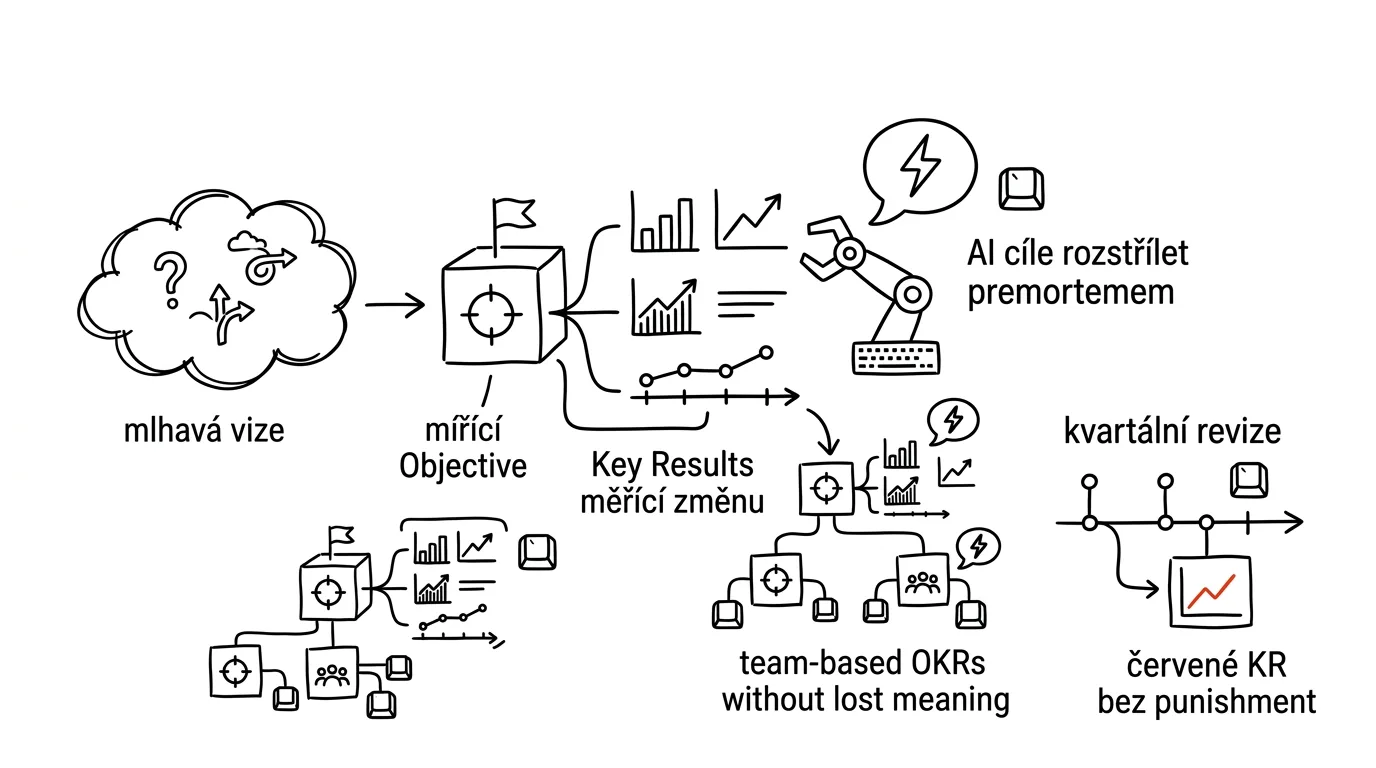
Most companies' strategy comes in two forms, and both fail the same way. The first is the offsite deck: thirty slides, nice words about customer focus and innovation, a document nobody reopens a week later. The second is the OKR spreadsheet people fill in the day before the deadline because they have to — and refill again next quarter, because the last one was never properly reviewed. The two are more connected than they look: goals nobody uses to make decisions aren't management, they're reporting.
This guide is about the opposite — turning a vision into a handful of goals that actually run the quarter, and using AI to get there. Not as a goal generator; goals have to be owned by the person who's accountable for them. As a sparring partner: a machine that can produce twenty Key Result variants in ten minutes, ask the merciless question “and what actually gets better if you hit this?”, and premortem the strategy you love precisely because it's yours.
The guide runs in six phases: from vision to what should be different a year from now, through writing Objectives and Key Results, red-teaming and a premortem, cascading to teams, a quarterly rhythm, and an honest close-out. Every phase has prompts you can copy — just fill in the brackets. One rule sits above everything: AI proposes, the human approves. A model can write a formulation, spot a hole, and offer ten alternatives. Deciding what the company bets the next quarter on has to be made by whoever is accountable for the outcome.
A typical scenario
Marek runs a fifty-person software team at a company in the Czech Republic. They introduced OKRs a year ago, and after four quarters they looked like this: every team had three Objectives, every Objective had four to five Key Results, a hundred and twelve lines in a spreadsheet altogether. Ninety percent of the Key Results read like “finish the migration to the new system,” “introduce regular retrospectives,” “launch the onboarding process.” At the end of the quarter everyone filled in a completion percentage, the average came out to 78%, and everyone breathed a sigh of relief.
The problem was that the company wasn't doing well. Customers were leaving at the same rate as before, hiring stalled, the new release slipped by a quarter. A hundred and twelve completed lines, and nothing got better — because those lines measured that work happened, not that anything changed.
After a rework, Marek had three Objectives and nine Key Results for the whole division. He wrote them with AI as a sparring partner: he had it generate fifteen alternative KRs for the first draft, then had it sort them into “measures change” and “measures activity,” then asked it a single question — which of these KRs can be hit without anything actually improving — and threw out six of them. The whole process took two afternoons instead of the usual two weeks of a spreadsheet making the rounds. At the end of the quarter, two KRs finished green, four yellow, three red — and for the first time it led to decisions: one project got stopped, one position opened earlier than planned, one bet turned out to be a dead end after six weeks instead of a year.
Phase 1: from vision to what should be different a year from now
OKRs can't be written out of thin air. When a team jumps straight to the spreadsheet, you get a list of what it was already doing, rewritten in goal form. There's a step that most companies skip: agreeing on what should be different a year from now compared to today. Not what we'll do, but how the company will be different.
Translate the vision into a difference, not a slogan
A vision like “be the number-one choice for customer experience in our market” is usable as a wall poster and useless for running the company. AI is good at pulling out what would have to be measurably different if a sentence like that were actually true.
I'm [role] at a company that does [industry, size, type of
customers].
Our vision statement is: [vision statement].
Current situation: [3-5 sentences on where the company stands —
revenue, customers, team, main pain point].

Don't write me goals. Do one thing: translate that vision into
a picture of the company three years from now. Describe what
would have to be measurably different from today, across five
areas: customers, product, people, processes, money.

For each area, write:
- what it looks like today (based on what I gave you)
- what it would look like if the vision were fulfilled
- in one sentence, what the gap between the two actually is

Where you're missing information, write QUESTION: [what you
need to know], instead of guessing.
It comes back with a structured picture of the target state and — more valuable — a list of questions you haven't answered yet. Watch for one thing: the model likes to add ambitions you never stated (“international expansion”). Cut anything you didn't feed in, or consciously claim it as your own.
Choose bets, not a wish list
Strategy is a choice about what you're not doing. The three-year picture will yield eight to ten things worth improving; only two or three fit in a quarter. This prompt forces you to make that choice deliberately.
Here's the picture of our company three years out, and the
list of areas where we need to move forward:

[paste the output of the previous prompt, or your own list]

The upcoming quarter is [Q4 2026]. Capacity: [number of
people, main constraint — e.g. two dev teams, one person on
marketing].
What's hurting us most right now: [description].

Propose 4 different strategic bets for this quarter. A bet =
one thing we commit capacity to, at the expense of everything
else.
For each one, write:
1. What we're betting on and why now
2. What we're consciously deferring or sacrificing
3. How we'll know in three months whether the bet paid off
4. What happens if we push it out a quarter
5. Why this bet might be the wrong choice

The bets must be mutually exclusive — not four variations on
the same thing. Don't recommend which one to pick.
Point 2 is why this prompt exists. If you can't name what a bet costs you, it isn't a bet — it's a wish. The last line (“don't recommend”) is there on purpose: the choice is yours, and right now you need the options laid side by side, not an authoritative recommendation from a machine that doesn't know half the context.
Phase 2: an Objective that actually points somewhere
An Objective answers the question “where are we going and why does it matter.” It should be inspiring and qualitative — something you can say out loud in a meeting without anyone's eyes glazing over. It shouldn't contain numbers; those belong in the Key Results.
The test for a good Objective
A good Objective meets three conditions. It's a direction, not a task — “become the go-to choice for small e-commerce shops,” yes; “launch the new pricing page,” no. You can tell when it's done — it has an endpoint, not an endless “improve.” And it could upset someone — if everyone in the company agrees with it instantly and it costs nobody anything, it probably says nothing at all.
Here's our strategic bet for the quarter: [describe the bet
in your own words, 5-8 sentences].
Company: [industry, size]. Team it affects: [description].

Write 6 Objective variants (a qualitative goal, no numbers)
that capture this bet. Vary the level of ambition and the
angle — two cautious, two ambitious, two framed from the
customer's point of view.

Rules:
- one sentence, 12 words max
- no numbers, no deadlines
- a verb that expresses a change of state, not an activity
- no corporate filler (“synergy,” “excellence,” “take it to
  the next level”)

Under each variant, write one sentence on what that phrasing
implicitly promises, and what it rules out.
It comes back with six formulations, of which you'll usually take one and merge it with half of another. The line about what the phrasing rules out is the most useful part — it shows that “simplify customer onboarding” and “shorten the customer's path to first value” sound similar but lead to a different quarter.
How many there should be
Three Objectives per team per quarter is the ceiling; two is better; one is legitimate. A company with six Objectives effectively has none — it's set a priority order where everything is first. When someone insists everything has to get done, ask which of those goals would stall the moment a key person left. The answer “none of them” means it's a work list, not a strategy.
Phase 3: Key Results that measure change, not hours logged
This is where the whole system breaks or holds. A Key Result isn't a task, it's a result. You can tell the difference with a single question: can it be checked off without anything actually improving? If yes, it's a task.
The most common mistake: a KR that's really a to-do list
Three examples from real spreadsheets, and their fix:
- “Implement a new customer support system” → that's a project. The result would be: “Median first-response time drops from 6h to 2h.”
- “Train the sales team on the new methodology” → training can be checked off with zero change. The result: “The share of deals with qualification filled in rises from 30% to 80%.”
- “Publish 12 blog posts” → twelve posts nobody reads is a completed KR and a wasted quarter. The result: “Organic blog traffic grows from 4,000 to 9,000 monthly visits.”
The second common mistake runs the other way: a KR so far removed from the team's work that the team can't influence it. “Revenue grows 20%” is weather for an engineering team, not a goal. Between those two extremes sits a usable KR — one that measures a change the team actually causes.
Generating variants
This is where AI saves you the most. You know what you want to achieve; there are ten ways to phrase a measurable result, and some are noticeably better than the first one that comes to mind.
Objective for this quarter: [Objective wording].
Team: [who, how many people, what they do].
Data we actually measure today: [list the metrics you have
in your systems, including where they live].
Metrics we'd have to start measuring: [list].

Propose 12 Key Result candidates for this Objective.
Split them into three groups:
A) outcome (lagging) — measures impact, shows up later
B) leading — measures the behavior that drives the impact
C) qualitative — measures a shift where no direct number
   exists (e.g. share of customers who mention [thing] in
   an interview)

For each candidate, give:
- exact wording as “from value X to value Y by end of
  quarter” (leave the values as [BASELINE] and [TARGET] if
  you don't know them)
- where that number comes from and who can pull it
- how often it can be measured
- how it could be hit dishonestly, without anything actually
  improving

Don't fill in numbers I didn't give you.
The last point for each candidate is the most valuable part of the answer — it shows in advance where the shortcut will be. “Reduce the number of open tickets” can be hit by mass-closing old tickets. Once you know where the cheating happens, either rephrase the KR or add a safeguard (a second KR that blocks the shortcut).
Baseline: the number nobody knows
Half of all OKR conversations stall because nobody knows the current value. Without a baseline, a target is just a random number — and a team never buys into a number that came from nowhere.
I want to set this Key Result: [KR wording].
I don't know the current value, or I'm not sure of it.
Data sources I have: [systems, exports, spreadsheets].
Time I can spend finding out: [e.g. 3 hours].

Write me a plan for finding the baseline in that time:
1. Exactly where to pull that number from and how
2. How to calculate it — an exact definition (what counts,
   what doesn't, over what period, how to handle duplicates
   and missing data)
3. Who at the company has the fastest access to it
4. What to do if it turns out this was never measured — the
   cheapest fallback metric, and what I give up by using it
5. How to write down the definition so it's calculated the
   same way three months from now

Write the definition so it can be pasted straight into the
OKR document.
Point 5 gets underrated and comes back to bite you at exactly the end of the quarter, when it turns out “active customer” meant one thing in January and another in March. Write the metric's definition once and leave it alone — if you decide to change it, change the baseline too, and note that you did.
Ambition: where to set the bar
A goal you're certain to hit isn't a goal, it's a plan. Standard practice is to set ambitious KRs so that 70% counts as a good result — but that only works if everyone's told that up front and nobody gets punished for landing at 70%. At the same time, some KRs must be hit at 100% (legal obligations, safety, a commitment to a customer). Tell them apart and say so out loud: nothing kills trust in the system faster than an “ambitious” goal quietly turning into a “committed” one after the fact.
Phase 4: red-teaming and a premortem before you approve it
A set of OKRs nobody challenged is a set of OKRs reality will challenge instead. Phase 4 takes an hour and is the best investment in the whole process.
The test that exposes theater
Run this prompt on every set of OKRs you're about to approve. The question inside it is simple and unpleasant.
You're a seasoned COO who's seen hundreds of OKR sets over
your career and can't stand goals written for reporting.
Be harsh, blunt, and specific. Don't compliment anything.

Here are our OKRs for the quarter:
[paste the Objectives and all Key Results, with numbers]

Context: [industry, team size, what the company does].

Go through them and answer four questions:
1. Which of these Key Results can be hit without anything
   actually improving? For each, describe the specific
   scenario of how I'd do it if I wanted to look good without
   working hard.
2. Which KRs measure activity instead of outcome? Rephrase
   them.
3. Which KRs is the team unable to influence through its own
   work?
4. Which Objective wouldn't surprise or unsettle anyone at the
   company on reading it — and is therefore probably empty?

Finish by saying what you'd cut first, and why.
It comes back with a list that won't please you — that's the point. In practice, this usually knocks out two or three of nine KRs and gets two more rephrased. A tougher approach to red-teaming, useful for other kinds of decisions too, is in the tip AI as a reviewer; for OKRs specifically, the model has to be given real numbers, or it only criticizes the wording in a vacuum.
A strategy premortem
A premortem is a retrospective run in reverse: jump ahead to the end of the quarter, declare that the bet failed, and go looking for why. People are noticeably better at finding reasons for failure when it's handed to them as a fact, not a risk.
It's the end of [Q4 2026]. Our strategic intent for this
quarter was [Objective wording], with these Key Results:
[paste the KRs and their target values]

It failed. Not by a little — we finished under 30%, and it
cost the company a quarter.

Write a post-mortem of how it happened:
1. The five most likely causes of failure, ranked by
   likelihood, not by drama
2. For each: the first warning sign, and in roughly which
   week of the quarter it would have shown up
3. Which causes were within our control and which weren't
4. What I should concretely do right now, in week 0, to head
   off the three most likely causes in advance
5. Which of those steps is cheap enough that there's no reason
   to put it off

Company context: [description]. What didn't go well last
quarter: [brief summary].
Point 2 is the most valuable. Take the warning signs from the premortem and put them on the calendar as checkpoints — by week six you're no longer asking “how's it going?” but “is that signal we were afraid of showing up?” That's the difference between a status update and actually managing something.
Who else should push back besides the machine
An AI red-team is cheap and fast, but it only knows what you tell it. Round it out with two human perspectives: someone on the front line (sales, support — they see the customer before the dashboard does), and someone who isn't accountable for the goal and can afford to say it's pointless. Use the AI's findings as the agenda for that discussion, not a substitute for it.
Phase 5: cascading to teams without losing the plot
Cascading is where OKRs die most often. A company goal gets sent down, each team takes a slice of it, and two levels down the team's goal looks like “publish three reports,” with a footnote about how it supports the company strategy.
Contribution, not a copy
A working cascade doesn't sound like “we split the company KR into fifths.” It sounds like: each team answers how it will contribute to the company Objective using what it's good at. Engineering and support contribute to the same goal through different things, and measure it differently.
Company Objective for the quarter: [wording]
Company Key Results: [list, with values]

Our teams and what they do:
- [team A]: [what it does, how many people]
- [team B]: [what it does, how many people]
- [team C]: [what it does, how many people]

For each team, propose:
1. In one sentence, how it can contribute to the company
   Objective using what it's good at (not by splitting the
   company number into pieces)
2. Two to three candidate team-level Key Results — measurable,
   within its reach, phrased as “from X to Y”
3. Which company KR(s) that supports
4. What the team would have to stop doing to have the
   capacity for it

Call out separately:
- where two teams' proposals overlap so much they'd end up
  doing the same work twice
- where there's a gap between the company goal and the team
  proposals that nobody covers
The last two points are why you run this for all teams at once instead of team by team. Overlaps and gaps are only visible from above, and they're hard to find by hand. Don't hand the proposals to teams as an assignment — hand them over as material for the team's own discussion, or you'll produce exactly the theater you're trying to avoid.
A sanity check at the bottom of the cascade
After the team round, run a reverse test: take the bottom level and ask your way back up.
Here are the team Key Results the teams set for themselves:
[paste, by team]

Company Objective and KRs:
[paste]

Run a cascade check. For each team KR, write:
- If it were hit 100%, how much would it move the company KR?
  If that can't be estimated, write “no defensible link.”
- Is it a result, or a renamed task?
- If this KR vanished, would anyone outside the team notice?

At the end, give three lists:
1. KRs whose link to the company goal is only asserted
2. KRs that are basically business-as-usual dressed up as a
   goal
3. Company KRs that no team is actually aiming at
List 2 tends to be the longest, and that's normal — business-as-usual has a way of creeping into goals on its own. You don't have to cut all of it; just name it and move it elsewhere (into operational metrics you track but don't pretend are strategy).
Phase 6: a quarterly rhythm, reviews, and an honest close-out
OKRs set in January and opened again in April are a ritual. What keeps the system honest is the rhythm, not the spreadsheet.
A short check-in, not a status meeting
Every two weeks, twenty minutes, three questions per KR: where we are, what's changed since last time, what needs a decision. Have the material prepared ahead of time — and above all, strip out anything that isn't a decision.
Prepare material for our biweekly OKR check-in.

Current state:
[for each KR: wording, baseline, target, value today, value
two weeks ago, one sentence on what happened]

Give it back to me like this:
1. A stoplight color for each KR (green / yellow / red) and
   one sentence why — based on pace, not gut feel: compare
   progress against where we should be at [week] of 13
2. At most 3 things that actually need to be decided at the
   check-in, each phrased as a question with answer options
3. What's just information that can be sent in writing and
   doesn't need airtime in the meeting
4. One question someone should ask and nobody will, because
   it's uncomfortable

No summary, no intro — go straight to the points.
Point 3 is what cuts the meeting in half. Point 4 is why the prompt is worth running at all. It follows the same logic as the weekly AI review — the point of a review is to drive a decision, not to document work done.
What to say when a KR turns red
A red KR isn't a person's failure — it's information that arrived on time. A culture that punishes red turns everything green within two quarters, and blind. The structure that works: numbers, cause, decision — and the decision has to be in every message, even if it's “we're continuing unchanged.”
Our Key Result [wording] is red.
Baseline was [X], target [Y], today we're at [Z], [number] of
13 weeks remain.
What's happened: [brief description, including what we've
tried].
My read on the cause: [your opinion].

Draft a message for [leadership / the team], 10 sentences,
structured:
1. Where we stand (the number, no dressing it up)
2. Why — separate causes we controlled from external ones,
   and don't hide the first kind
3. What we've learned that we didn't know before the quarter
4. The decision I'm recommending: push through / cut scope /
   stop — and what that means for the rest of the quarter
5. What I need from you to make that decision

No hedging language, no “unfortunately.” Don't try to make it
sound better than it is.
The last line matters — models have a strong tendency to smooth a result into something more pleasant to hear. Check the number in point 1 against the actual data source, not against what you remember from last week. For broader help preparing material for leadership, see reporting up the chain.
Closing the quarter: scores and lessons
Closing out isn't filling in a percentage. It's two questions: where did we land, and what did we learn about how we set goals. The second matters more, and everyone skips it.
We're closing the quarter. Here are our OKRs and the results:

[for each KR: wording, baseline, target, final value, 2-3
sentences on how it went]

Give me a quarterly review:
1. A score for each KR (0.0-1.0) and one sentence of
   assessment
2. For KRs under 0.7: was the cause performance, a badly set
   target, or a shift in external conditions? Keep those
   separate, don't blend them.
3. For KRs above 0.9: was the target set too low? How would
   you tell?
4. Which KRs turned out impossible to evaluate because we
   defined them badly — and how to phrase that better next
   time
5. Three lessons for next quarter's goal-setting, specific to
   our company, not generic advice
6. Which of these goals should continue, and which should
   definitely end

Work only from the numbers I gave you. Where data is missing,
say so instead of estimating.
Point 3 is the one people forget: a quarter where everything shows green isn't cause for celebration — it's a reason to ask whether the company just agreed on things it was going to do anyway. Save the output — after three quarters you'll have a documented history of how your estimates have shifted, and that's the best tool there is against repeating the same mistake.
The trap: OKR theater
OKR theater is what happens when goals get written for reporting, not for management. You can spot it by a few tells: KRs get filled in after the work is already planned; nobody can recall the goal wording without opening the spreadsheet; check-ins report on activity (“we're working on it”); and above all — nothing during the quarter ever got stopped because of the goals. A goal system that never stops anything isn't a goal system.
Run this check once a quarter, and let a machine do it — people inside the company get used to the theater.
You're an auditor looking for signs that goals are being
written for reporting, not for management. Be skeptical.

Here are our OKRs from the last two quarters, their results,
and the check-in notes:
[paste]

Find the signs of OKR theater:
1. Goals that are business-as-usual described in goal form
2. Goals whose wording shifted during the quarter toward
   whatever turned out achievable
3. KRs whose status got reported in words instead of numbers
4. Decisions that were actually made because of the goals —
   list them. If you can't find any, say so plainly.
5. Goals that keep reappearing quarter after quarter with no
   movement in the numbers

At the end, list three concrete process changes that would
curb this, and for each one, what it would cost.
Point 4 is the harshest diagnosis in the whole exercise. If half a year of OKRs doesn't produce a single traceable decision — a project stopped, a person reassigned, a priority changed, hiring pulled forward — then the goals weren't managing anything. Everything else is decoration.
Common mistakes
- A Key Result written as a task. “Implement a system,” “train the team,” “publish twelve posts” — all of them can be checked off without anything getting better. The test is a single question: can it be hit without improvement? If yes, rephrase it as an outcome.
- Too many goals. Six Objectives and twenty KRs means the company doesn't have priorities, just a work list. Two to three Objectives per team, two to four KRs per Objective — everything else belongs in operational metrics.
- Goals without a baseline. A target with no known starting point is a random number nobody buys into. Before you agree on a target, agree on the metric's definition and where it stands today.
- Punishing red. One quarter after the first punishment, every goal turns soft and the system goes blind. Red is information that arrived on time; the problem is red that stayed quiet until the last week.
- Cascading by dividing a number. A company KR sliced into fifths and mailed out to teams produces goals nobody feels ownership of. Every team should answer how it contributes using what it's good at.
- Letting AI invent the goals and just rubber-stamping them. The model doesn't know what the company can absorb, what's politically viable, or what people are afraid of. It can produce variants and find weaknesses — it can't take on the choice or the accountability.
The best tools
- Claude Projects — persistent context for the whole strategy cycle: upload your vision, metric definitions, past OKRs and their results, and every conversation about goals starts with knowledge of the company. See the tip a project with persistent context.
- A second model as reviewer — have a different model tear apart the OKR set than the one you wrote it with; a co-author critiques leniently.
- A spreadsheet tool (Sheets, Excel) — one place for KR wording, baseline, target, current value, and data source. Version history shows when and by whom a target got “adjusted.”
- A calendar — premortem checkpoints and biweekly check-ins belong on the calendar, not in good intentions.
- Scheduled AI routines — a reminder that offers to prep your check-in material every two weeks on its own, so the rhythm doesn't dissolve into day-to-day operations.
What you get out of it
- Time: putting together a set of OKRs shrinks from two weeks of a spreadsheet making the rounds to two afternoons — the model produces the variants, you choose and decide.
- Money: a premortem and a theater check surface a blind bet in week six instead of at year end; a stopped project that was going nowhere is the cheapest quarter you'll ever save.
- Peace of mind: goals you can say from memory, and a check-in where you decide instead of report. Red stops being an embarrassment and becomes information.
- Quality: a KR that measures change instead of activity means a completed quarter and an improved company are the same thing. In most spreadsheets today, they aren't.
Pro tip
Start a document called “history of our estimates”: one paragraph per quarter — what we thought would happen, what actually happened, and why we got it wrong. After a year, feed it into a model and have it find the pattern in your own mistakes (“you systematically underestimate hiring time,” “goals dependent on an external vendor have failed you four times out of five”). It's the cheapest planning-improvement tool available, and almost nobody keeps it.
And a closing rule that overrides everything else: a goal that didn't cause you to stop doing anything for an entire quarter wasn't a goal. Before you approve a set of OKRs, ask what will stop happening because of it. If there's no answer, you don't have a strategy — you have a description of business-as-usual with a more ambitious headline.
Want to go deeper? The handbook has a whole chapter on it — AI and automation.
Similar tips
Data Analysis with AI: From CSV to a Conclusion You Can Defend
A complete guide with prompts: why a language model must not calculate inside the chat and when it may, how to turn a spreadsheet into a script that recalculates the numbers on demand, how to explore an unfamiliar dataset, find a trend or an anomaly, pick the right chart, and not overreach the interpretation.
Excel and Sheets with AI: Formulas, Errors, Structure, and Macros
A complete guide with prompts: how to describe a formula in plain English and get a working solution on the first try, how to have an inherited formula explained, how to debug #REF! and #N/A, how to design a table that won't fall apart, and when to reach for a macro instead of a formula.
The follow-up watchdog: AI remembers who never replied
A complete walkthrough with prompts: how to set up a routine that finds threads without a reply, tracks the deadline by message type, drafts a reminder pitched at the right level of politeness, and once a week lists every open loop. AI drafts it, you always send it.
Liked this tip?
I send one like it every week by email. Two minutes to read, hours saved.
1 tip a week · no spam · unsubscribe in one click