Tips & tricks · Shortcuts · Windows · ~2 min a day · 2 min read
Win+Home: minimize everything except the window you're working in
Last reviewed:
Win+Home
In this article
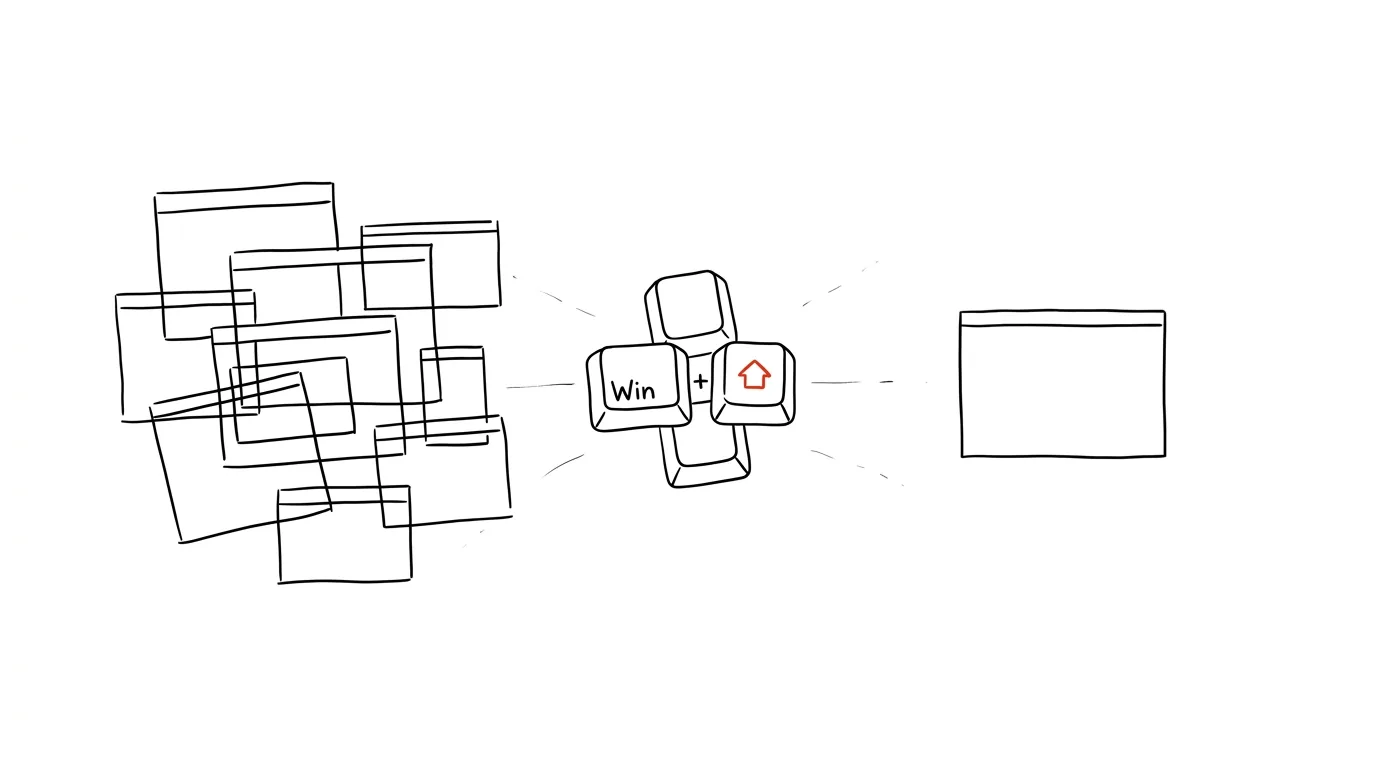
You're writing an important document and chaos flickers around it: mail, chat, three browser windows, a spreadsheet. The well-known Win+D shortcut clears the whole desktop — but it also hides the one window you're actually working in. This is exactly what Win+Home is for: it minimizes every window except the active one. All that's left is your work, and quiet.
How to do it
- Click into the window you want to keep and press Win + Home — every other window minimizes to the taskbar in a single instant.
- Press Win + Home again and the minimized windows return exactly where they were — so it's a temporary tidy-up, not a destruction of your layout.
- You can achieve the same trick with the mouse: grab a window by its title bar and quickly shake it side to side — the other windows drop to the taskbar; shake again and they come back.
- In Windows 11, shaking is off by default: turn it on in Settings → System → Multitasking under the title bar window shake option. In Windows 10 it works out of the box.
A typical scenario
You have to finish a message for leadership before the end of the hour. But Teams, Outlook, and six browser tabs are all lit up on screen — and every blink in your peripheral vision pulls your eyes away from the sentence you're writing. Win+Home: only the document remains. You write. When you need to look something up, the same shortcut brings the windows back — all in their places, nothing to reopen or rearrange.
The student version: while writing a term paper, only the editor stays on screen while sources wait minimized — zero distraction in sight, everything ready on the taskbar. And because the second press restores windows to exactly their original layout, you also skip the usual tax of tidying up: the five minutes of rearranging windows back to the state where you were working comfortably.
What you get out of it
- Focus without closing anything: distracting windows disappear from view but don't disappear entirely — you return to them with one press once you're done.
- Speed over manual clicking: minimizing eight windows one at a time means eight precise clicks on a small button; here it's one shortcut.
- A complement to Win+D, not a replacement: Win+D clears straight to the desktop — useful, say, when you need to find something on the desktop; Win+Home instead clears around your unfinished work and leaves that one important thing right in front of you.
Pro tip
If windows distract you on a regular basis — every morning while writing, every Friday during a report — a more systematic solution is worth considering: virtual desktops permanently separate work and communication windows, so Win+Home then only needs to handle the occasional emergency.
Want to go deeper? The handbook has a whole chapter on it — The app categories that matter.
Similar tips
Win + 1 through 9: apps at a single keypress
Win+1
Open apps pinned to the taskbar by their position number. No more hunting with the mouse.
Black screen? Win+Ctrl+Shift+B restarts graphics without restarting the PC
Win+Ctrl+Shift+B
The display freezes or turns black after connecting a monitor, but the computer is still running. Win+Ctrl+Shift+B restarts the graphics driver — the picture comes back and you lose nothing.
Win + D: instant screen cleanup
Win+D
One press hides every window and shows the desktop. A second press brings it all back.
Was this helpful?
Liked this tip?
I send one like it every week by email. Two minutes to read, hours saved.
1 tip a week · no spam · unsubscribe in one click