Tips & tricks · AI · Everywhere · ~peace of mind, all year · 19 min read
Final Exams with AI: A Year-Long Plan from September to Study Leave
In this article
- A typical scenario
- Phase 1: a calendar built backward from your deadlines
- Phase 2: breaking your topics down into weeks
- Phase 3: practice standardized tests and mistake analysis
- Phase 4: oral exam practice out loud
- Phase 5: the essay as practice, not a commission
- Phase 6: study leave week and the final days
- Mind and body: stress, sleep, and performance
- The most common mistakes
- The best tools
- What you get out of it
- Pro tip
Your final exams — school-leaving exams like the Czech maturita, A-levels, AP exams, or whatever your country calls them — aren't really testing how much you know in May. They're testing whether you could plan eight months ahead. Almost everyone who struggles with them actually knows more than they show — they just studied it in an order and at a pace that let half of it slip away before it was ever needed.
This guide is about the second part: a plan you can put together in September that's still holding up in April. AI doesn't do any of the actual work for you here — it works out a calendar backward from your exam dates, breaks your mistakes on practice tests down by root cause, quizzes you out loud on your topics, and keeps track of what you haven't opened in two months. Those are exactly the tasks people are worst at handling on their own, because we study what we enjoy and put off what we don't know.
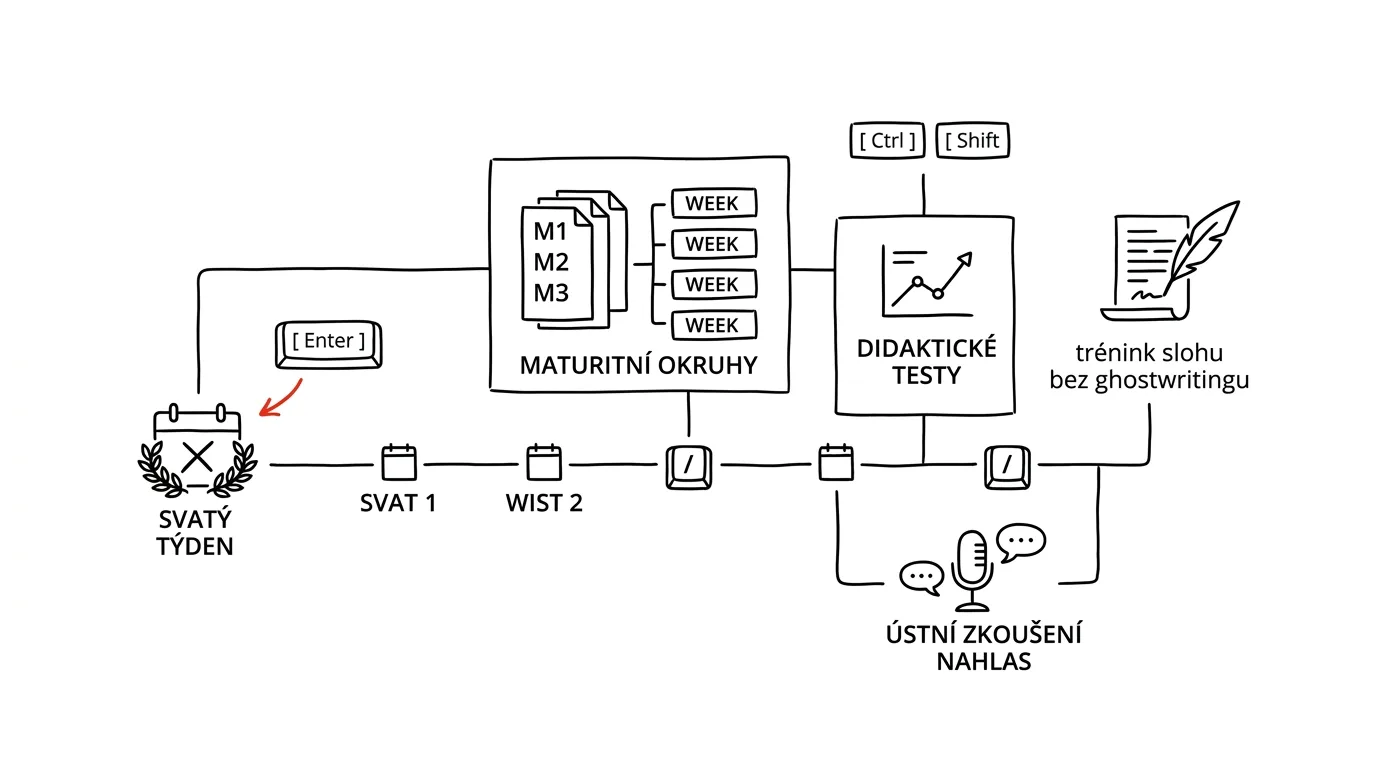
The guide moves chronologically: first the calendar and breaking your topics down (September and October), then practice standardized tests and mistake analysis (all year, with the real weight starting in January), oral exam practice out loud and essay prep (spring), study leave week, and finally sleep and stress — which decide more points than one last all-nighter. One rule governs the whole guide: always verify official dates, your topic list, and the rules with your own school. They change, they vary by program, and a model will happily make them up. Only dates you have in writing from your school or an official source belong in your plan.
A typical scenario
Kuba is starting his senior year. His required exam subjects are set: his native language and English, plus two electives — geography and social studies — roughly eighty topics in all, twenty books on his reading list, and the essay exam, which scares him most, since he regularly runs out of time on practice papers.
Last year's strategy was: “I'll really buckle down starting in January.” In practice that meant nothing before winter break, panic at the sheer scope of it in January, three intense weeks in February, burnout in March, and in April cramming topics in whatever order they happened to be listed on paper — so he saw the last third of them exactly once, the day before the exam.
The new approach starts in September with one evening spent at the calendar. Kuba enters his exam dates, his topic list, and how many free hours he has per week, and has it worked out how many topics he needs to cover each week so a month is left over for review in April. It comes out to two and a half topics a week — which sounds like nothing, and that's the whole trick. Every Sunday he has a micro-plan generated for the week ahead, once a month he sits a practice standardized test and has the mistakes analyzed, and starting in February he practices reciting topics out loud twice a week while walking the dog. During study leave week he's not catching up on anything new anymore — just reviewing weak spots and sleeping eight hours a night. He walks into his oral exam without any adrenaline spike, because he's already recited every single topic out loud at least once.
Phase 1: a calendar built backward from your deadlines
First, find out the real dates
Before you plan anything, you need numbers, not impressions. Write down on one sheet of paper the dates of your standardized tests, the essay exam, exam week for orals, the reading-list submission deadline, any practical exams, and the last day of regular classes. You'll find the exact dates on your school's website and from the official exam board — double-check them again in spring, since they occasionally shift. The same list should include things that won't cause you to fail but will eat your time: college entrance exams, a ski trip, prom, a part-time job. A plan that doesn't account for these falls apart at the first obstacle.
A calendar that counts backward
Planning forward from September leads to discovering in December that you're not going to make it. Planning backward from the deadline leads to a number that either works or doesn't — and if it doesn't, you find out in September, while there's still something you can do about it.
I'm planning my prep for my final exams and I want a schedule
built backward from my exam dates.

Dates (verified with my school):
- standardized tests: [date]
- essay exam: [date]
- oral exams: [week from-to]
- reading list submission: [date]
- last week of classes before study leave: [date]

My subjects: [native language, English, geography, social studies]
Number of topics: [native language 25, English 20,
geography 20, social studies 15]
Reading list: [20] books, [6] read so far
Today is [date].

Realistic time available for prep: [8] hours a week, [15]
hours a week during school breaks. Zero hours during these
periods: [ski trip, prom, college entrance exams on ...].

Build me a month-by-month schedule from today to exam day:
1. What should be done by the end of each month (a checkable
   output, not "study social studies").
2. How many topics a week that works out to, and whether it
   fits my available time.
3. Where the slack is for getting sick or falling behind.
4. Leave the last [4] weeks before each test free for review,
   not new topics.
5. List 6 milestones that would show the plan is slipping,
   and what to do if that happens.

If it doesn't fit my available time, say so directly and
suggest what to cut. Don't sugarcoat it.
You'll get back a schedule you can transfer into your calendar as recurring blocks. Check two things manually: whether the plan accounts for the reading list being due before you'll actually have time to finish reading it (a classic trap), and whether the last month is really left for review. This is a proposal — you're the one approving it. If a teacher tells you the topics are changing this year, the teacher wins.
The weekly micro-plan
A year-long plan is a map, not a work order. What actually gets you to sit down on Sunday night is a concrete list for the next seven days. Have it generated fresh every week — it takes two minutes and keeps the plan alive.
I'm in the middle of my final-exam prep according to my
year-long plan. This week the plan has me covering: [topics /
tasks].

Status: last week I didn't get to [what], and this week I also
have [a math test on Wednesday, practice on Tuesday and
Thursday].
Free time: [list days and hours].

Plan me a concrete week:
- what I'm doing on which day and for how many minutes,
- what the top priority is if only three of the six blocks
  actually happen,
- where to fit in review of older topics (not just new
  material),
- leave one block for catching up on what I missed last week.

For each block, write a concrete action, not a topic — so
"go through topic 7 and recite it out loud," not "study
social studies."
You'll get back a week you can actually check items off on. The line about priority is the key one: in a week where something derails your plans, you need to know what to sacrifice, and you need to decide it in advance, not in a panic on Friday night.
Phase 2: breaking your topics down into weeks
Audit: what you actually know
Eighty topics look like eighty identical chunks of work, but they're not — some of them take you an hour, others take five. Before you slot topics into your calendar, sort them by where you actually stand. A rough self-rating is enough: know it / halfway there / no idea.
Here's my list of final-exam topics for [subject], with my own
rating of where I stand on each one (1 = I know it and could
talk about it for 10 minutes, 2 = I know something but have
gaps, 3 = I barely know anything):

[paste the topics with ratings]

Turn this into a working plan:
1. Order the topics by the sequence I should study them in.
   Account for the fact that some build on others — a topic
   that's a prerequisite for another one comes first.
2. For each one, estimate how many hours of prep it needs
   based on my rating.
3. Flag topics that can be combined into a single study block
   because they overlap.
4. Flag topics that can mostly be learned by rote, and the
   ones where I need to understand the underlying connections
   — for each group, say which method to use to study them.
5. Add up the total estimated hours and compare it against the
   fact that I have [22] weeks at [8] hours each before the
   exam.

If the total doesn't add up, tell me what to do about it —
which topics to consciously shortchange, and why those specific
ones.
You'll get back an order and an hour budget. Point 5 tends to be a cold shower, and that's the point: it's better to know in October that you have an average of two hours per topic across eighty of them than to find that out in April. Point 4 then determines the method — flashcards (Anki with AI) suit the factual part, talking things through out loud suits the connections.
What a finished topic looks like
A topic isn't “done” once you've read it. A topic is finished when you have three things out of it: an outline on paper (what you'll say and in what order), flashcards for the facts (dates, names, terms, formulas), and one recitation out loud without looking at your notes. Until you have all three, the topic counts as still in progress.
I'm working through exam topic [number and name] for [subject].
I'm attaching my source material: [class notes / a textbook
chapter / my notes].

[paste the material]

Build me the following FROM IT (don't add anything from your
own knowledge, and if the material doesn't cover something,
write TODO: what to look up):

1. AN OUTLINE for 10 minutes of speaking: 5-7 points in the
   order they should come up at the exam, with one sentence
   per point on what I should say there.
2. 10 FACTS I need to know precisely (dates, names, terms,
   numbers), in the format question;answer.
3. 3 CONNECTIONS to other topics on my list: [list of topics].
4. 3 FOLLOW-UP QUESTIONS I'll most likely get asked at the
   exam if I answer following that outline.
5. One sentence to open the topic with and one to close it.
You'll get back material you can both study from and be quizzed on. The last point isn't cosmetic: the first and last sentences are the only thing you're guaranteed to remember at the exam, and a strong opening knocks down your nerves in the first thirty seconds, when they're at their worst.
Phase 3: practice standardized tests and mistake analysis
Where to get tests and how to sit them
Past years' practice tests are usually publicly available from the official exam board, and schools generally hand them out too. Download them and sit them under real conditions: on paper, against the clock, no phone, in one sitting. A test done “sort of, kind of” tells you nothing — and that self-deceiving version is by far the most common one. A rhythm that works: one test in the fall (a baseline — where do I stand), one a month starting in January, and the last two weeks before the deadline. More than that doesn't help, because there's only a finite number of tests, and the skill of sitting one is trained more slowly than you can memorize the answers.
Mistake analysis by root cause — the single most valuable prompt of the whole year
Most people grade their own test, count the points, frown, and move on. In doing that they throw away the most valuable thing: information about exactly why they lost those points. There are three kinds of mistakes, and each one gets fixed differently. A knowledge mistake means you didn't know the material — the fix is studying. Carelessness means you knew it and still answered wrong (missing a “not” in the question, copying down the wrong number) — the fix is changing how you approach the test while writing it. A strategy mistake means you ran out of time, got stuck on one problem, or left something blank that you could have guessed at — the fix is practicing time management. The ratio between these three decides what you should be doing next month, and it's often surprising: for people who “can't handle tests,” two-thirds of the mistakes are frequently carelessness and strategy, not knowledge.
I sat a practice standardized test in [subject] under real
conditions, [xx] minutes, scoring [xx] points out of [xx].

Here's the list of problems I got wrong or left blank. For
each one I've noted: problem number, the question, my answer,
the correct answer, and a note on what was going through my
head.

[paste the list]

Analyze EVERY mistake and sort it into one of these categories:
A) KNOWLEDGE — I didn't know the material or mixed it up
B) CARELESSNESS — I knew it, but the answer is wrong (missed
   a word in the question, a typo, a copying error, answered
   a different question than asked)
C) STRATEGY — a timing mistake: I ran out of time, got stuck,
   left something blank that I could have guessed at
D) THE QUESTION — I didn't understand what the problem was
   actually asking for

Then tell me:
1. What percentage of mistakes falls into each category.
2. For category A: which specific topics I need to study more,
   ranked by how many points they cost me.
3. For category B: what specific habit while taking the test
   would eliminate it (what to do differently, step by step).
4. For category C: how to budget my time on the next test.
5. For category D: what these questions have in common and
   how to read them.
6. One sentence: what I should focus on most next month.

Don't be polite about it, I want it straight.
You'll get back an analysis you can translate directly into next month's plan. One trap: people report category B even when it's actually A (“oh, I know that, I just mixed it up”). Guard against it with a line in the prompt: “if the same mistake repeats more than twice, classify it as A, even if I claim it's carelessness.”
Practicing test-taking strategy
When the analysis shows that time is your main source of lost points, that gets trained separately — and it's the fastest thing to improve out of the entire exam prep.
I'm taking a standardized test in [subject]. The test has [xx]
problems worth [xx] points, [xx] minutes. Structure: [e.g. 10
closed-answer problems, 5 open-answer, 3 long-text problems].

From past tests I know: I run out of time on the last [4]
problems, I spend [15] minutes reading the long text and then
have to rush.

Suggest a test-taking strategy:
1. What order to solve the problems in, and why that order.
2. A maximum number of minutes per section, with checkpoints
   ("by the halfway mark I need to be at problem number X").
3. When to abandon a problem and come back to it later — how
   to tell when that's the right call.
4. What to do with problems I don't know: when to guess, when
   to leave it blank (account for whether wrong answers get
   penalized: [yes/no]).
5. The last 5 minutes: exactly what to check.

Write it as a checklist I can read right before the test that
fits on half a page.
You'll get back a strategy you try out on your next practice test — that's where you find out if it actually works. Double-check point 4 against the official rules for your specific exam; scoring systems vary, and the model can easily get this wrong.
Phase 4: oral exam practice out loud
Why out loud, and why with someone
An oral exam doesn't test what you know — it tests what you can say out loud in front of people wearing serious expressions, and those two things are less related than you'd expect. Anyone who's spent the whole year studying by reading formulates an actual answer for the first time on exam day, and discovers that a thought which made perfect sense in their head falls apart the moment it has to become sentences.
So the training is boring and effective: recite every topic out loud, without looking, at least once. AI makes a better partner for this than a classmate, because it never gets bored, it asks follow-up questions, and it's available at two in the afternoon or ten at night. Voice mode also means you can do this while walking.
Act as my examiner for my final exam in [subject] and quiz me
on topic [number and name]. We're talking by voice.

How this should go:
1. Give me the topic prompt and let me talk. Don't interrupt
   me until I finish or get stuck for more than 10 seconds.
2. If I get stuck, prompt me only with a question, never with
   the answer.
3. Once I'm done talking, ask me 3 follow-up questions of the
   kind that actually get asked at this exam — from easier to
   more uncomfortable.
4. Then give me feedback in four parts:
   - what I got right,
   - what I left out that should have been mentioned,
   - what I said wrong or imprecisely,
   - how I spoke (structure, pace, filler words).
5. Finally, suggest what I should study more on this topic.

Don't give me a grade — the exam board decides that, not you.
Be factual and rigorous, but not mocking.
You'll get a quiz session that feels a lot like the real thing. For your first few attempts, I'd recommend leaving the prompt exactly as written: point 4 is the most valuable one, because nobody's aware of their own delivery quirks (stammering, “like,” sentences that never end) on their own. And be careful about the factual side — when the model claims you said something wrong, check it against the textbook. It occasionally “corrects” an answer that was actually right.
Literature: analyzing a work you've actually read
For your native-language exam, the questioning is tied to books on your reading list and to analyzing a passage from one of them. Here the line is hard: AI is not there to summarize a book you haven't read. First, it makes things up — for lesser-known works it mixes up characters, endings, and themes, and you'll recite that with a straight face at the exam. Second, passage analysis exposes within a minute whether you actually know the book, because the examiner asks about things that aren't in an online summary. Legitimate use: read the book, write your own notes, and let AI help turn those notes into an analysis structure and train you on how to talk about the work.
I'm preparing for my oral exam in [native language / literature],
on the work [author, title], which I've read. Here are my own
notes:

[paste your notes: the plot in your own words, the characters,
what struck you, how the book affected you]

Help me turn these into exam prep following this structure:
1. Context within the author's body of work and era — from my
   notes; where something's missing, write TODO and what to
   look up in the textbook.
2. Theme, motifs, setting, structure, narrator, characters.
3. Literary devices I can point to during the analysis.
4. 5 questions I'm most likely to get asked about this work.
5. Three sentences of my own personal assessment that don't
   sound like they're copied from the internet.

Don't fill in information about the plot or characters from
your own knowledge. When something's missing from my notes,
write TODO so I can look it up in the book myself.
You'll get back an analysis outline built on what you actually read. The ban on filling in gaps is there because of that first paragraph — without it, the model fills the gap with content it remembers from other books.
Foreign language
For an oral foreign-language exam, the only thing that counts is fluency at the exact moment you're nervous. A conversation in voice mode is the cheapest training there is for that: you talk for twenty minutes a day and nobody laughs at your pronunciation.
I'm training for my oral exam in [English], level [B1/B2].
Have a conversation with me on topic [topic from the list]
following the structure of the exam: [describe the parts —
e.g. picture description, individual presentation, interaction].

Rules:
- speak to me [in English], but at a pace that matches the
  exam,
- correct me only at the end of each part, not mid-sentence,
- at the end, give me: 5 mistakes I keep repeating, 10 words
  and phrases I needed and didn't know, and one piece of
  advice on structuring my answers,
- if I don't know how to say something, prompt me with a
  different phrasing, not a translation into my own language.

Write the final feedback in [your own language].
You'll get back a conversation plus a list of words you're missing for that topic — turn that into a flashcard deck for next week. Feedback at the end, not mid-conversation, is deliberate: correcting you mid-sentence teaches you to be afraid to speak.
Phase 5: the essay as practice, not a commission
Why ghostwriting doesn't even make practical sense here
The essay exam gets written on the spot, on paper, against the clock, with no internet. A text that anyone — a person or AI — writes for you at home is useless to you in the moment: you won't have it in front of you, and you won't have practiced the process that takes you from a prompt to a finished piece in ninety minutes. Having someone write your essay for you isn't just dishonest — more importantly, it's pointless.
It's worth training three skills: reading the prompt and choosing the right form, building an outline in five minutes, and writing the piece within the required length without rambling in the introduction and running out of room for the conclusion. All three can be practiced with AI as your coach.
Practice: from prompt to outline in five minutes
I'm training for the essay portion of my final exam. Give me
[3] practice prompts in the exam's format: a title, a form/genre,
a description of the situation, and a length of [xx] words.

Make the topics varied and matched to different forms:
[narrative, character sketch, opinion piece, report, open
letter, feature article].

For each prompt, ask me these questions and wait for my answers
before giving me the next one:
1. Which form is this, and how did you tell?
2. Who's the audience, and what tone does that call for?
3. What's your 4-point outline?

Once I answer, evaluate it: whether I identified the right form,
whether the outline fits the required length, and what you'd
change about it.
Don't write any text for me, not even a sample.
You'll get a training session that takes fifteen minutes and is the best-invested time in your entire essay prep. The ban on writing samples matters — the moment you get a finished text, you stop thinking and start memorizing.
Feedback on your own writing
This is the core of it. Write an essay by hand, against the clock, following a practice prompt. Then transcribe it or photograph it and have it analyzed — but not corrected.
I'm attaching my practice essay for the prompt [prompt], form
[form], length [xx] words, written by hand in [90] minutes
with no aids.

[paste the text or a photo]

Evaluate it as an experienced language teacher would, using the
criteria the actual essay exam is graded on:
1. Addressing the topic and prompt — does the text match what
   was actually asked for?
2. Sticking to the form — is this really [form], or did it
   drift into something else? Where exactly?
3. Composition — do the introduction, body, and conclusion
   work? Where does the text lose momentum?
4. Argument and ideas — what's load-bearing and what's filler?
5. Language and style — repeated words, overlong sentences,
   an inconsistent tone.
6. Spelling and punctuation — list the errors, citing the
   location and the rule I broke.

Don't rewrite the text for me and don't suggest replacement
wording.
For every criticism, tell me what to do differently NEXT TIME,
so I can figure it out myself.
At the end: three things I did well.
You'll get back an assessment you can actually learn from. The “what to do next time” phrasing is the key: the goal isn't to have this text corrected, it's to write the next one better. And always double-check spelling errors against the actual rules — models sometimes flag a correct form as an error, especially with commas in complex sentences.
Repeat this cycle roughly once every three weeks, with a different form each time. Five essays written and analyzed beat fifty sample essays read.
Phase 6: study leave week and the final days
What's still worth doing in the last week, and what isn't
The time off before oral exams is short, and people use it to make the single most expensive mistake of the whole year: they start learning the topics they've been putting off all year long. You can't learn a new topic in a day well enough to still have it at the exam — but you can reliably use it to scramble everything you already know and wreck your calm.
The rule is uncomfortable but it holds: nothing new gets learned in the last week. You review the topics that are still in progress, polish weak spots, and above all, talk out loud. And one or two topics you never got to are deliberately sacrificed — the risk that you'll actually draw that one is small, the risk that trying to cover it wrecks everything else is large.
I have oral exams in [subject(s)] in [6] days.
Here's the state of my topics:

Know it and have recited it out loud: [topic numbers]
In progress, have the outline, haven't said it out loud: [numbers]
Barely anything: [numbers]

I can do [7] hours a day, but I know my attention drops off
after [4] hours.

Build me a plan for these 6 days:
1. Lay out the days in blocks, including breaks and sleep —
   plan for 8 hours of sleep, not 5.
2. The priority is reciting in-progress topics out loud, not
   reading new ones.
3. Tell me bluntly which topics I should give up on, and
   justify it.
4. Plan the last day before the exam differently from the
   rest: what to do in the morning, what in the afternoon,
   and when to stop.
5. Plan the morning of the exam: when to get up, what to
   review, and what not to.

Don't plan any late-night studying for me. If the plan only
works with all-nighters, that means something has to be cut
— tell me what.
You'll get back a plan whose most valuable part is point 3. The decision about what to sacrifice is uncomfortable, which is exactly why it never gets made on its own — and a plan that sacrifices something up front always beats a plan that collapses on Friday.
The final day and the morning of
The day before the exam should serve three purposes: light review in the morning, something physical in the afternoon (a walk, a bike ride, whatever), and studying stops by early evening. Get your ID, clothes, and food ready the night before, so you're not dealing with any of it in the morning. In the morning, review your topic outlines at most — one page, not a whole notebook; the goal isn't to learn more, it's to warm up your memory. And if you realize on the way there that you don't know something, let it go: the anxiety from a freshly discovered gap costs you more points than the gap itself.
Mind and body: stress, sleep, and performance
This isn't a bonus section — it's the one that decides the most points, and it's the one that's missing from almost every study plan out there.
Sleep beats a late-night cram session, and that's not a platitude. Memory gets consolidated during sleep — material crammed until 2am largely never gets stored at all, and on top of that you show up to the exam with your reflexes and focus in tatters. Eight hours of sleep before an oral exam is an investment with a better return than two more hours of cramming. When you're choosing between “I'll go through two more topics” and “I'll go to sleep,” go to sleep; the math here is unambiguous.
Stress goes down through practice, not reassurance. The sentence “don't worry” won't calm your nerves at the exam — the fact that you've already lived through the situation ten times in practice will. That's why out-loud quizzing shows up so often in this guide — you're training performance under pressure, not knowledge.
Your body is part of your performance. A week with no movement and running on energy drinks is, physiologically, almost the same as being sick. A thirty-minute walk a day belongs in your study plan and is just as useful as thirty minutes of topics.
I have my final exams in [3] weeks and I'm not handling it
well mentally: [describe what's going on — insomnia, panic
before tests, procrastination, dread of studying, comparing
yourself to classmates].

My daily routine right now: [wake up, study from-to, sleep
from-to, eat, exercise, phone use].

Give me concrete advice:
1. What's the main problem in my routine and what to change
   first.
2. How to structure my day so studying fits and there's still
   room for sleep and movement.
3. Three concrete techniques for acute nervousness right before
   the exam that I can use at my desk or in the hallway.
4. How to tell the difference between normal pre-exam stress
   and a state where I should talk to an adult or a
   professional.

On point 4, be specific and don't try to reassure me at all
costs.
You'll get back usable advice on your routine. Point 4 is there on purpose and it's meant seriously: AI is not a therapist, and no exam is worth your health. When it's too much — you haven't slept properly for weeks, you're not eating, you're having anxiety attacks or thoughts that scare you — talk to a parent, a school counselor, or a school psychologist. Don't delegate this one to a chatbot.
The most common mistakes
- A plan built forward from September instead of backward from the deadline. It looks the same, but it has no reality check built in — and you discover the missing slack in April, when there's nothing left to do about it.
- Putting off the topics you don't know. Left to their own devices, people study what they already feel good at. Without an audit and a pre-set order, you end up with five topics you never opened and a feeling that you worked hard all year anyway.
- Practice tests taken half-heartedly and graded without analysis. A test taken with a dictionary and phone breaks measures nothing. And without sorting mistakes into knowledge, carelessness, and strategy, you keep restudying material even when what's actually costing you points is time management and reading the questions carefully.
- Having someone write your essay, or an analysis of a book you haven't read. The essay gets written on the spot, so someone else's text is useless to you, and with a literature analysis, not knowing the book shows up on the very first follow-up question. On top of that, models make up book plots.
- Catching up on new topics during study leave week. New material in the final days pushes out what you already know and costs you your calm. Deliberately giving up on two topics is a better strategy than trying to cover everything.
- Trusting dates and rules from AI. Deadlines, point totals, exam structure, and the rules change, and a model will happily invent them. Build your calendar on what your school has in writing.
The best tools
- Claude — planning backward from deadlines, mistake analysis from practice tests, out-loud quizzing in voice mode, and feedback on your own essays. Persistent context in a project means you don't have to re-explain your topics and dates every single time.
- Anki — the factual part of your exams (dates, terms, vocabulary, formulas) via spaced repetition, ideally from your own notes following the guide to flashcards with AI.
- Your phone's calendar — a year-long plan is useless sitting in a document; it's useful as recurring blocks with reminders. Transfer it there on the very first evening.
- Official practice tests from past years — the only source that exactly matches the exam's format; download them and spread them across the whole year.
- Paper and a stopwatch — both the essay and the tests get written by hand, against the clock. Practicing on a keyboard trains a different skill than the one you actually need at the exam.
What you get out of it
- Time: the difference between spaced-out prep and a February sprint is roughly double the usable value from the same number of hours — and, most importantly, the weeks spent relearning material a second time because the first pass didn't stick simply disappear.
- Points: root-cause mistake analysis usually reveals that a large share of your lost points aren't about knowledge at all, but about reading the question and managing your time. That gets fixed faster than restudying an entire subject.
- Calm: you walk into the oral exam having already recited every topic out loud at least once. The nervousness doesn't vanish, but it stops being the deciding factor.
- Quality of sleep in May: a plan that's built in slack from September on means the last week is a review, not a rescue mission.
Pro tip
Set up one persistent project in your chat tool for your final exams and put three things into it: your topic list, your dates, and your current status on every topic. From that point on you don't have to re-explain the context in any prompt — you just ask straight up “what should I do this week” or “quiz me on the topic I haven't opened in the longest.” Update your status with one sentence every Sunday; that one minute a week turns the plan into a living document instead of a piece of paper you wrote in September and lost track of by January.
And the closing rule that governs the entire year: AI proposes, you decide, and your school has the final word. The plan, the mistake analysis, and the quizzing are all tools to help you speak for yourself at the exam — not to have someone speak for you. You'll be sitting there alone on exam day, and that's the whole point of the preparation.
Want to go deeper? The handbook has a whole chapter on it — AI and automation.
Similar tips
Your own deadline: two days before the real one
Submit by your own D−2 deadline. You get a buffer for review, printer trouble, illness — and a calm night's sleep.
Pomodoro: 25 minutes of work, 5 minutes of break
Studying in short blocks with breaks holds your attention longer than heroic three-hour marathons. And starting is easier — it's just 25 minutes.
Study 5 times for an hour, not once for 5 hours
The same amount of time spread over more days means you remember multiples more. Your calendar is the strongest study tool you have.
Was this helpful?
Liked this tip?
I send one like it every week by email. Two minutes to read, hours saved.
1 tip a week · no spam · unsubscribe in one click