Tips & tricks · AI · Everywhere · ~a day before report cards go out
Report Card Comments and Parent Communication with AI
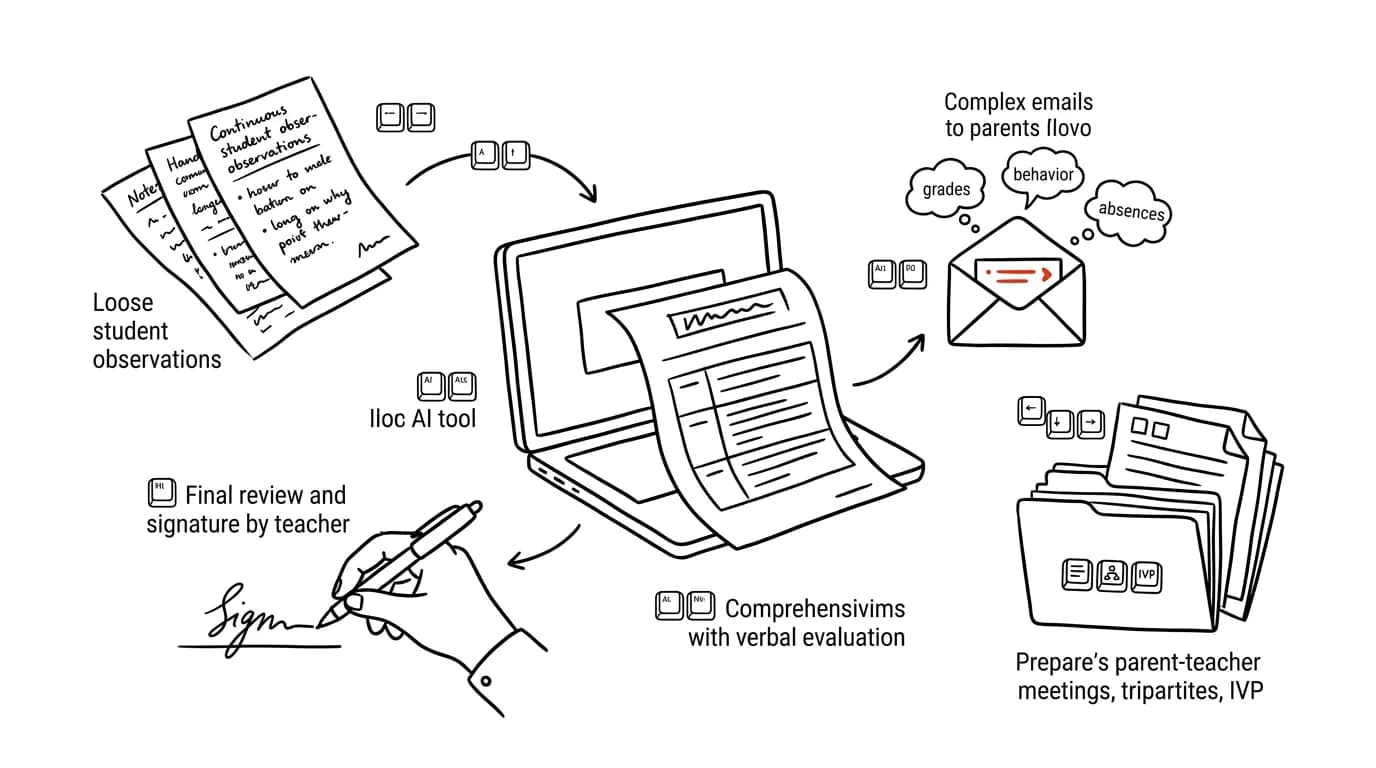
It's Thursday before the term closes, and twenty-four report card comments are sitting in front of you. Each one is supposed to be specific, kind, and different from the rest. You write the first three carefully; by the tenth you start recycling phrases, and by the twentieth you're just shuffling the same three sentences around. The parent who actually cares about that kid reads the result — and can tell they got a template.
AI knows nothing about your students, and that's exactly why it pays to use it correctly. It can't write the comment — it can only turn your notes into readable prose. Feed it something like "missed three assignment deadlines, but in December came up with a group-project idea on his own and pulled it off," and you get back a concrete comment. Feed it nothing, and you get back a cliché — and a cliché in a report card comment is worse than a grade, because it pretends to a kind of attention nobody actually paid.
This guide moves from setup and data protection through running notes and comment-writing to tough emails, parent conferences, and paperwork for an individual education plan (IEP). Every stage has copy-paste prompts — just fill in the brackets. You don't have to read it start to finish; grab whichever section is burning right now. But three rules hold across the whole piece. Student names and details don't belong in a chat — work with initials or roster numbers instead. Use a school or paid account with a data-protection agreement, not some random free chat tool. And the teacher signs the comment: whatever goes out to parents is something you read, rewrote, and stand behind.
A typical scenario
Petra teaches language arts in middle school and is the homeroom teacher for 7th grade. Across her classes she has around a hundred and ten students total, twenty-four of them in her own homeroom. Last year the school switched to a combination of a grade and a written comment for homeroom-taught subjects, so at the end of the term she writes twenty-four comments of roughly ten lines each. On top of that, three unpleasant emails: two parents need to be told their child is at risk of failing, and one needs a description of a repeated incident in class. And in two weeks there are three-way conferences, for which she needs to prepare notes on every student.
Until now it looked like this: on Sunday, from three in the afternoon until eleven at night, she wrote comments from memory, because her running notes were scattered across a notebook, her phone, and nowhere in particular. For half the students she'd recall one striking moment and pad out the rest with generalities. She rewrote emails to parents five times, because the first version sounded like an accusation and the third like an apology.
Now it looks different. She dictates notes into her phone two minutes after each class and once a week has them sorted by student — building up a record she won't have to invent in January. She writes her comments from that record: the model drafts a version, she rewrites it in her own words, and for five students she throws the draft out and starts over because it missed the point. The email about the risk of failing has a structure that works — facts, impact, a concrete offer, an invitation to talk. She goes into conferences with a four-line card on every student. The whole thing takes a Friday afternoon instead of an entire Sunday — and, more importantly, every comment is different, because every student is different and the notes can carry that.
Phase 1: Before you write the first prompt
This phase takes an hour and happens once a year. Skip it and you either run into a data-protection problem or find yourself re-explaining your school's grading approach in every single chat.
Anonymization: the key stays with you
Notes about students are personal data, and some of it is sensitive. Only anonymized notes belong in a chat — and anonymizing isn't the same as "I left out the last name."
Label students with initials or a roster number: S1, S2, S3. Keep the number-to-name key with you — in the school's information system or in a file on your own computer — and never put it in a chat. When you're describing a conflict between two children, they become Student A and Student B. Leave out last names, birth dates, addresses, the names of parents and siblings, the school's name, and anything that, in combination, points to one specific child — "the only boy in the class who commutes from [town]" is an identification even without a name. Don't describe diagnoses and health information by their clinical name; describe what you observe instead: instead of naming a disorder, write "needs more time on written assignments and has more trouble sustaining attention during a lecture."
What you must not leave out, on the other hand, are the concrete facts: grade level, subject, number of missing assignments, number of absences, the date and description of an incident. Those are exactly what makes a comment readable. An anonymized note stripped of numbers and situations produces precisely the clichés you're trying to avoid.
You pair the finished comment with a name only on your own end — in the school's system, in Word, in a spreadsheet. The name never needs to go into the chat at all.
Account and school approval
Use a school license or a paid account with a data-protection agreement, not a free chat tool. Before you start, ask your principal or IT coordinator two things: which tool the school has approved, and whether there's an internal policy for handling student data in AI tools. "We don't have anything like that" is also an answer — it means you work anonymized and keep finished text inside the school's own systems. Five minutes spent asking this now saves you an awkward conversation once you've already written a hundred comments.
A project with persistent context
Every school grades differently: some write in the third person, others address the student directly; some cover performance only, others behavior and cooperation too. Explaining that to the model in every chat is a waste of time — that's what Projects are for, persistent context carried into every conversation inside that project. Upload your school's grading rules (an excerpt from the grading policy), three to five anonymized comments of your own from past years that you consider well written, and set instructions:
You are a teaching assistant for a [middle school] teacher,
subject [language arts].
You help me draft report card comments and parent communication.

Standing rules that apply to every response:
- Work EXCLUSIVELY from the notes I give you. Don't invent
  anything about a student or pad the text with generic
  pedagogical phrases.
- If the notes are too thin for a specific comment, write
  NOTES MISSING instead of a comment, and list what I need
  to provide.
- Don't use labels or judge character ("is lazy," "is smart,"
  "is a problem child"). Describe behavior and work, not
  personality.
- Don't use superlatives or phrases like "improved significantly"
  unless the notes say by how much and in what.
- I identify students by initials or numbers. Never ask for names.
- Write factually, kindly, and concisely. No opening pleasantries
  and no summary closing lines like "wishing much success."

I've attached samples of comments I wrote myself. Match
their vocabulary and length.
You set the instructions once and save yourself repeated corrections. The rule about missing notes is the most important one: without it, the model fills every gap with a nice-sounding sentence you have nothing to back up. More on this mechanic in the tip custom instructions.
Phase 2: Notes worth grading from
Comment quality isn't decided in January — it's decided over the course of the year. This phase is tedious, and it's the one that matters most.
What to write down
A useful note about a student comes in three forms, and all three carry a date. Evidence of what they can do: a specific moment where something went well ("on Tuesday explained the difference between a modifier and an appositive to a classmate, and explained it better than I did"). Movement: what changed since fall, even if it's small ("started turning things in on time, for the first time in December"). Need: what specifically is blocking the next step ("reads with comprehension but can't sustain a paragraph's structure in writing").
Two or three notes like that per term, per student, are enough for a comment that won't read like a template. Zero notes means you'll write a cliché in January no matter what tool you use.
Dictating after class
The fastest way to keep records isn't typing them into a spreadsheet — it's dictating them into your phone. Two minutes after class, say a stream of consciousness: what happened today, and with whom. It doesn't need to be organized — organizing is a job for the machine. The dictation itself is covered in the tip dictating text. Once a week, drop the transcripts into a chat:
Here are my dictated notes from this week's classes.
They're raw, disjointed, and mix students with organizational
stuff. I called students by name — replace every name with
a stable code (S1, S2, …) and put the name-to-code key at
the end so I can delete it.

[paste transcripts]

Sort the content like this:
1. For each student mentioned: bullet points in the form
   date — situation — takeaway (what they can do / movement /
   what they need)
2. Organizational items and tasks for me, as a separate list.
3. Notes too general to draw anything from — put those in
   an "unusable" section, don't flesh them out.

Don't add anything and don't evaluate. Just sort and rewrite
into economical sentences.
You get back records organized by student, which you copy into your own spreadsheet. The "unusable" section is there on purpose: it shows you that a note like "it was fine today" carries no value for a comment, and next week you'll dictate something more specific. Delete the name key once you've copied it over.
Auditing your notes before closing the term
Three weeks before the term closes, go through your records and count how many students have fewer than two usable notes. It's often surprising: the thinnest notes usually aren't for the loudest kids, but for the quietest ones — the ones who don't act out and don't stand out. Those are exactly the students whose comment slides into emptiness. Three weeks' notice, knowing who to watch, fixes that.
Phase 3: Report card comments
Cliché versus a substantive comment
The difference shows up in a single pair of examples. The cliché reads: "The student works conscientiously in class and takes her responsibilities seriously. More attention should be paid to homework preparation next term." You can't tell who this is about, what happened over the term, or what the parent is supposed to do about it at home. It fits ten kids in the class.
The substantive version reads differently: "In oral exercises she made the biggest jump in the class this term — moving from reading a prepared text aloud to speaking freely with notes. In writing, paragraph structure still eludes her: she has the ideas, but orders them in whatever sequence they occur to her. A concrete step for next term is writing a three-point outline before a composition, which we tried together in December and it worked."
The second text has three qualities you can ask a prompt for: it's specific, it describes work instead of character, and it ends with a step that's actually doable. The source material is three notes from the record — nothing more.
Drafting one student's comment
Write a draft report card comment for student [S7], [7th grade],
subject [language arts], for [term 1].

My notes:
[paste notes from the record — date, situation, takeaway]
Grade they'll get: [C]
Comment length: [8-10 lines]
Recipient: [parents; this will also go in the student's grade book]

Structure:
1. What the student can do — referencing a specific documented
   situation
2. What changed over the term (progress or stagnation — describe how)
3. What's still not working — describe the behavior, not the
   cause, and without labels
4. One concrete step for next term that's within their reach

Rules:
- Work only from my notes. Where I have no notes for a point,
  write NOTES MISSING and don't invent filler.
- No generic pedagogical phrases ("conscientiously fulfills
  responsibilities").
- Don't judge character or family background — judge the work.
- Don't write that something "must" happen unless my notes
  frame it as a requirement.

At the end, attach a list of sentences you wrote at the edge
of what my notes support, which I should double-check.
You get back a draft that usually just needs rewriting into your own words — and sometimes needs to be thrown out entirely, because it shows the notes weren't enough to comment from. Either outcome is useful. Read the "edge of the notes" list carefully: it's the one place where the model admits where it pushed.
The whole class at once
One student at a time, that's twenty-four chats. It's faster to hand over the whole spreadsheet — but with an explicit ban on repetition, or you'll get twenty-four variations on the same thing.
Here are the records for the whole [7th grade] class, subject
[language arts], for [term 1]. Each row is one student: code,
grade, 3-5 notes from the term.

[paste table]

Write a draft comment for every student, length [6-8 lines],
following the structure: what they can do — what changed —
what's not working — one concrete next step.

Hard rules:
- Every comment must be recognizably about a different child.
  Don't reuse the same opening or closing line twice.
- No sentence may repeat across comments.
- Work only from that student's own notes. Don't carry anything
  over between students.
- For students where the notes are thin on some point, write
  NOTES MISSING: [what I need to provide] instead of a sentence.

At the end, add two lists: students whose notes were insufficient,
and phrases that repeated anyway.
You get back a complete set of drafts in a single pass. That last paragraph is a self-check and works surprisingly well. Still, read the whole set at once: a repeating rhythm of sentences only shows up when you see them together — and parents who compare notes with each other will notice it too.
Two versions: for parents and for the student
The text written for parents and the text written for the child differ by audience, not content. For the student, the comment needs to be understandable and usable — a phrase like "the student demonstrates" does nothing for a thirteen-year-old holding it. So have the finished comment rewritten into second person, and attach four conditions to the request: keep every fact and number unchanged, simplify the language to grade level, write the critical part clearly but about the work and specific situations rather than about the child as a person, and phrase the closing step as something they can do next week.
The last condition matters most: don't soften it until the content disappears. The typical failure is that "didn't turn in five assignments" becomes "there were a few times an assignment didn't quite make it in." The number has to survive.
Checking before you sign
Do one last pass with the finished texts, aimed at catching what you missed.
Review these [24] finished report card comments as a strict
colleague who's about to see them published. Don't rewrite
anything — just list findings with a reference to the specific
spot:

[paste comments]

Look for:
1. Clichés that would fit anyone — quote them verbatim.
2. Judgments of character or family background instead of work.
3. Labels and words that pigeonhole the child.
4. Claims with no visible basis in the text.
5. Phrasing a parent could read as an accusation even if it
   wasn't meant that way — suggest what the problem is with each.
6. Sentences that repeat across comments.
7. A mismatch between the comment's tone and the grade given.

Rank the findings by severity. Don't fix them.
The ban on fixes is there on purpose: if you let the model rewrite the text, you'll trade one set of clichés for another and lose your own voice. Point 7 is worth watching — a glowing comment sitting next to a D will raise a question you'll be answering at the conference.
And then the rule the whole site stands on applies: AI proposes, the human approves. You sign the comment, you defend it, and you're responsible for it. A text you only copied won't hold up the moment a parent asks, "how did you arrive at this?"
Phase 4: Tough emails to parents
A structure that works
An unpleasant email to a parent fails the same way every time: either it's wrapped in so much padding the message gets lost, or it's so terse it reads as an accusation. A structure that works has four parts, in this order. Fact — what happened, when, how many times, no adjectives. Impact — what it means for the child, not for you. Offer — what specifically the school will do. Invitation — a proposed conversation with specific times. What to avoid: judging the parents' parenting, comparing to other children, guessing at a diagnosis, and promising a result.
At risk of failing
Write a draft email to the parents of student [S12], [7th grade].
Subject [language arts]. Situation: the student is at risk of
failing [term 2].

Facts to work from (don't add anything):
- [5] of [9] compositions not turned in, deadlines were [list]
- of [3] written tests, [2 F's, 1 D]
- in class [works when given the assignment in smaller chunks]
- [in November he came to ask for help twice after class]
What the school is offering: [conference Thursday 2:00pm,
tutoring on Tuesdays, option to turn in 2 assignments by 4/30]

Structure: fact — what it means for their son — what we're
offering — invitation to meet with two specific times.

Rules:
- No judgment of the family or home routine.
- No comparison to other students.
- Don't promise anything ("if he does X, then he'll definitely...").
- Don't apologize for writing, and don't spend three lines on
  opening pleasantries.
- Max [250] words, factual and calm tone.

Write two versions: one shorter, one that explains more.
You get back two variants to choose from depending on how well you know the parents. Check whether the model softened any numbers — "several missing assignments" instead of "five of nine" is exactly the kind of change that keeps a parent from grasping how serious it is.
Behavior and a classroom incident
With behavior, the trap is different: it's easy to slide from describing a situation into describing the child.
Write a draft email to the parents of student [S4], [7th grade],
about a repeated situation in class.

What happened (stick exactly to these facts):
- [3/3, 3/10, and 3/17] disrupted the lesson [describe concretely
  what he did — not how it felt]
- responses I tried: [moved his seat, talked with him after class,
  logged it in the system]
- what worked, at least briefly: [pair work with S9]
- the other student in the conflict is [Student B]; I'm informing
  their parents separately

Structure: what happened — how it's affecting him and the class —
what I've already tried — what I'm proposing next — invitation
to meet.

Rules:
- Describe behavior in specific situations, never the child
  as a person.
- No guessing at causes (home life, friends, health, attention).
- Don't name or give an identifiable description of the other
  student.
- Don't mention "other parents' complaints," even if there were any.
- Frame it as looking for a solution together, not announcing
  a punishment.
- Max [250] words.
You get back a text that sticks to the facts. The most common fix: the model likes to add an explanatory sentence like "this is probably an attempt to get attention" — cut it. Interpreting the causes of a child's behavior has no place in an email to parents. For the conversation that follows the email, you can rehearse it — see rehearsing a difficult conversation.
Absences
Write a draft email to the parents of student [S18], [7th grade],
about absences.

Facts: [86] class periods missed [Feb-Apr], of which [74 excused,
12 unexcused]. Common pattern: [single days, most often Mondays].
Impact on coursework: [missed the entire unit on complex
sentences, 4 of 6 grading assessments missing].
School policy: [quote verbatim what the student handbook says
about excusing absences and about the possibility of not
receiving a grade].

Structure: numbers — what it means for grading — what the
handbook says — offer to make up material — invitation to meet
with proposed times.

Rules:
- Don't ask about the reasons for the absences in the email,
  and don't speculate about them.
- Don't claim anything about truancy or the family situation.
- State the numbers exactly as I gave them.
- Tone: informative and offering help, not a warning.
- Max [220] words.
You get back wording that states the facts and opens the door. Speculation belongs outside written communication: reasons get worked out in a meeting, or through a school counselor if needed. And enter the handbook wording verbatim into the prompt — paraphrasing from memory is where a claim that isn't actually in the handbook sneaks in.
Responding to a hostile email
The hardest genre. Rule number one is to let the email sit for at least a day. Rule number two is not to let AI write the reply — let it show you what's actually in the email.
I received this email from a parent. Don't reply on my behalf.

[paste email]

Do three things:
1. Break down what the parent is actually asking for — separate
   concrete requests and questions from emotion and blame.
2. List claims I need to verify against documentation (what's
   fact, what's their interpretation, what's inaccurate).
3. Sketch a reply outline in bullet points: what I should
   answer in writing, what belongs in a face-to-face meeting,
   and what I need to hand off to the principal or school
   counselor.

Don't write a finished reply, and don't comment on the parent's
tone.
You get back a breakdown that strips the emotion from the email and leaves the requests. Only once you know what you're replying to does it make sense to have a draft written — the process is in the tip AI writes the first draft, you write the final one. And it still holds: a human always hits send.
Phase 5: Parent meetings and conferences
Notes for the group portion
The group portion of a parent meeting can be prepared in twenty minutes: list the points that need covering (no names, about the class as a whole), and have an agenda drawn up with time estimates, two to four sentences per point that you can say out loud, anticipated parent questions with answers, and a short summary for anyone absent. Add one more request that makes the whole thing worthwhile: a list of things that don't belong in front of the whole group and need to be handled individually. A specific child's performance, behavior, and anything personal — never in front of a room of parents — and it helps to have that written down in front of you for the moment someone asks anyway.
Cards for three-way conferences
A teacher-parent-student conference lives or dies on whether you've got something concrete prepared for each child. Without notes, it dissolves into generic small talk.
From these records, prepare conference cards for three-way
meetings (teacher, parent, student), [7th grade].

[paste records — student code, grades, notes]

One card per student, max 6 lines:
- two things that went well this term (specific, documented)
- one thing to build on going forward
- one question I'll ask the STUDENT (not the parent), so they
  talk
- one agreement I want to leave the meeting with
- what I should double-check before the meeting starts

Cards must be short enough to read in ten seconds. Work only
from the records; note where evidence is missing.
You get back a set of one-page-per-student cards. The question for the student is deliberately on the card: a three-way conference where the adults talk about the child for twenty minutes while they sit there checks a box and misses the point.
Meeting minutes
Write up your minutes right after the meeting, while you still remember what was agreed.
Here are my notes from [4] conferences, written during the
meetings themselves. They're raw.

[paste notes]

For each conference, write minutes:
- date, participants (role only: mother / father / student /
  homeroom teacher)
- what we discussed (3-5 points)
- what we agreed on — list action items separately in the
  form who — what — by when
- what remains unresolved and who's following up

Separate agreements from mere discussion. If a note doesn't
make clear whether something was an agreement or an option
under consideration, put it in the unresolved category and
flag it with a question mark.

No student names — use the codes I have in my notes.
You get back minutes to file, and in May they'll show you what actually came of what was agreed. Separating agreement from discussion is the crux of it — it's exactly what gets disputed three months later. The same mechanic works for staff meetings too: staff meeting minutes.
Phase 6: IEP paperwork
Who writes the IEP, and what AI's role is
An individual education plan (IEP) is drawn up by the school based on a recommendation from the school's counseling and psychological services, in cooperation with the parents. AI doesn't change any of that: the model can't recommend a support measure, guess at a diagnosis, or decide on modified requirements. What it can do is help you turn what you've observed in class into something the counseling team and your colleagues can work with. The strictest version of the data rules applies here: no names, no diagnoses, no references to medical records — only behaviors and situations.
Help me write up a classroom observation as input for an
IEP meeting. I'm not a diagnostician and neither are you —
don't suggest a diagnosis or specific support-tier
accommodations.

Student [S5], [7th grade], subject [language arts].
My observations from [September-January]:
[paste notes — specific situations with dates]
What I've already tried in class and how it went:
[paste — for each measure, note how long it ran and with
what result]

Write a structured description:
1. How the difficulty shows up in class — specific situations,
   not generalities
2. Where the student has no difficulty, by contrast (documented
   strengths)
3. Under what conditions performance improves (what I observed)
4. What I tried, and what worked and what didn't
5. Questions I should ask the counseling team

Write descriptively, in the past tense, without evaluative
adjectives and without interpreting causes. Where I'm missing
evidence, say so.
You get back a text you can send to the school counselor. Point 3 is usually the most valuable to the counseling team and the most commonly missing from notes: "completes work when given the assignment in chunks, doesn't start when given it all at once" is more useful for designing support than a description of what doesn't work.
Evaluating after the term
The plan gets evaluated on an ongoing basis, and the same prompt works for that too — just swap the observations for the current accommodations and classroom records, and ask for a description of how each one was applied and with what observable effect. Add a line saying that where the records don't support evaluating an accommodation, the model should say so explicitly; without it, you'll get a plausible-sounding evaluation for an accommodation you have no evidence for. And the same limit applies as above: the model writes up the input — the team, together with the counseling service and the parents, decides whether support continues or changes.
Common mistakes
- Letting AI write a comment with no notes to work from. Without notes, you get clichés a parent spots on first read. The tool can't replace observation — it can only turn it into text.
- Putting names, diagnoses, or a whole class roster into a chat. Student personal data belongs in the school's systems, not in a conversation. Initials or numbers, with the key kept on your end — otherwise, don't do it at all.
- Sending a parent text you only read. Rewrite it in your own words. If a parent asks about phrasing you wouldn't have used yourself, you'll feel it before they say anything.
- Letting the model interpret the causes of behavior. "This is probably a reaction to something at home" is a sentence that belongs in neither an email nor a comment — it's a guess, not an observation, and parents read it as a verdict.
- Using labels in a comment, or promising a result in an email. "Is lazy" judges character instead of work; "if he reads at home, things will even out by June" will come back to bite you in June.
- Producing twenty-four comments that all sound the same. Without an explicit ban on repetition, the model recycles phrasing. Always read the whole set together, not one at a time.
The best tools
- Claude or another chat tool on a paid or school account — drafting comments and emails from anonymized notes; don't use a free account for school business.
- Projects (persistent context) — one place where the model holds your school's rules, samples of your own comments, and your instructions; you don't have to repeat them in every chat.
- Dictating on your phone — two minutes after class instead of trying to remember it all in the evening; one prompt turns a raw transcript into records.
- A records spreadsheet (Excel, Sheets, Notion) — columns for student, date, note, category (can do / progress / needs); this is the source you write from in January.
- The school's information system, and a colleague as a second set of eyes — finished text and names belong in the system; for anything contentious with parents, have a human read the email before it goes out, not the model.
What you get out of it
- Time: comments for a whole class, from prepared records, take an afternoon instead of an entire Sunday; a tough email takes fifteen minutes instead of an hour of rewriting. The condition is the records — without them, there's no time saved.
- Quality: a comment built on documented situations is specific, and a parent recognizes their own kid in it. The difference shows up most for quiet students, who usually get the most generic text.
- Peace of mind: an email with the fact–impact–offer–invitation structure draws noticeably fewer combative replies than the same content written at ten at night with no structure.
- Clarity: conference minutes with who–what–by when agreements mean you're not arguing in May about what was decided in March.
Pro tip
The advanced trick is to keep your records so they can be written from in either direction. Add one extra word to each note: who it's for — the student, the parents, or the file. Come January, you're not filtering text, you're selecting from it, and one set of records serves comments, conferences, and any IEP paperwork alike. It costs a second at the time you write the note and saves hours when it's time to write.
And a final rule with no exceptions: the machine proposes, the teacher decides and signs. The grade, the comment, what you tell parents, and what you send to the counseling team are your professional decisions. AI can save you an evening spent on wording — it can't save you the responsibility for what you write about a child.
Want to go deeper? The handbook has a whole chapter on it — AI and automation.
Similar tips
Dictate messages on the go
The microphone on your keyboard writes what you say — reliably. A reply on the move doesn't have to wait for the keyboard.
Your first no-code AI automation: trigger, AI step, draft for approval
A complete guide with prompts: when a Claude routine is enough and when you need n8n, Zapier, or Make, what a scenario's anatomy looks like, three full scenarios step by step, the AI-step prompt, and error handling.
Hiring with AI: from job description to structured interview
A complete guide with prompts: how to write a job description from your team's reality instead of a wishlist, a job ad someone will actually answer, a scorecard with real criteria, a structured interview with the same questions for everyone, and a rejection people won't resent. Plus a hard line — AI sorts the material, a human always decides on the candidate.
Liked this tip?
I send one like it every week by email. Two minutes to read, hours saved.
1 tip a week · no spam · unsubscribe in one click