Handbook · At the company · 13 min read
Why personal systems don't add up
A team made entirely of productive people can still be slow. Coordination costs, three sources of loss, and shared context as the group's real capital.
In this article
Picture a department where each of eight people has their personal system dialed in. One runs on GTD, another does time-blocking in their calendar, a third keeps notes in Obsidian meticulously enough to publish a book from them. Nobody procrastinates, nobody forgets tasks, inboxes are empty. And yet the team delivers slowly, projects run long, and everyone feels like they're working themselves ragged for very little to show for it.
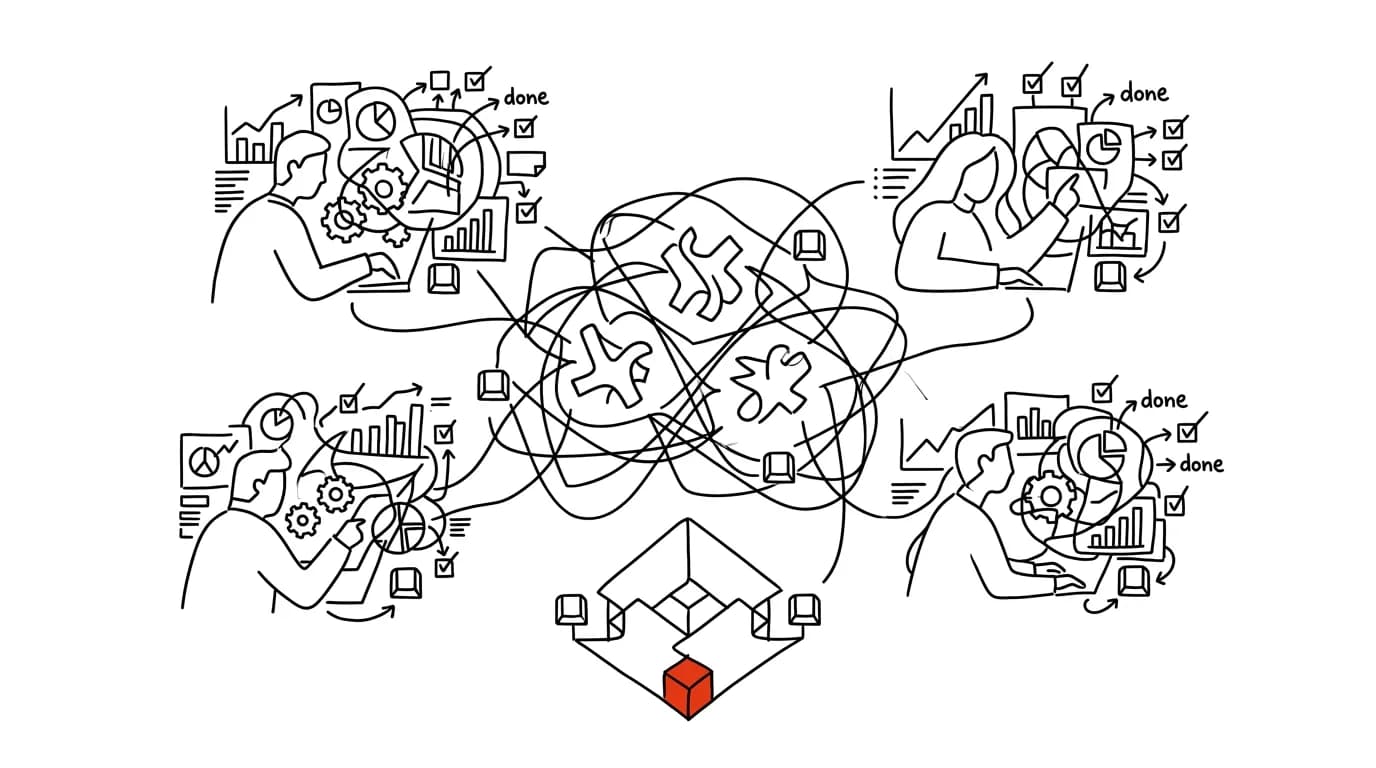
It's not a paradox or bad luck. It's the logical consequence of the fact that a team's output isn't determined by the sum of individual outputs, but by the quality of what happens between them. Personal productivity optimizes what one person does in a day. Team productivity optimizes something else: how fast work moves through the whole group, from assignment to finished result. Those are two different quantities, and you can improve one at the expense of the other. Eight people who each perfectly guard their own time can, together, build a system in which nobody ever gets an answer on time.
This chapter is about the principles of group performance. The concrete tools, meeting formats, and the mix of synchronous and asynchronous communication are covered in the chapter Team productivity — here we're one layer beneath that: why coordination gets expensive, exactly where time gets lost, and what the capital actually is that makes one team faster than another with equally capable people.
Coordination costs grow faster than the team
When a person joins a team, working capacity goes up. But so does something that never gets planned for: connections. In a group of three, there are three relationships to maintain. In a group of five, ten. In a group of eight, twenty-eight. In a team of twelve, sixty-six. Capacity grows linearly, the number of possible connections grows quadratically — and so does the time people spend staying aligned.
In practice, of course, nobody maintains all connections at once — that's what structure, roles, and splitting into smaller units are for. That's exactly why they exist: they're tools for taming a number that would otherwise devour the team. A team with no structure pays the full price.
This math is behind the well-known observation from software development that adding more people to a project that's already behind schedule can slow it down further. A newcomer first consumes the time of the people who already understand the work, and adds more connections to a network that now needs synchronizing. Don't take this as a law that holds always and everywhere — for cleanly separable work it doesn't apply. Take it as a warning against the instinct that says "we're behind, let's add people." That instinct silently assumes coordination is free.
There are three practical consequences. Smaller teams with clearly scoped responsibility outperform a larger team with no boundaries. Splitting a large group into units that need to talk to each other daily is an organizational decision with a direct impact on speed. And every team expansion has its own payback period — typically several weeks during which the team is slower than before, which needs to be planned for, not treated as a surprise.
Three sources of loss: waiting, rework, interruption
When you want to speed up a team, it's tempting to start with "how do we get people to do more." A more useful question runs the other way: where is work that's already been done getting lost? In the vast majority of teams, loss takes three forms.
Waiting
A task in a team spends most of its life in a state where nobody is doing anything with it. It waits for approval, for input from a colleague, for someone to get back from vacation, for the Friday meeting where it'll get decided. If a team measured how long a typical task takes from assignment to done, and subtracted the net time actually spent working on it, the number that came out would usually surprise everyone.
Waiting is the quietest loss, because it doesn't show up on anyone's timesheet. Nobody's sitting there staring into space — everyone's doing something else in the meantime. That's exactly why it's insidious: a team with a high share of waiting looks busy while delivering slowly. And because nobody wants to be idle, everyone picks up more work in progress, which stretches the waiting even further. The result is a state where everything is in progress and nothing is done.
The remedies are boring and effective: limit how much work is in progress at once (WIP limits are covered in the chapter Scrum, Kanban, and OKR), shorten approval chains, and above all make queues visible. A board that shows what's waiting on what, and for how long, does more for speed than a call for more effort.
Rework
The second loss is work that got done and has to be done again, because the brief wasn't clear, context was missing, or conditions changed in the meantime and nobody said so. It's the most expensive of the three, because it consumed full time and created no value — and on top of that, it drains people's motivation.
Most rework starts at the beginning, not the end. The brief "prepare a presentation for the client" has at least five unknowns: for whom exactly, what it should lead to, what the client already knows, how long it should be, and what happens if a problem comes up. Whoever leaves those unfilled has delegated uncertainty, not a task. A brief template covering context, expected output, deadline, boundaries, and escalation is described in the tip delegating with AI — the most valuable part of it is having someone who knows nothing about the matter check the brief for you.
The second source of rework is late feedback. A draft that someone first sees only once it's finished either gets accepted even though it's not good, or gets thrown out entirely. A quick check on a work-in-progress concept takes ten minutes and saves days.
Interruption
The third loss is the best documented: after an interruption, it takes a while to get back to the same depth of focus, and for demanding work that loss compounds. Attention research confirms this repeatedly, and most people know it even without the research.
But in a team context, something matters that personal-productivity guides don't cover. Interruption arises from something that's desirable in itself: willingness to help, a quick reply, availability. A colleague who answers within two minutes is a great colleague — and also a person who's chopped their day into pieces where nothing hard can get finished. This is where the difference between personal and team optimization shows up most sharply: a fast reply raises the recipient's output and lowers the sender's.
The fix isn't disappearing. The fix is agreeing on what's actually urgent. Most teams have a single speed of communication — everything right now — and that's exactly why there's no way to tell what genuinely needs to be fast. A team that has three agreed levels (right now, by phone; today, in a message; this week, in the task tracker) gets its focus back without making anyone less available for what actually matters.
Shared context is the team's real capital
Ask why an experienced team is faster than one freshly assembled from equally capable people. The answer isn't in skills. It's that an experienced team doesn't have to explain most things: it knows why a decision was made two years ago a certain way, knows the client's habits, has a hunch about who to call when the accounting system breaks, and understands the shorthand in its own documents.
This is what you'd call shared context, and it's the one asset a team genuinely owns. Individual skills leave with people. Context, if it only exists in people's heads, leaves with them too — and that's the most expensive form of departure a company experiences. When someone quits and the team discovers "only she knew that," they haven't lost a worker — they've lost a piece of the organization's memory.
Context gets built through three things, and all three are uncomfortable precisely because their payoff shows up later.
Write down decisions, not just tasks. Task trackers record what needs to get done. Almost nowhere is it recorded why: what options were on the table, what decided it, what wasn't known at the time. Yet that record saves hours of rehashing next time — and above all prevents the same debate from happening again every six months. One paragraph per major decision is enough.
Write in a findable place. Information in a direct message is locked inside two heads and practically doesn't exist for the organization. The same thing in an open channel is the team's property. This is the one habit change that costs nothing and changes a lot: whatever can be written publicly, write publicly.
Describe how things are done at the moment they're done for the first time. Not later, "when there's time." There won't be. The cheapest documentation is created as a byproduct of the work — and the best moment to check it is a newcomer's arrival, because they're the only one reliably able to spot what's missing from it. The tip onboarding a newcomer shows how to turn that kind of documentation into a source that answers a newcomer's questions instead of colleagues having to.
Who decides what
The most common hidden brake on a team isn't laziness or incompetence. It's a lack of clarity about who's allowed to decide what. It shows up in two opposite ways, and both cost a lot of time.
The first is a decision that crawls upward. Something a person on the spot could resolve in five minutes goes to a meeting, from the meeting to a manager, from the manager to a director — and waits a week in the meantime. It's not a lack of courage: on a team where people get called out for a wrong decision but never for delay, kicking it upstairs is a rational strategy.
The second is a decision everyone makes their own way. Three people answer a client three different ways, because nobody said who owns that area. The resulting firefighting costs more than the original decision would have.
The fix is boring and enormously effective: for recurring types of decisions, write down who makes them, who gets consulted, and who just gets informed afterward. It's not about hierarchy, it's about removing uncertainty. It's worth adding a second layer too — up to what amount, or what level of impact, a person decides on their own. A clearly stated boundary ("up to this amount, it's your call, no need to ask") is one of the strongest speed tools a manager has, and at the same time the cheapest expression of trust.
- 1Decide, no need to reportRoutine operation within the role. Most decisions on a well-functioning team should live here.
- 2Decide and let me knowYou do what you judge is right, and write about it afterward. The manager knows, doesn't slow you down.
- 3Propose and get it approvedYou prepare a recommendation with reasoning. The approver says yes or no, doesn't rethink it from scratch.
- 4I decideHigh-impact or irreversible matters. Should be a short list, not the default state.
A decision table has one quality no training session can replace: it lets you point without blame. When something drags, there's no need to hunt for a culprit — you just check whether the item was categorized correctly and move it down a level.
Deep work can only be protected together
The advice "turn off notifications and block off time" is only half true on a team. When everyone protects different hours, the result is that nobody ever meets and everyone is a little unavailable all the time. Personal protected time on a team creates a loss elsewhere.
The opposite arrangement works: the whole team's protected blocks are at the same time. Two meeting-free mornings a week for everyone, or a regular no-meetings day. Synchronized quiet has two benefits that don't add, they multiply. First, nobody is missing anybody — when nobody's in meetings, nobody has to apologize for being unavailable. Second, legitimacy for being unreachable shifts from the individual to the rule: I'm not replying not because I'm difficult, but because it's Thursday morning.
Two conditions have to hold for this to last. There has to be an agreed exception for a genuine crisis, otherwise the rule breaks on first contact with reality and never recovers. And the manager has to follow it too. A manager who calls a meeting during the protected block has just announced that the rule only applies to everyone else — and thereby cancelled it.
The rest of coordination can then get pushed outside the protected time. A status meeting replaced by three written questions in a shared document gives the whole team back an hour a week and leaves a findable trail; the process is in the tip a written status instead of a status meeting. One-on-ones, on the other hand, are worth keeping synchronous — with the difference that they have a standing shared document both sides keep adding points to over time, as described in the tip 1:1 with a living document.
Measuring performance without theater
The moment you start measuring activity, the team learns to manufacture activity. It's not bad faith, it's a reaction to a signal: measure the number of closed tasks, and tasks will get split into smaller ones; measure hours worked, and hours will get logged; measure response speed, and people will stop thinking before replying. Any metric tied to evaluation sooner or later becomes a target in itself, and at that point it stops measuring the thing it was created to measure.
Sensible team measurement holds to four principles.
Measure output, not motion. Not how much people did, but what's finished and usable for whoever it was meant for. The question "of what we shipped this month, what does anyone actually use" is uncomfortable and enormously useful.
Measure flow, not people. The most valuable numbers describe how work moves through the team: how long a task takes from assignment to done, how much is in progress at once, how much work comes back for rework. These numbers point at the system, not at people, which is why people don't block them.
Ask about the trend, not the absolute value. A single number means nothing on its own, because you have nothing to compare it to. The direction it's been moving for six months means a lot.
Separate measurement from evaluating people. The moment rewards start flowing from numbers, the numbers stop reflecting reality. Metrics are for improving the system; evaluating a person calls for a conversation, context, and judgment. The tip reporting upward shows how to turn operational numbers into a summary leadership will actually read, without it turning into theater.
Psychological safety isn't a soft topic
Of all the traits of well-functioning teams, one keeps coming out as the strongest, and at first hearing it sounds like an HR topic: whether people feel they can say something uncomfortable without fear. Admit a mistake, admit they don't understand something, disagree with a superior, flag a risk.
It's not about a pleasant atmosphere — it's about speed. A team without this kind of safety pays a delay for every piece of information. A mistake surfaces later and costs more. A risk gets named only once it's already happened. Nobody asks about what they don't understand, and delivers bad work that then has to be redone. Disagreement doesn't come up in the meeting, but afterward in the hallway, where it changes nothing. All three losses from the earlier sections — waiting, rework, interruption — grow in an unsafe team.
It's built mainly through how people react to bad news. When someone brings a bad piece of news and walks away feeling good about having brought it, the team learns that it pays off. When they walk away feeling like it was their own fault, the team learns something else — and next time, leadership finds out later. A manager who openly admits their own mistake does more for openness than any workshop.
Two things reliably destroy it: hunting for a culprit instead of a cause, and publicly criticizing a specific person in a meeting. Both teach the whole team that staying quiet is cheaper. How similar mechanisms play out at the individual level is covered in the chapter The psychology of productivity — fear and overload affect a team the same way they affect one person, it's just harder to see.
Key takeaways
- A team's output isn't the sum of people's output. Personal productivity optimizes an individual's output; team productivity optimizes how work flows through the group — and one can be improved at the expense of the other.
- Coordination costs grow faster than the team. Structure, clear roles, and smaller units aren't bureaucracy — they're a tool against the quadratic growth of connections. Adding people to a project that's behind schedule can slow it down first.
- Look for losses, not reserves of output: waiting (the quietest and biggest), rework (the most expensive, born at the start from a bad brief), and interruption (born from a willingness to help).
- Shared context is the only capital a team owns. Write down decisions along with their reasons, write in a findable place, and describe procedures the moment they're created.
- Clearly split authority is a speed tool, not hierarchy. A stated boundary — "this one's your call" — shortens turnaround time more than any motivational talk.
- Protected blocks only work if they're shared — the whole team at the same time, with an agreed exception for a crisis and a manager who follows the rule too.
- Measure flow and output, not activity, track the trend rather than absolute numbers, and don't tie metrics to evaluating people — or you'll grow yourself a theater.
- Psychological safety is a condition for speed, not a soft bonus. A team where bad news arrives late pays that delay in every one of the other losses too.
Want to keep the momentum?
One tip from the handbook by email each week — in an order that makes sense.
1 tip a week · no spam · unsubscribe in one click