Handbook · At school · 15 min read
Lesson prep as a system, not improvisation
The cascade from the school curriculum down to a single lesson, a materials bank that pays off years later, and a lesson plan that almost never survives contact with the class. How to turn prep into a system instead of endless evening firefighting.
In this article
- The cascade: from the curriculum down to one lesson
- Prep once, use it five times
- The anatomy of a lesson, and why the plan almost never survives contact
- Differentiation as a project, not improvisation
- A stock of backup activities
- What to archive and what not to
- Covering a colleague's lesson without panic
- Key takeaways
Picture two teachers who teach the same lesson to the same class with the same result. The first prepared it last night, from eight until half past ten, because they only realized on Monday that this topic was coming up. The second prepared it three years ago, spent fifteen minutes this year tweaking it based on a note they wrote to themselves last year, and was in bed by ten last night. The difference between them isn't skill or work ethic. It's that one has a system and the other doesn't.
Improvisation in teaching has its place — the best moments in a lesson often come from a question nobody expected. But improvisation as the default mode of prep is something else entirely. It means reinventing every lesson from scratch, not remembering what worked last year, having materials scattered across three drives and two folders, and having to deliver your best creative work in May, right when your energy is lowest. The previous chapter, on why teaching burns you out differently, describes how unforgiving that mode is. This chapter answers the question of what to do about it.
The basic idea is simple: prep isn't an event, it's capital. A lesson you prepare properly today and store so it can be found and edited isn't a cost — it's an investment that pays out again every following year, in every parallel class, and every time you hand a sick colleague a finished material instead of an apology. A system is simply a way of making sure that investment actually pays off.
The cascade: from the curriculum down to one lesson
The most common mistake in lesson prep isn't a shortage of work, but a missing middle layer. Teachers know the school curriculum and they know tomorrow's lesson, but between the two there's a gap — so every lesson gets planned in isolation, as if no context existed. The result is the classic teaching year where, by Christmas, only half the intended material has been covered, and May turns into a sprint that benefits no one.
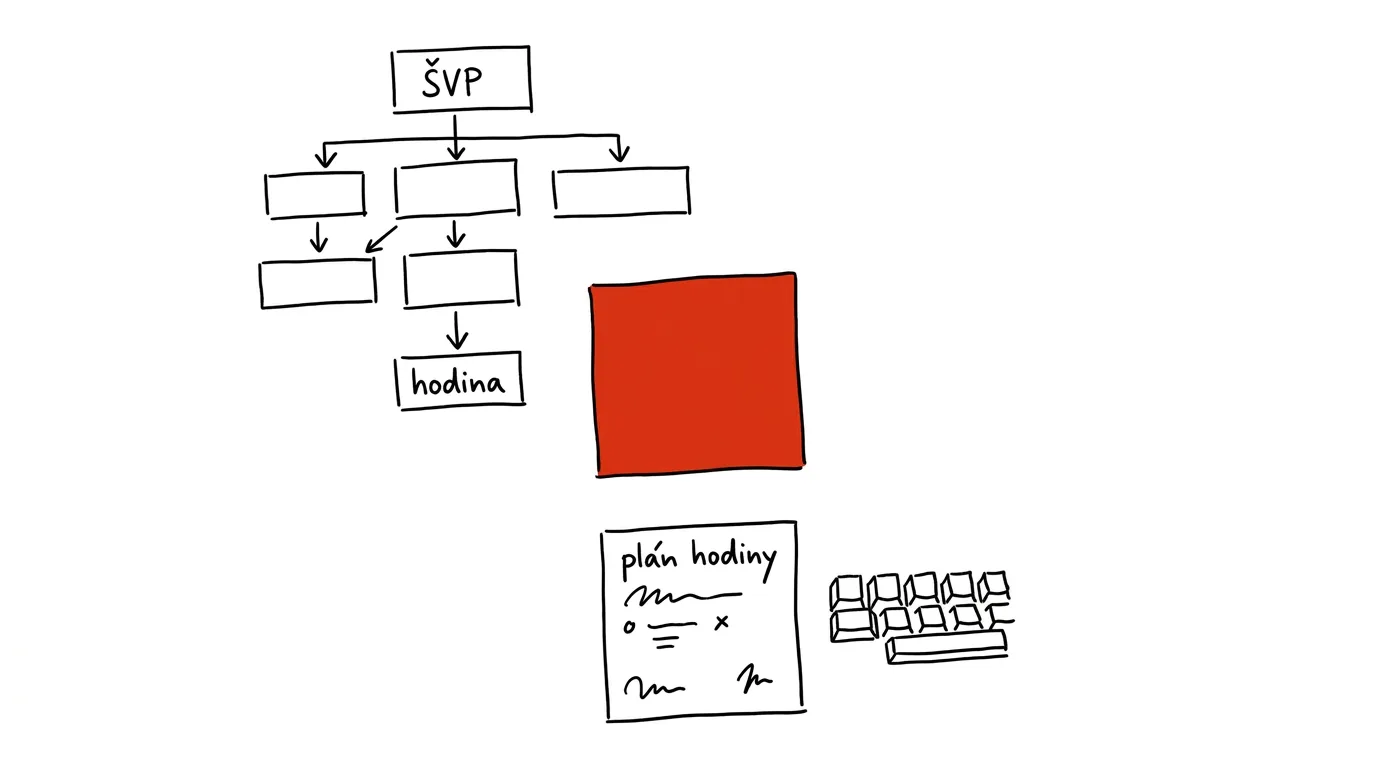
Working planning is a cascade of four levels. Each has a different frequency, a different level of detail, and a different lifespan.
- 1Curriculum and learning outcomesWhat a student should know by the end. You rewrite this every few years, but it's the frame every decision about what to cut refers back to.
- 2Yearly topic planSplitting the material into months and weeks, with a realistic buffer. Created in August and honestly revised at midyear based on where you actually are.
- 3Weekly layoutConcrete lessons for next week: what gets taught, what gets assigned, what gets graded. Half an hour on Sunday or Friday afternoon.
- 4One lessonGoal, structure, materials, backups. The shortest horizon, and the only level where content is actually created — if the three levels above it are working.
The key rule is easy to state and hard to keep: the yearly plan needs a buffer, not a maximum. If the plan assumes every single lesson will run without a hitch, it's wrong. Staff training days, field trips, ski week, a flu outbreak, a teacher's illness, and a day when the whole class walks in checked out aren't exceptions — they're normal parts of the year. A plan that doesn't account for them falls apart by November, and from that point on it's just playing catch-up.
A practical benchmark: plan for roughly eighty percent of your available lessons and leave the rest open. That fifth will reliably get consumed. When it happens not to, you get room for the things there's never time for — a project, deeper review, a lesson the class picks for itself.
The second rule concerns revision. A yearly plan without a midyear check is just a document in a drawer. Half an hour in January comparing the plan against reality and deciding what will actually happen in the second semester, and what falls away, saves you a panicked pace in May. And the hardest, most useful decision of all: fewer topics done properly beats all of them done superficially.
Prep once, use it five times
This is where it's decided whether prep becomes a cost or capital. The rule is: the amount of effort in prep should match how many times you'll use it.
A lesson you'll teach once and never again deserves an efficient minimum — a goal, a structure, existing material. A lesson you teach across three parallel classes and will keep teaching for the next five years deserves real work, because its cost gets split fifteen ways. Most teachers do the opposite by instinct: they pour the most energy into whatever's burning, meaning tomorrow, and never get around to building reusable things.
A materials bank
A materials bank isn't a folder on your desktop. It's a place with a clear structure, set up so things can be found a year later. A working structure is boring, and that's exactly why it works: subject → grade → topic unit → individual lesson. Within that, consistent file naming — topic, material type, year. Anyone who names files "presentation2_final_revised" is building themselves an archaeological dig site two years from now.
Three kinds of things belong in the bank. Finished materials — worksheets, slides, assignments, tests. Sources — links, videos, texts, images you found and would otherwise have to search for again. And implementation notes, which are the most valuable and most neglected category: two sentences on how the lesson actually went. "Opening activity took 15 minutes instead of 5, cut it next time." "The sudoku example clicked immediately, the train one didn't at all." These notes take ninety seconds to write right after the lesson and save you half an hour of thinking a year later. This connects to the principle of external memory covered in Your second brain — your head isn't storage, it's a workspace.
Versioning without complexity
Versioning in a teaching context doesn't mean any developer tool. It means one decision: don't destroy the original material when you edit it. When you update last year's worksheet for this year's class, save it as a new version with the year in the filename and leave the old one alone. The reason is practical — this year you'll realize the previous version was better for a weaker group, and you won't have to reconstruct it from memory.
Equally important is keeping one clear "current" version. The worst state isn't no system at all, but five files where you don't know which one is actually in use. A simple solution: the current version lives in the main folder, older ones in an "archive" subfolder. Nothing more.
Sharing in the department office
This is where the multiplier grows the most. When three teachers of the same subject each prepare the same lessons separately, the same work gets done three times. When they split it up and share, it gets done once. The obstacle is rarely unwillingness — it's usually the absence of a form. Nobody knows where to store what, in what format, or whether it's even okay to touch a colleague's material.
The agreement that fixes this fits into one afternoon: a shared drive with an agreed-upon structure, consistent naming, a rule that someone else's material gets copied and the copy gets edited, and a division of who prepares which topic unit. It's not an organizational revolution — it's making sure sharing doesn't require a fresh decision every time. For recurring agreements and routines, the approach in the tip Checklists for recurring processes fits well.
The anatomy of a lesson, and why the plan almost never survives contact
A well-built lesson has a recognizable structure. It doesn't have to be the same structure every time, but the elements repeat because they match how people learn: first you need to activate what they already know, then bring in the new material in portions, then they need to try it themselves, and finally name what they're taking away.
- 0–5Warm-upA question, an image, a short problem. The goal is to activate what students already know and open the topic — not deliver an intro lecture.
- 5–20Instruction in portionsNew material in pieces with short checkpoints along the way. An unbroken explanation longer than ten minutes falls apart for most classes.
- 20–35PracticeStudents work alone or in pairs. This is where the actual learning happens — and where the teacher finds out what didn't land in the instruction.
- 35–42ReflectionWhat we learned, where we'll use it, what's still unclear. Five minutes that decide whether the student takes anything away.
- 42–45Wrap-upAssignment, tidying up, goodbyes. Plan for this part to exist — otherwise it eats into reflection.
And now the important part: this plan almost never survives contact with the class, and that's not a failure. The warm-up takes off and it's worth letting it run. A question comes up during instruction that reveals half the class has a gap further back. Practice goes slower because the assignment was harder than it looked. The bell doesn't wait.
The difference between improvised and systematic prep isn't that systematic prep always goes as planned. It's that systematic prep knows in advance what gets cut in an emergency. When a lesson has one clearly stated main goal, and each part has been marked as essential or nice-to-have, cutting on the fly becomes a calm decision instead of a panic. In practice that means marking, during prep, the minimum that has to happen, and treating the rest as bonus program.
The second consequence is about planning. If the plan regularly runs ten minutes over, the fix isn't talking faster — it's planning for thirty-five minutes. The buffered topic plan (see above) is just this same thinking one level up.
The part that most often gets cut first is reflection. That's a shame: it's the cheapest way to find out what the class actually took away, and it's feedback you'd otherwise only get from a test. When a lesson has to be shortened, cut from practice before cutting the wrap-up.
Differentiation as a project, not improvisation
In every class there's a student who gets the assignment in ten seconds and one who's still reading what's being asked five minutes in. The improvised response to that gap means telling the fast one "help your neighbor" and rephrasing the assignment for the slow one on the spot. It works, but it burns through the teacher in real time and depends on how much energy they happen to have left.
The systematic answer is to solve the gap during prep, not during the lesson. The simplest working form is a trio of levels for the same assignment: a base version everyone has to manage; an extension question for those who finish early; and a simplified variant with more scaffolding for those who need step-by-step support. It gets created once and used repeatedly, and in the lesson you just hand it out.
Other forms work similarly: the same assignment with optional number difficulty; a text in two lengths; questions graded so the first level is doable by everyone and the last is for those who want more. What matters is that all the variants get created at once, while you still have the topic in your head. Creating two additional versions of an assignment that already exists takes a fraction of the time of building from scratch — and that's exactly the kind of work AI can significantly speed up, when you feed it the finished assignment and tell it what variant you need. The tip Lesson prep with AI walks through a concrete process; for enforcing a consistent output format, the tip Format examples for AI helps.
One principle applies here that must never be dropped in a school setting: AI proposes, the human approves. A simplified assignment for a student with support needs has to go through the teacher — the model doesn't know what specifically that particular child struggles with. And names, diagnoses, or evaluative information about students don't belong in an ordinary tool; work with a general assignment, not personal data.
A stock of backup activities
Every teacher knows this. A lesson meant to run the full forty-five minutes is done in thirty. The tech doesn't work. You show up to cover a class and have nothing prepared. Half the class is at a competition and there's no point continuing the material with the other half.
Improvising in this situation is exhausting, because it hits exactly when you have the least room to think. The systematic answer is a stock of prepared activities that require no prep and no materials and can be used at any moment.
A useful stock has three types. Short activities of five to ten minutes tied to the subject — a review quiz, a puzzle, a quick problem on the board. Longer activities of twenty to thirty-five minutes that stand on their own and work even in someone else's class — independent work with a text, a discussion topic, a small project task. And a universal fallback that works across grades, for when you know absolutely nothing about where you're walking into.
The stock doesn't need to be big. Five to eight items per subject cover most situations and build up gradually — every time something works, you jot it down. What matters is keeping it in one place, accessible from your phone, with a note on each item for which grade and how long.
What to archive and what not to
An archive where everything gets saved is as useless as no archive at all. Deciding what to keep is therefore part of the system, not an oversight in it.
It's worth archiving what's expensive to make and easy to reuse: your own worksheets and slides, assignments and tests with answer keys, projects and their prompts, good sources that are hard to find again, and implementation notes for lessons. This also includes things done once a year and reinvented every time — the structure of parent evenings, wording for evaluations in a particular situation, a supply list for a lab.
It's not worth archiving what's tied to a specific run: filled-in student work (except samples that have value as models and are anonymized), organizational emails, class lists, old schedules, working drafts of documents whose final version lives elsewhere. And anything containing students' personal data with no clear reason to exist — school data-handling rules apply to such things, and the retention period should be limited.
The best moment for cleanup is the end of the school year. Half an hour in June, going through what got created, moving what's usable into the bank, and deleting the rest, keeps the archive usable even ten years on. Without that, it turns into a dump nobody searches, and the system practically reverts to improvisation. The general principle of capturing and sorting is developed further in Capturing information.
Covering a colleague's lesson without panic
Covering a lesson is the system's stress test. The moment you find out in the morning that you're covering fourth period for a seventh-grade class in a subject you don't teach, it shows whether you have reserves or just good intentions.
A well-run school has a minimum standard agreed for this: every teacher leaves a note with each topic unit saying where the class is and what logically comes next. It doesn't mean a full lesson plan for whoever's covering — that's not realistic — just two pieces of information that are enough to keep the lesson from being wasted. When this gets established as a routine part of planning, it's one of the cheapest, highest-impact changes a school can make.
From an individual's standpoint, there's a lot you can do. First, keep your own stock of backup activities as described above — it covers you when you're covering someone else's subject. Second, keep your own materials shared in the department office, so a colleague can grab something finished instead of improvising if you're out sick. Third, keep an up-to-date "where we are" note for every ongoing unit — not just for whoever covers, but for yourself after a week of being out sick.
And fourth: don't make more of a covered lesson than it is. The goal of covering isn't to teach material you don't know, but to spend forty-five minutes with the class meaningfully. A reasonable expectation saves a lot of unnecessary stress — and it's exactly the kind of boundary discussed in Why teaching burns you out differently.
Key takeaways
- Plan in a cascade: the curriculum sets outcomes, the yearly plan lays out the year with a buffer, the weekly layout refines it, and only then does one lesson get created. A missing middle layer is why material gets rushed in May.
- The yearly plan needs a buffer, not a maximum. A sensible benchmark is planning for about eighty percent of lessons and honestly revising the plan in January.
- Prep effort should match how many times you'll use it. A lesson taught fifteen times deserves real work; a one-off lesson deserves an efficient minimum.
- A materials bank rests on a boring structure, consistent naming, and above all two sentences of implementation notes written right after the lesson.
- A lesson plan almost never survives contact. Systematic prep knows in advance what gets cut — and cuts reflection last.
- Build differentiation and backup activities ahead of time, not during the lesson. Create assignment variants all at once, while the topic is still fresh in your head.
- Archive what's expensive to make and easy to reuse; delete the rest every June. Students' personal data doesn't belong in the archive or in AI tools.
Want to keep the momentum?
One tip from the handbook by email each week — in an order that makes sense.
1 tip a week · no spam · unsubscribe in one click